Portuguese
  Spanish


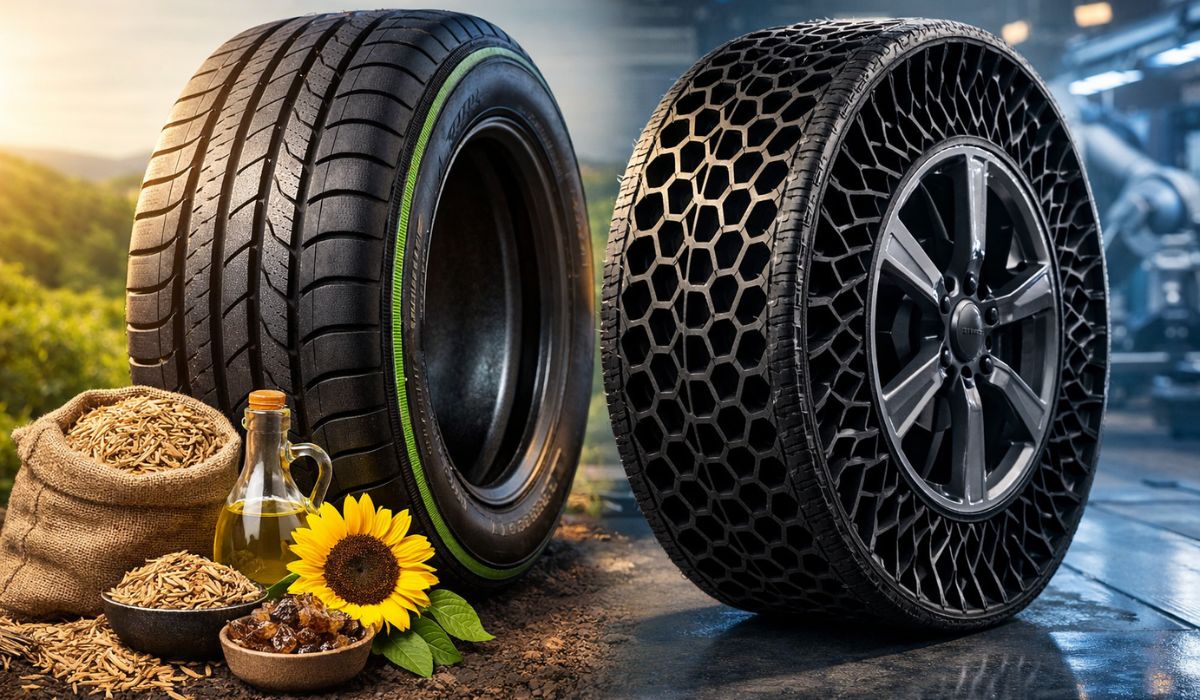


A concept tire from Goodyear uses materials such as rice husk ash and aims for a durability well above the current average, while the industry tests ways to reduce waste, increase reuse, and change the logic of use of this component.
A tire with rice husk ash silica, sunflower oil, and pine resins has already been presented by Goodyear, but is still in the concept phase.
Named Eagle GO, the model was developed for the concept car Citroën oli and aims to achieve up to 500,000 kilometers of lifespan.
According to the manufacturer, this mark would not be reached solely with a more resistant compound.
-
World Cup Ball Chip Uses Technology to Detect Invisible Touches, Confirms Offside, Secures Portugal’s Victory Over Croatia

-
36-Meter Hydrogen-Powered Superyacht Arrives in Brazil to Debut German Engines and Showcase Future of Clean Navigation

-
Indian Students from Jaipur Win Top Prize at World’s Largest Science Fair with EcoFog, an Affordable Mesh to Harvest Fog Water Without Energy

-
Italy Sinks Massive 11-Story Concrete Structures in the Ligurian Sea to Create a 6.2 km Barrier, Clearing the Way for 400-Meter Ships in Genoa



The proposal combines less fossil-origin materials, monitoring sensors, and the possibility to renew the tread twice over the product’s lifespan.
In practice, this does not mean that a single tire would leave the factory and run half a million kilometers under the usage conditions of a conventional model.
According to Goodyear, the goal depends on the reuse of the casing and the renewal of the tread, the part that wears out in contact with the ground.
In the case of the Eagle GO, the company states that the depth of 11 millimeters of the tread would allow for two renewals.
As a result, the total mileage of the set would be increased over time.
How the Eagle GO tire from Goodyear works
The reference to rice is in the use of silica obtained from rice husk ash, a waste product from industrial processing.
According to Goodyear, this material can reduce landfill waste and replace part of the fossil-origin inputs used in the traditional composition of tires.
Alongside this component, the concept uses sunflower oil, pine resins, and natural rubber.
According to the manufacturer, the tread of the Eagle GO has been formulated with almost all sustainable or recycled materials.
This development is also aligned with the proposal of the Citroën oli, a project created to reduce weight and simplify components.
In the concept car, the tire works with a hybrid steel and aluminum wheel.
A Stellantis informed, at the launch of the model, that this solution is 15% lighter than an equivalent wheel made entirely of steel.

According to the company, the reduction helps to decrease the total mass of the vehicle and relieve the effort on the tire-wheel assembly.
Another point of the project is the electronic monitoring.
The tire was presented with the Goodyear SightLine technology, which uses an embedded sensor to monitor usage parameters and the condition of the part in real-time.
According to the company, this system allows for identifying situations outside of the ideal driving conditions and indicates more accurately the appropriate time for renewing the tread.
The proposal also aims to reduce waste and improve wear management.
So far, however, the Eagle GO remains in the conceptual field.
Goodyear presented the model in September 2022, and there is no official announcement of mass production or commercial launch for consumers.
Therefore, the goal of 500 thousand kilometers should be understood as a technical objective linked to the study.
This is not currently a specification of a tire available on the market.
Michelin Vision and the search for more durable tires
The attempt to increase tire durability is not limited to Goodyear.
On another front, Michelin developed the Vision Concept, a wheel and tire set without air that the company describes as “infinitely renewable”.
Presented as part of a vision for sustainable mobility by 2050, the concept has an airless structure, uses renewable or recycled materials, and allows for tread renewal through 3D printing.
The proposal is to maintain the structure and only replace the part subject to wear.
At this point, the logic is similar to that adopted in the Eagle GO.
In both cases, the industry is trying to reduce the need for complete tire disposal whenever the contact area with the ground loses efficiency.
Still, the Vision Concept also remains in the experimental stage.
Michelin has not disclosed a public mileage target equivalent to that reported by Goodyear for the Eagle GO.
While these more radical solutions are still under development, manufacturers are advancing in the market through less disruptive paths.
One of the main focuses is on the chemistry of the compounds used in manufacturing.
Silica, wear, and new technologies for tires
In this context, the combination of silica and coupling agents used to improve the interaction of this material with rubber is gaining traction.
When this dispersion occurs efficiently, the result can include lower energy loss and greater wear resistance, according to the industry itself.
In addition to the chemical formulation, the design of the tread, the construction of the casing, and wear control come into play.
This set of factors helps explain why some brands have begun to offer mileage warranties that exceed the historical average of passenger tires.


Goodyear Assurance MaxLife 2 is already on the market
An example cited by Goodyear is the Assurance MaxLife 2, launched by the company on July 23, 2025 in the United States and Canada.
The manufacturer presents it as its most durable passenger tire to date.
According to the company, the model has a limited tread life warranty of 85,000 miles, equivalent to about 140,000 kilometers.
The brand attributes this performance to the so-called TredLife Technology.
According to the company, this technology combines enhanced chemical compound, tread design, and wear indicators.
Therefore, it is an advancement applied to a commercial product, not just a prototype.
The difference between this type of tire and experimental concepts helps to situate the current stage of technology.
On one hand, the industry already offers models in the market with extended durability and warranties superior to those of conventional tires.
On the other hand, projects like Eagle GO and Vision Concept are trying to redesign the product lifecycle.
The proposal includes structural reuse, scheduled renewal, and broader use of renewable or recycled raw materials.
Large-scale adoption, however, still depends on factors such as industrial viability, cost, renewal logistics, and standardization.
In the case of Eagle GO, what has been confirmed so far is the presentation of a concept tire aimed at increasing durability and reducing dependence on petroleum derivatives.
In this scenario, the use of rice husk ash appears as part of the strategy to incorporate industrial waste into the tread composition.
The application of this material was announced by Goodyear as one of the central elements of the project.
The promise of greater durability, therefore, is linked to a technical proposal already publicly presented, but still without confirmed market arrival.