Portuguese
  Spanish


To tackle drought, students Diivij Todi and Mrityunjay Gupta from Jaipur, India, created EcoFog: a low-cost mesh that captures water from fog and humid air without using electricity. The project won an award at Regeneron ISEF, the world’s largest science fair.
Two young Indians transformed humid air into a weapon against water scarcity. In Jaipur, India, students Diivij Todi and Mrityunjay Gupta developed EcoFog, a mesh capable of capturing water from fog without consuming electrical energy. The project was recognized by the Society for Science, organizer of the largest science fair on the planet.
The idea directly addresses an old problem: drought. Instead of relying on pumps or expensive technology, EcoFog uses a mesh that works passively, taking advantage of the water vapor present in fog and high humidity air. It is a simple solution to bring water to places where it is lacking.
The work has already earned international recognition. Besides winning an award at the world’s largest science fair, EcoFog was selected as a finalist in an important environmental competition for young people. Next, see who the creators are and what makes their mesh so promising against drought.
-
Italy Sinks Massive 11-Story Concrete Structures in the Ligurian Sea to Create a 6.2 km Barrier, Clearing the Way for 400-Meter Ships in Genoa

-
Wireless Charging Roads for Electric Vehicles: Detroit Implements Coil Technology, France Successfully Tests 300 kW Transfer Near Paris

-
Scientists Create Lab-Made Cell with Only 36 Genes That Eats, Grows, Copies DNA, and Divides, Raising the Question: Is This Life?

-
World’s Largest Camera, with 3,200 Megapixels, Begins Operation, Capturing Sky Images Every 30 Seconds for the Next Decade




Who are Diivij and Mrityunjay, the students of EcoFog
Behind the invention are two young researchers. Diivij Todi and Mrityunjay Gupta are students at Jayshree Periwal International School, in Jaipur, in the state of Rajasthan, India. It was at school that the duo developed EcoFog and turned it into an award-winning science project.
The duo reached major competitions through a well-known path. The students participated in IRIS, an Indian initiative for research and innovation in sciences that selects the best projects in the country. It was through this selection that EcoFog gained space to compete internationally.
What is known is that the motivation was practical. Living in a region marked by a dry climate and water scarcity, the duo sought an accessible way to capture water from fog and air humidity. The result was EcoFog, designed to be cheap and easy to use.
Their journey reinforces the power of science fairs. By transforming a concern into a project, with research and tests, the students went from the classroom to international stages. It’s the kind of path that often reveals future scientists and engineers.
What is the EcoFog: a new composite mesh
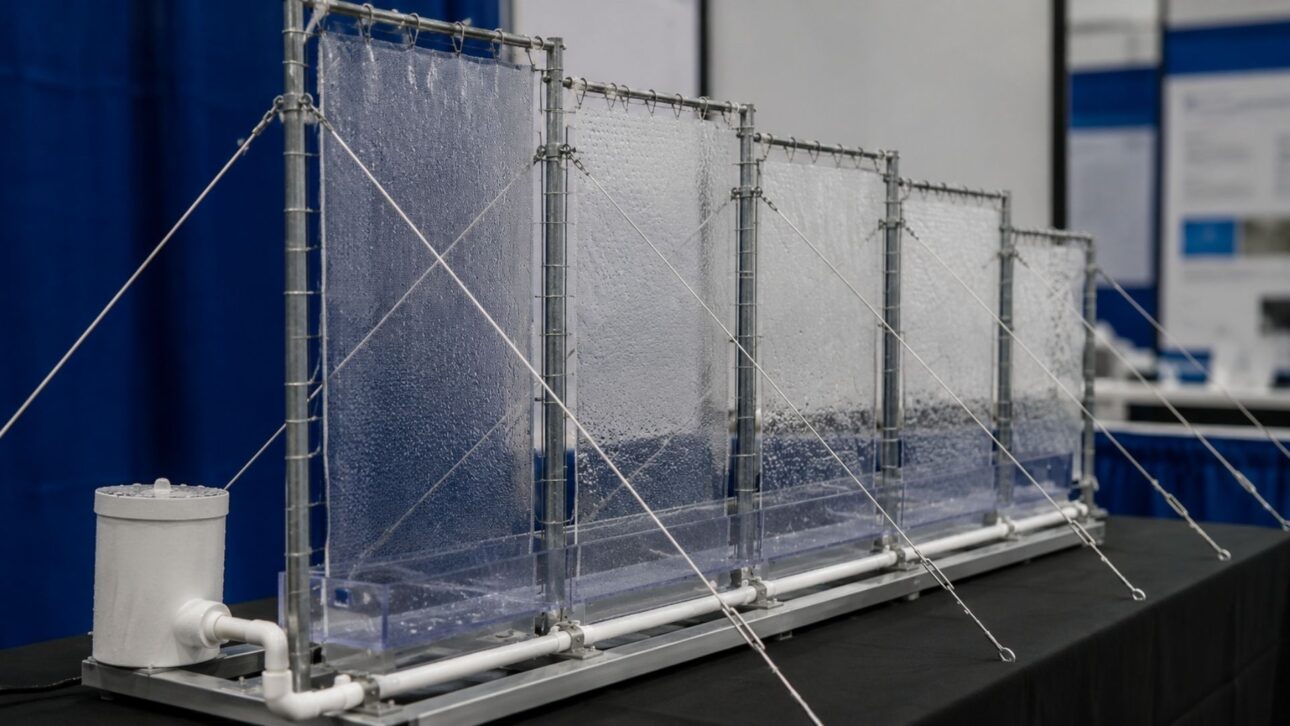
The heart of the project is the mesh itself. According to the official title of the work presented at the fair, the EcoFog is “a new composite mesh for the passive collection of water from fog and environments with high relative humidity.” In other words, it’s a special fabric designed to draw water from the air without using energy.
The word “passive” is the key to the proposal. The system does not use pumps, motors, or electricity: it simply remains exposed to the air, allowing water vapor to condense on the mesh and flow down to be collected. This makes the EcoFog ideal for places without reliable access to the power grid.
The difference compared to older solutions is in its scope. Instead of working only with dense fog, the EcoFog was also designed for high humidity environments, meaning situations where there is plenty of water vapor in the air, even without thick fog. This expands the places where the mesh can be useful against drought.
The creators have not yet publicly disclosed all the technical details of the mesh material or its exact cost. What stands out, and what caught the judges’ attention, is the proposal of a more efficient and accessible composite mesh for capturing fog water.
Fog water without electricity: how the idea works
The logic behind the EcoFog is the same as a simple natural principle. Anyone who has seen droplets form on a spider web or a leaf on a misty morning understands the basis: thin surfaces can “comb” the humid air and turn the vapor into liquid water droplets.
In the case of the mesh, the process happens in stages. The moisture-laden air passes through the fabric, tiny droplets get trapped in the threads and accumulate until they flow by gravity to a collection point. Without any motor, the fog water becomes storable potable water.
It is precisely this simplicity that gives strength to the idea. Since everything operates without electricity, the operational cost is extremely low and there are no complex parts to break. Just install the mesh in a location with fog or humid air and let nature do the rest, a huge contrast to expensive water-producing machines.
Here, the fog is just the means, not the end. The merit of EcoFog is not in “discovering” that water can be extracted from the mist, something already known, but in creating a new mesh, supposedly more efficient and cheaper, to do it better. It is this material engineering that the students placed at the center of the project.
It is worth remembering that efficiency varies with the climate. The more humid and foggy the environment, the more water the mesh tends to capture; in dry air, the yield decreases. Therefore, EcoFog works better in regions with frequent fog, something the students considered when thinking about where the solution makes the most sense.
Made for drought and for those with little
The context from which the idea was born explains a lot. Rajasthan, a state in India where Jaipur is located, is a region with a dry climate, long periods of drought, and communities struggling to obtain clean water. It was by looking at this scenario that the duo sought a low-cost solution.
The focus on simplicity is no accident. Expensive desalination or air water production technologies exist, but they often rely on a lot of energy and heavy investment, something out of reach for poor villages. EcoFog attempts the opposite path: doing more with much less.
Therefore, the proposal targets those who need it most. A cheap mesh that captures fog water could help rural families, small communities, and isolated regions to have an extra source of water during the drought. It is a technology designed to be accessible, not a luxury.
This type of solution gains even more importance with climate change. With more frequent and intense droughts in various parts of the world, cheap ways to capture water become valuable assets. EcoFog fits into this search for simple answers to an increasingly larger problem.
The problem the duo tackles is global. According to international organizations, billions of people worldwide still live without safe access to drinking water, and the drought worsens this situation year after year. Any cheap technology that helps capture water tends to have enormous demand.
The award at the world’s largest science fair
The recognition came on the largest possible stage for young scientists. EcoFog was awarded at the Regeneron International Science and Engineering Fair, the ISEF, considered the largest pre-university science fair on the planet. Getting there is, in itself, a difficult achievement.
The competition brings together the best among students from all over the world. Organized by the Society for Science, the ISEF gathers thousands of young people from dozens of countries, selected at national fairs, to compete for prizes totaling millions of dollars. It was in this environment that the Indian mesh stood out.
Winning a prize there puts EcoFog in the spotlight. More than the value itself, the recognition at ISEF gives visibility to the project, opens doors for partnerships, and shows that the idea of the students was taken seriously by experts. It is the kind of showcase that can transform a school invention into something bigger.
For the duo from Jaipur, the prize is a boost and validation. Seeing their own mesh recognized among the best projects in the world confirms that the chosen path makes sense. From there, the challenge becomes transforming the awarded prototype into something that actually reaches those who need water.
The achievement also holds value for Indian science. In recent years, projects by Indian students have been standing out at international fairs, many of them aimed at real problems in the country, such as water scarcity. EcoFog joins this wave of inventions born out of necessity.
Finalist of the Earth Prize 2026
The success of EcoFog did not stop at the science fair. The project was also selected as a finalist for the The Earth Prize 2026, a global sustainability competition aimed at teenagers. The mesh ranked among the best teams in the world in this environmental contest.
The selection is highly competitive. According to the prize organization, EcoFog made it to the list of the year’s top 35 teams, representing India and the Asia region among solutions from young people from various continents. Just being in this group is significant recognition.
Here, however, an important clarification is needed. EcoFog was a finalist, not the global winner of the The Earth Prize 2026. The grand prize of the edition went to another Indian team, which created a powder made from tamarind seeds to remove microplastics from water. Confusing the two would be a mistake.
Even without the top title, the participation reinforces the project’s impact. Being among the finalists of a global competition and also being awarded at the world’s largest science fair shows that the idea of the students from Jaipur caught attention on more than one prominent stage.
The difference compared to common collection networks
Capturing fog water is not a new idea, and this is where EcoFog needs to stand out. Around the world, fog collection nets are already used in dry places, such as parts of Chile and Morocco, where large screens fixed on mountains collect moisture coming from the sea.
These collection projects have already changed the lives of communities. In dry villages, fog nets have started to provide water for drinking, cooking, and irrigating gardens, reducing the daily walk in search of the resource. This is the type of impact that EcoFog wants to achieve, in an even more accessible way.
The difference proposed by the duo lies in the material and the reach. While many traditional nets work well only with dense fog, the EcoFog was presented as a composite mesh capable of operating also in high humidity, which would expand the areas of use. If the promise is fulfilled, it would be a real advancement.
Cost reduction is another central point. The idea of the students is to offer an efficient and low-cost mesh, so that the technology ceases to be an exception and can be replicated on a large scale. Democratizing access to fog water is, in the end, the great goal of the project.
Even so, it’s worth keeping our feet on the ground. Since the technical details and performance numbers have not been fully disclosed, it’s too early to say how much EcoFog surpasses current solutions. What can be stated is that the proposal excited the judges and targets an urgent problem related to drought.
What this has to do with Brazil
The topic of fog water directly relates to Brazil. The country experiences severe droughts, especially in the semi-arid northeast, where millions of people face water shortages for long periods. Cheap collection technologies spark interest as a reinforcement to cisterns and wells.
Brazil even has favorable natural conditions in some regions. Mountain and coastal areas, covered by fog for much of the year, could test collection systems similar to EcoFog, taking advantage of the moisture already in the air. It is a potential still little explored here.
Brazilian researchers are already studying ways to capture dew and fog. In universities and projects in the Northeast, tests seek to understand how much water the air can offer in each region. Bringing a cheap mesh like EcoFog into this debate could accelerate solutions against drought in the country.
There is also a link with young Brazilian science. Just like the students from India, Brazilian teenagers have been creating solutions against drought and water scarcity in fairs like Febrace and Mostratec, some even awarded internationally. The talent exists and needs support to grow.
Finally, here is the inspiration about low-cost innovation. The case of EcoFog shows that simple ideas, designed for the poorest, can conquer the world. For a country with so much inequality in access to water, investing in cheap and accessible solutions is a path worth following.
And you, would you drink water taken from the fog?
The story of EcoFog shows how young creativity can tackle huge problems with simple solutions. Two students from Jaipur, in India, created a low-cost mesh to capture fog water without electricity, won an award at the world’s largest science fair and even made it to the finals of a global competition, all aiming at drought.
And you, would you drink water taken directly from the fog and humid air? Share your thoughts in the comments about the invention of these two young people and whether you believe such solutions could help bring water to drought-stricken regions, including in Brazil.