Portuguese
  Spanish


Moser’s lamp became known for transforming a homemade solution into a global reference: a PET bottle with water and bleach began to spread sunlight in dark environments, without generating electricity and without relying on batteries.
A light inside the bottle.
This is how Alfredo Moser, a mechanic associated with Uberaba, in the Triângulo Mineiro, became known outside Brazil. During the energy crisis of 2001 and 2002, he found a simple way to illuminate dark environments during the day using a PET bottle, water, a small amount of chlorine, and a hole in the roof.
The creation became known as Moser’s lamp or bottled light. It does not generate electricity, does not store energy, and does not work at night in its original version. Even so, it drew attention because it managed to spread sunlight into houses, workshops, and warehouses, with an effect compared to a 40 to 60-watt bulb, depending on the size of the bottle and the solar intensity.
-
Swiss glaciers melting fast enough to fill an Olympic pool every 6 seconds, France confirms 3,700 heatwave deaths, and WMO predicts strong El Niño intensifying extremes until 2027

-
Sudden Sea Recession in São Paulo Sparks Tsunami Alert and Online Debate on Giant Wave Risks in Brazil

-
China Launches World’s First 307-Meter Floating Wind Platform to Supply Oil Rigs, Aiming to Cut 35,000 Tons of CO2 Annually
-
Japan Deploys Offshore Concrete Factory, Constructs Massive Caissons in 8 Days, Revolutionizing Port Construction with Industrial Efficiency


According to Believe Earth, which published an interview and technical information about the case, the idea gained strength precisely because it combined low cost, material reuse, and a real need: to illuminate dark spaces without increasing the energy bill.
The PET bottle that became a solution on the roof
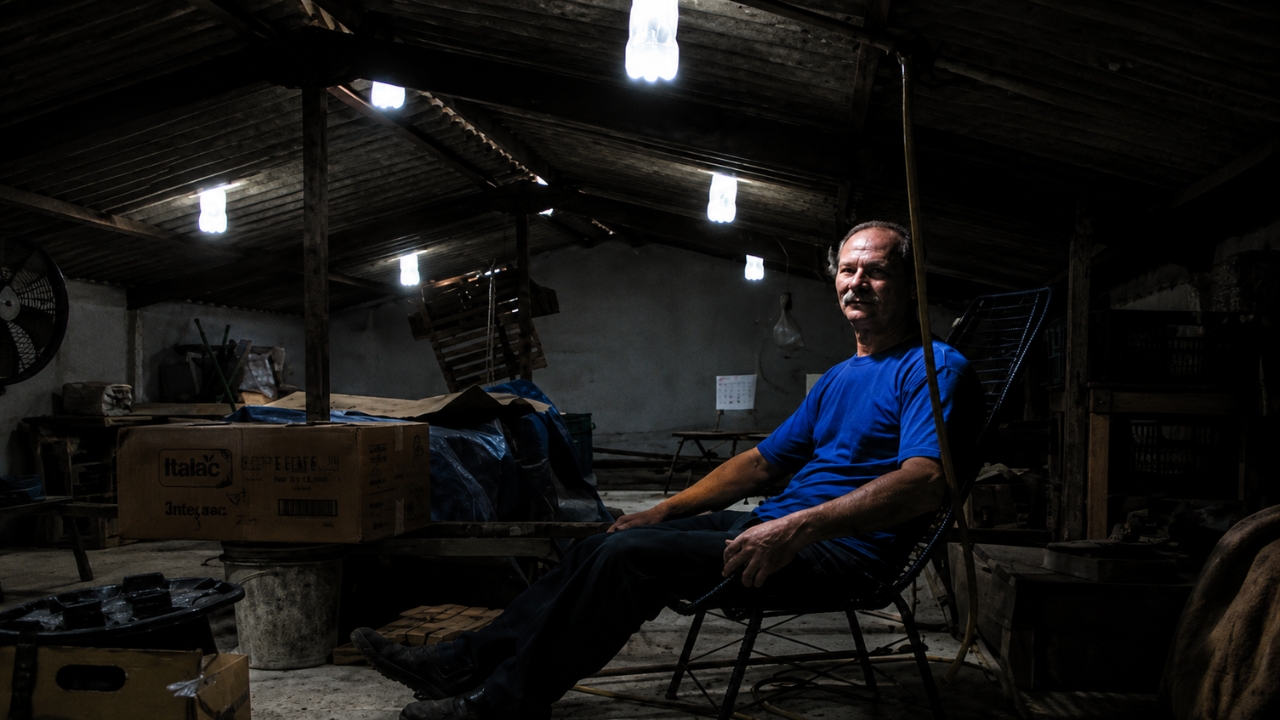
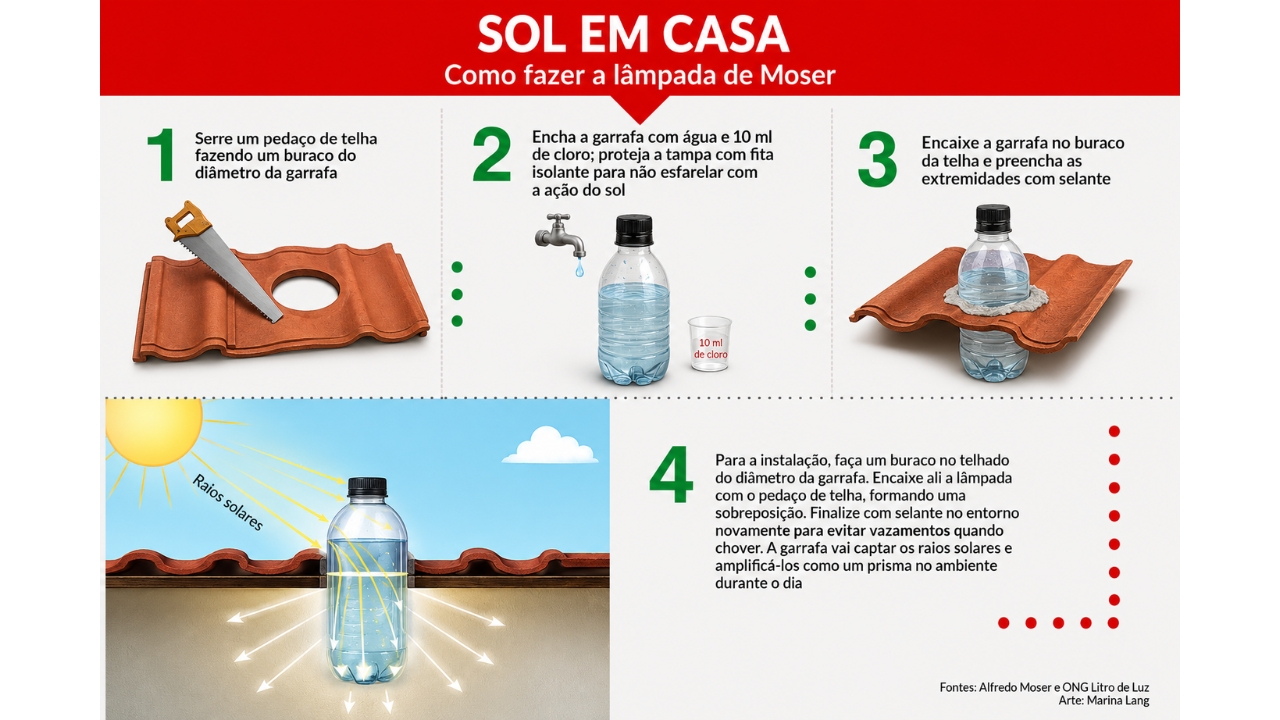
The logic of the invention is simple. The transparent bottle is filled with clean water and a small amount of chlorine or bleach. Then, it is fitted into an opening made in the roof, leaving part of the bottle outside and part facing inside the environment.
When sunlight passes through the water, it spreads throughout the room. The effect occurs by refraction, like a kind of popular skylight. The water helps to distribute the brightness and the chlorine prevents the liquid from turning green or cloudy over time.
According to Believe Earth, a 600 ml bottle can offer lighting close to 40 watts. A 2-liter bottle can reach about 60 watts. The average lifespan cited for the system is approximately five years, provided the installation is well sealed.
The origin came from a dark workshop
The story gained even more strength because it was not born in a laboratory. Moser told Believe Earth that the inspiration came from simple observations about the reflection of light in a bottle with water.
During the blackout period in Brazil, he decided to test the solution in his own workshop, which was dark during the day. He drilled the roof, installed the bottle, and saw the environment gain brightness without an electric lamp.
Later, the idea began to be used in his house, in neighbors’ properties, and even in a neighborhood supermarket. What seemed like a domestic improvisation turned into a replicable solution, especially in places where natural lighting was insufficient and electricity was a financial burden.
The invention is not solar electricity
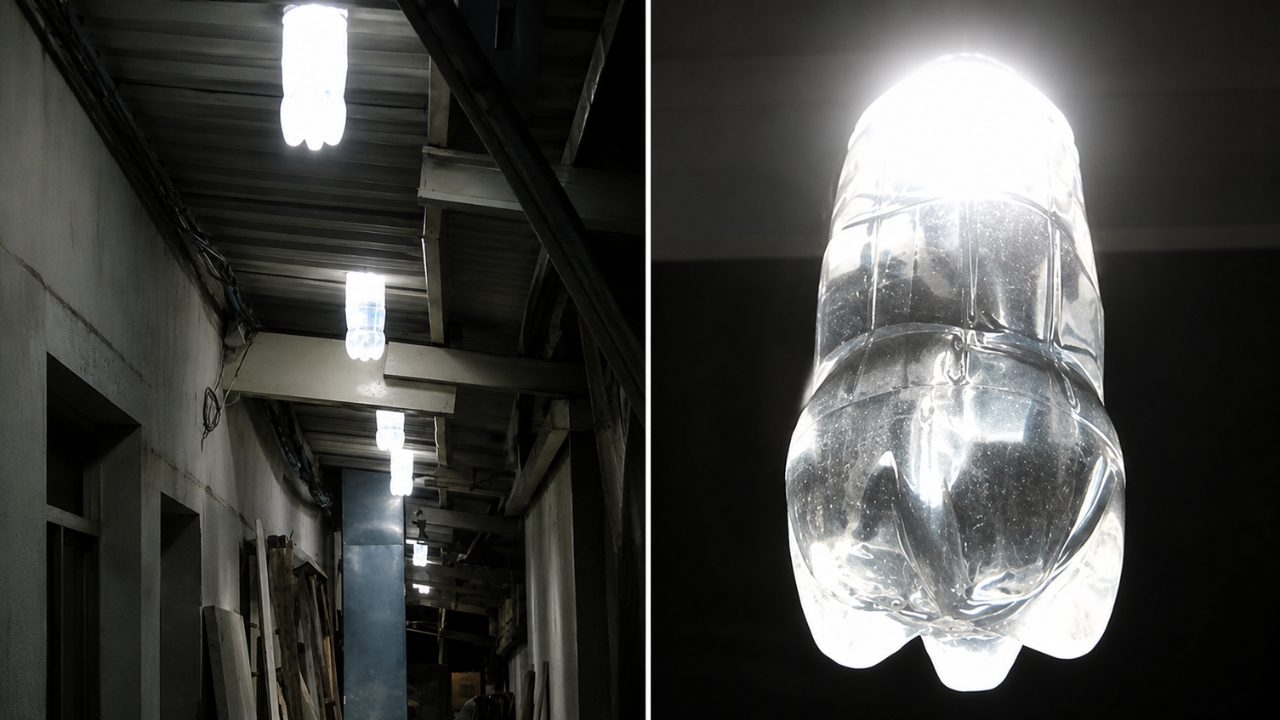
An important point is to understand what Moser’s lamp actually does. It does not work like a solar panel, does not charge a battery, and does not convert sunlight into electric current.
The invention directly uses the daylight sun. Therefore, it is more accurate to call it a natural solar lamp, bottled light, PET bottle skylight, or Moser lamp.
This difference is essential because, years later, social projects inspired by the idea began to develop versions with solar panels, LED, and batteries. These technologies are already later adaptations, not the same solution originally created by the mechanic.
The Brazilian idea that reached other countries
The simplicity of the solution helped spread the story. According to Revista Projeto and the Araucária Foundation, the technology associated with bottled light reached communities in countries like the Philippines, India, Bangladesh, Tanzania, Argentina, and Fiji.
One of the most well-known connections occurred in the Philippines, through Illac Diaz, founder of the MyShelter Foundation. The project adapted the idea for poor communities and helped transform the bottle lamp into a daytime lighting alternative for thousands of homes.
Reports from 2013 cited in the research indicate that, in the Philippines, about 140,000 homes had already received the solution, with a goal to reach 1 million beneficiaries shortly.
Litro de Luz took the concept further
The organization Litro de Luz also cites Alfredo Moser as an inspiration for its work. According to the NGO itself, the idea of mixing water and bleach inside a PET bottle, attached to the roof to illuminate spaces during the day, was the symbolic foundation for the movement.
In Brazil, Litro de Luz started in 2014. The organization’s impact page reports more than 5,590 solar solutions installed, over 40,000 people continuously impacted, and 213 communities served in the country.
In this case, the technology has already advanced to systems with solar energy, posts, and lamps. Nevertheless, the root of the narrative remains linked to the simple solution created by Moser.
Low cost, economy, and reuse
The appeal of the Moser lamp lies in the combination of three factors: low cost, reused material, and direct use of sunlight. Instead of relying on expensive parts, the solution starts with a PET bottle, water, chlorine, and proper sealing on the roof.
Believe Earth also cites a study on the installation of 336 Moser lamps in an industrial warehouse in Rio Grande do Sul, with a 40.8% reduction in energy consumption.
The data shows that the invention was not limited to popular imagination. In environments where natural light can replace lit lamps during the day, the savings can be significant.