Portuguese
  Spanish


The glaciers of Switzerland have already lost all the snow from last winter almost three months early, and are now melting centuries-old ice under a heatwave that killed thousands in Europe. For scientists, climate change combined with a strong El Niño promises even more extreme summers until 2027.
Imagine losing, every six seconds, enough melted water to fill an entire Olympic pool. That’s roughly what’s happening with the glaciers of Switzerland at the beginning of July 2026, as a historic heatwave punishes Europe. Glaciologist Matthias Huss, who directs the Swiss glacier monitoring network, GLAMOS, used exactly this image on Jornal Nacional to describe the speed at which the Alpine ice is disappearing. All the snow that fell last winter has already vanished, and now the glaciers are starting to melt ice accumulated over decades, sometimes centuries.
The problem goes far beyond the landscape. According to G1, the same heatwave accelerating the thaw has already exacted a terrifying human toll: France, Belgium, and the Netherlands confirmed about 3,700 additional deaths caused by extreme heat at the end of June, according to a report released on July 3. And the message from scientists is that the worst may still be to come, because climate change now gains a powerful reinforcement: the World Meteorological Organization has just announced that a strong El Niño is forming and is expected to intensify heat extremes at least until 2027. In this scenario, glaciers have become the most visible thermometer of a planet in imbalance.
The glaciers of Switzerland are losing centuries-old ice in weeks
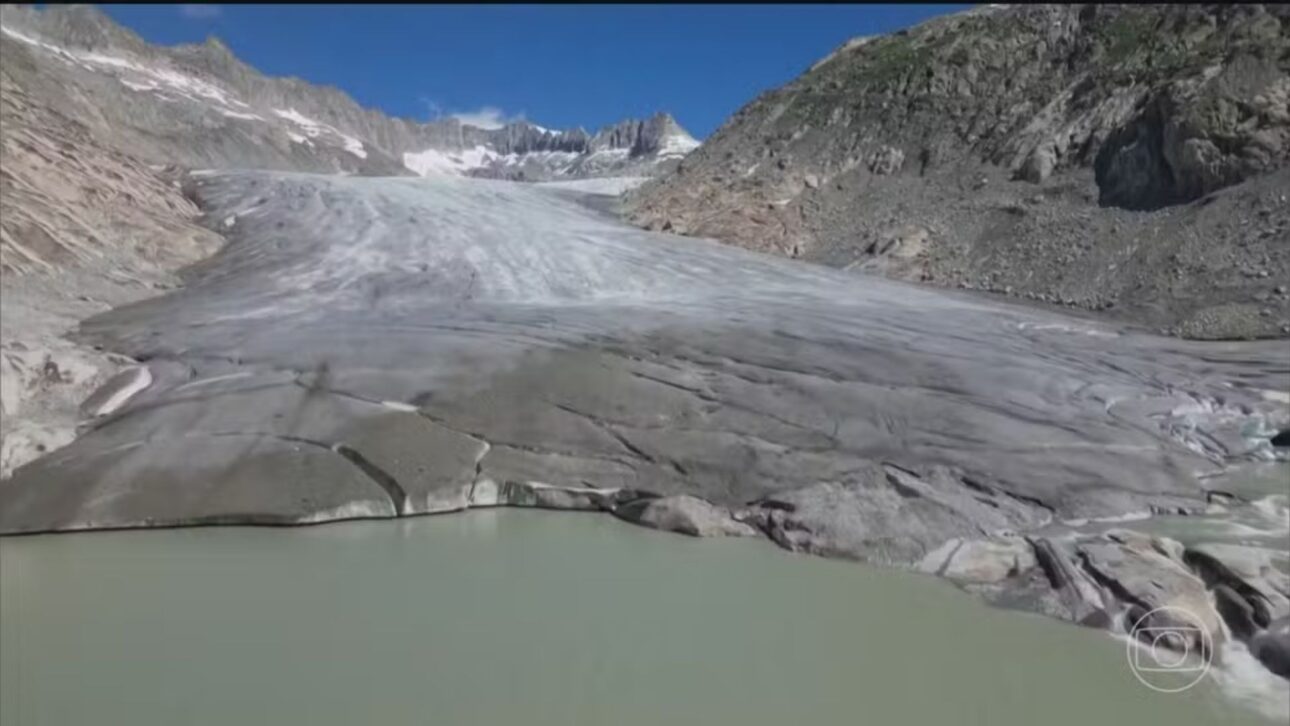
Every summer, Swiss glaciers melt a little, and that’s normal. What is not normal is the speed this year. According to GLAMOS, all the snow accumulated last winter is expected to disappear at the beginning of this week, marking the second earliest day of glacial loss since monitoring began in 2000. Only 2022 was worse, with the date falling on June 26. From that point on, every gram of ice that melts is old ice, formed over many years, in a scenario that scientists directly link to climate change.
-
Sudden Sea Recession in São Paulo Sparks Tsunami Alert and Online Debate on Giant Wave Risks in Brazil

-
China Launches World’s First 307-Meter Floating Wind Platform to Supply Oil Rigs, Aiming to Cut 35,000 Tons of CO2 Annually

-
Japan Deploys Offshore Concrete Factory, Constructs Massive Caissons in 8 Days, Revolutionizing Port Construction with Industrial Efficiency

-
China Builds World’s Largest Power Grid, Generating Enough Energy to Supply 15 Times Brazil’s Needs, Surpassing the US, EU, and India Combined


Matthias Huss does not hide his concern. On a recent visit to the Rhone Glacier, one of the country’s most emblematic, he measured a loss of about one meter of ice thickness in just ten days, something he classified as direct evidence of the heatwave’s impact. The more consecutive days of extreme temperature, the worse the damage becomes. The melting is happening about three months earlier than normal, as Swiss glaciers usually lose all the winter snow only by mid-August.
To understand the magnitude of the impact, it’s worth remembering the background. Switzerland has about 1,400 glaciers, and they have been continuously shrinking for two decades, at an accelerating pace. In the years 2022 and 2023, Swiss glaciers together lost about 10% of their total volume, and in the last decade, nearly a quarter of the ice has disappeared. The country feels the warming firsthand: the temperature rises there about twice as fast as the global average, according to the Swiss federal meteorological service.
Why does a heatwave melt glaciers so quickly?
The answer starts with the white color of the snow. During winter, a layer of fresh snow covers the glacier and acts as a shield: being light, it reflects much of the sunlight back to the sky, protecting the ice underneath. As long as this white blanket exists, the glacier withstands the summer relatively well. The problem arises when all the snow melts too early, as it happened now.
Without the protective snow, what is exposed is the bare, darker, and older ice. Dark surfaces absorb heat instead of reflecting it, so the ice starts to melt much faster under the strong sun. It’s a self-reinforcing effect: the more dark ice exposed, the more heat absorbed, the more melting. Add to this a winter that barely snowed in Switzerland, followed by two consecutive heatwaves, one in May and another at the end of June, and you have the perfect recipe for the record melting that Huss is documenting. That’s why glaciers serve as one of the clearest indicators of climate change.
The heatwave that has already killed thousands in Europe
While the ice melts in the Alps, people die in the cities. The heatwave that hit Europe between the end of June and the beginning of July was classified by scientists as the worst ever recorded on the continent, and the number of victims is staggering. In France alone, the public health agency Santé publique France recorded 2,025 excess deaths in the week starting June 22, with home deaths soaring 91% at the peak of the heat.
In Belgium, mortality rose by 39%, equivalent to 1,222 more deaths, the highest daily number since the first wave of COVID. Meanwhile, the Netherlands recorded about 480 additional deaths, mostly among people aged 80 or older.
Combined, the three countries reached 3,700 confirmed deaths by July 3, and authorities warn that the data is still preliminary and may rise.
Spain, apart from this count, reported at least 1,028 heat-related deaths in June alone, more than double the number recorded in the same month of 2025. Extreme heat is one of the deadliest and least visible climate threats, as it doesn’t topple houses or sweep away cars, but silently overwhelms bodies and hospitals. It’s no wonder that this year’s heatwave exposes how climate change is already killing real people.
And it wasn’t just the heat itself. The wave brought fire along: in France, more than fifteen hundred tourists had to flee campsites surrounded by fires, and the flames also spread through Spain, with thermometers exceeding 40 °C. Italy placed 25 of its largest cities on red alert during the worst days.
What does El Niño have to do with all this?
This is where the warning that scares scientists comes in. On the same July 3, the World Meteorological Organization announced that a strong El Niño is expected to develop rapidly between July and September 2026, with high confidence in forecasts and Pacific sea surface temperatures expected to exceed 2 °C above average. El Niño is a natural warming of the equatorial Pacific waters that disrupts the planet’s climate, and when it appears, it usually pushes global temperatures up.
“El Niño will give an extra push to global temperatures,” summarized Alvaro Silva, a scientist at the WMO, noting that El Niño years tend to break heat records. The organization’s representative, Clare Nullis, emphasized that June already broke records, with Germany registering a new national record of 41.7 °C on the last weekend of the month.
As El Niño tends to peak between the end of 2026 and the beginning of 2027, and exert its greatest influence the following year, experts project that heat extremes may intensify at least until 2027, when combined with underlying climate changes.
This message is relevant for Brazil as well. It is the same El Niño that Cemaden, the Brazilian disaster monitoring center, has been pointing to as a risk of thermal disaster for the country in the second half of 2026, at a time when low reservoirs may pressure energy and food prices. In other words, what melts glaciers in Switzerland is part of the same mechanism that can increase electricity bills here.
Disappearing glaciers exact a price that goes beyond the landscape
It may seem that a glacier melting far away in the Alps doesn’t change anything in the life of someone far from the snow. But it does. The glaciers of Switzerland are a central piece in the supply of drinking water and the generation of hydroelectric power for much of Central Europe. When the ice that should last all year melts all at once in the summer, there is too much water now and too little later, which threatens water supply and electricity production in the drier months.
The horizon that Huss paints is grim. If global warming continues at the current pace, he warns that by the end of the 21st century, Switzerland may have only a few small remnants of ice on the highest mountain peaks. The less desperate part is that it is still possible to save a portion of the glaciers, but this depends on the world cutting emissions quickly and drastically, something that has not yet happened.
The ice of the Alps has become the clearest alarm of a feverish planet
In the end, the glaciers of Switzerland are playing the role of an alarm. They show, in a visible and measurable way, what a historic heatwave combined with climate change is capable of doing, and the WMO’s warning about El Niño suggests that the coming summers could be even harsher. While centuries-old ice melts in weeks and thousands of people die from heat in Europe, it becomes difficult to treat the issue as something distant.
And you, have you felt these climate changes in your region, with stronger heat, untimely rains, or longer droughts? In your opinion, is Brazil and the world truly preparing for a scenario of extremes like this, or are they just trying to catch up when the crisis has already arrived? Leave your comment with your city and tell us what you have observed around you.