Portuguese
  Spanish


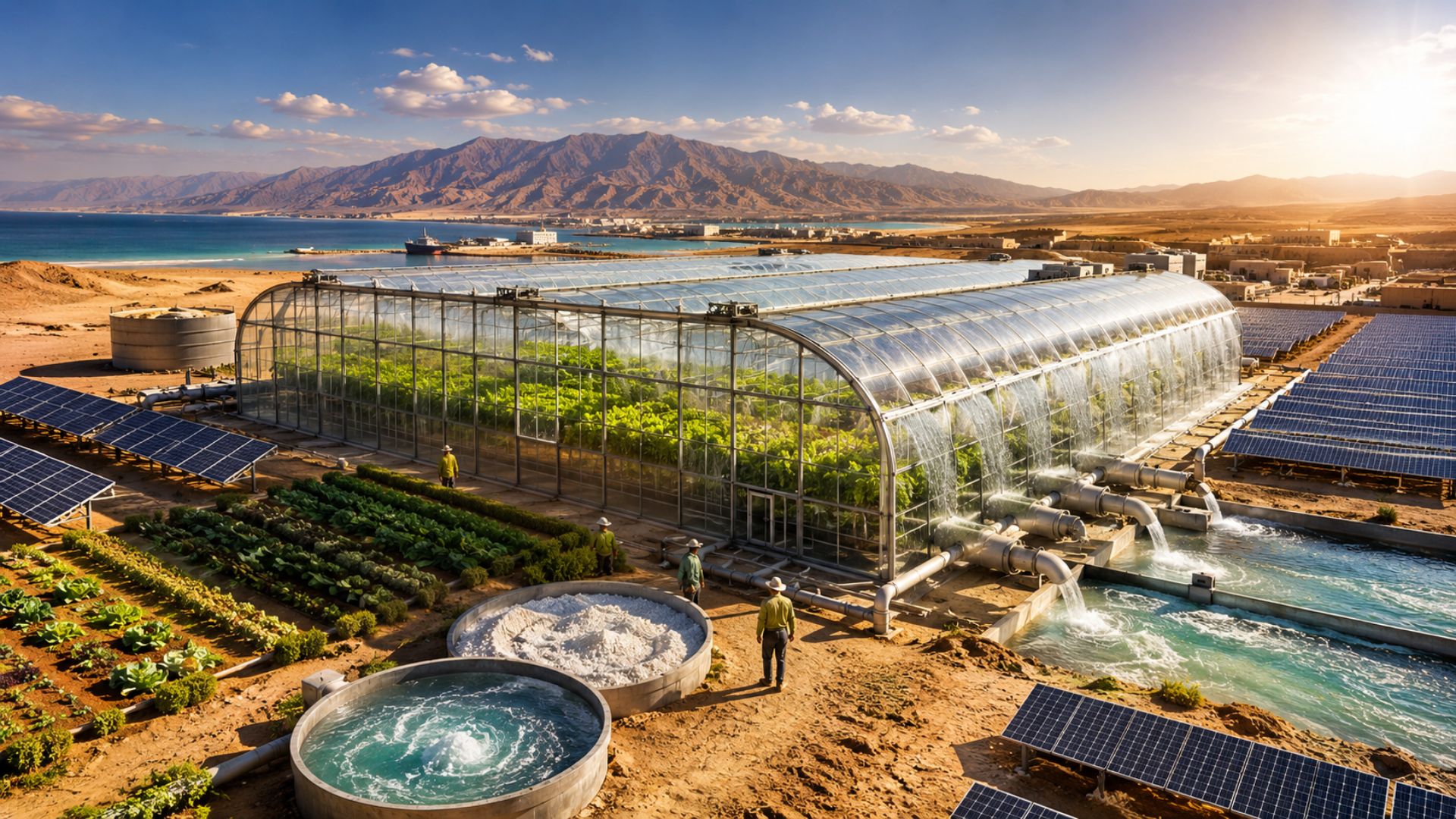

In the Aqaba desert, agricultural technology combines saltwater, solar energy, and desalination to grow vegetables in one of the most arid regions on the planet, showing how extreme resources can sustain food production, fresh water, and green areas in a controlled environment.
In the Aqaba desert, in southern Jordan, the Sahara Forest Project uses saltwater, solar energy, desalination, and evaporative-cooled greenhouses to grow vegetables in a region where conventional agriculture faces extreme heat, dry soil, and little available fresh water.
The facility functions as a demonstration unit, according to the organization responsible for the project, and not as an immediate substitute for large-scale agricultural production in arid regions.
The project was inaugurated on September 7, 2017, under the sponsorship of King Abdullah II of Jordan and then Crown Prince Haakon of Norway, according to information released by the Sahara Forest Project.
-
Pennsylvania Mine Creates Ice in Summer Heat and Melts in Winter, Turning a Mountain Crevice into a Reverse Natural Refrigerator

-
China Accelerates Global Expansion of Robotics: From Smart Vacuums to Industrial and Humanoid Machines, Millions Exported to Over 150 Markets
-
Polar Air Mass to Hit Brazil: Temperatures to Plummet in Nine States, Near Freezing in the South with Frost Risk Until Monday
-
Chinese “dark factories” produce electric cars 24/7 with minimal human intervention, as Zeekr assembles 800 units daily, raising concerns in Brazil.




The station is located outside the port city of Aqaba, near the Red Sea, a relevant location for a system that relies on the controlled use of saltwater in part of its processes.
According to the Sahara Forest Project, the proposal is to harness abundant resources in desert environments, such as intense sun, dry areas, and saline water, to produce food, fresh water, clean energy, and vegetation.
In this model, salinity is no longer treated merely as an operational obstacle and becomes part of the cooling, desalination, protected cultivation, and byproduct utilization stages.
How the farm works in the Aqaba desert
The Aqaba station occupies 3 hectares, an area equivalent to about four football fields, and includes two greenhouses with 1,350 square meters dedicated to protected cultivation.
In addition to the greenhouses, the complex includes 3,200 square meters of outdoor planting, photovoltaic panels, a fresh water production unit, and tanks used for salt production.
In the greenhouses, saltwater helps to cool and humidify the air through evaporation, creating a microclimate more suitable for the development of the plants grown on-site.
This process reduces the impact of heat on the crops and decreases the dependence on conventional cooling systems, which can increase costs and energy consumption in desert environments.
The fresh water used for irrigation comes from a reverse osmosis desalination unit, a technology that separates salts and impurities from saltwater before agricultural use.
In the arrangement described by the project, solar energy and protected cultivation infrastructure operate in an integrated manner, allowing different stages of the system to connect within the station.
The technical data released by the Sahara Forest Project indicate the capacity to produce up to 130,000 kilograms of vegetables per year and up to 20,000 liters of fresh water per day.
The unit also features 39 kW of installed capacity in photovoltaic panels, used to generate electricity within the agricultural station in Aqaba.
Outside the greenhouses, the project also tests external cultivation and revegetation with species adapted to dry and saline conditions, expanding the proposal beyond protected horticulture.
According to the organization, the initiative seeks to demonstrate how flows of water, energy, and biomass can be combined in areas where water availability limits conventional agriculture.
Saltwater and Solar Energy Against Water Scarcity
The presence of the project in Jordan is related to the country’s water context, identified by international organizations as one of the most pressured by water scarcity.
The World Bank states that Jordan is among the countries with the greatest water scarcity, with an annual availability of only 97 cubic meters per person.
This volume is below the absolute scarcity threshold of 500 cubic meters per person per year, used as an international reference to assess pressure on water resources.
UNICEF also classifies Jordan among the most water-scarce countries and cites the National Water Strategy 2023–2040 as a reference for the sector’s diagnosis.
According to the agency, each person in the country has access to about 61 cubic meters of renewable water per year, in a scenario marked by arid climate, population growth, and climate change.
In this context, the use of Red Sea water for cooling, desalination, and agricultural production reduces the direct dependence on traditional freshwater sources within the facility.
Still, the model requires specific conditions, such as proximity to the sea, technical infrastructure, available energy, and proper management of saline waste generated throughout the process.
Vegetable Production in Extreme Environments
The project is experimental in nature and, therefore, its results should be read as a technological demonstration in a controlled scale, not as a universal agricultural solution for all deserts.
The station shows that it is possible to produce food in highly arid environments, but it does not eliminate economic, logistical, and environmental challenges associated with replicating this type of structure on a large scale.
The very design of the Sahara Forest Project presents the technology as an adaptable combination, dependent on local conditions and the integration between saltwater, solar energy, and protected cultivation.
A report by the Jordan Times stated in May 2022 that the project had produced 220 tons of vegetables during its demonstration phase.
The data indicates that the facility has moved from the stage of a technological showcase to a real agricultural operation, although it remains on a controlled scale and dependent on technical monitoring.
The presence of greenhouses, green areas, and solar panels in an arid landscape has made the project a visual reference in debates about agriculture in dry regions.
In Aqaba, however, it is not a natural forest spontaneously emerging in the desert, but a planned infrastructure to transform heat, salinity, and sunlight into productive components.
The Jordanian experience presents an alternative for arid regions near the sea, especially in countries subject to water scarcity and the need to expand local food production.
The reach of the model depends less on an isolated solution and more on the integration between desalination, renewable energy, protected cultivation, resource reuse, and adaptation to the territory.