Portuguese
  Spanish


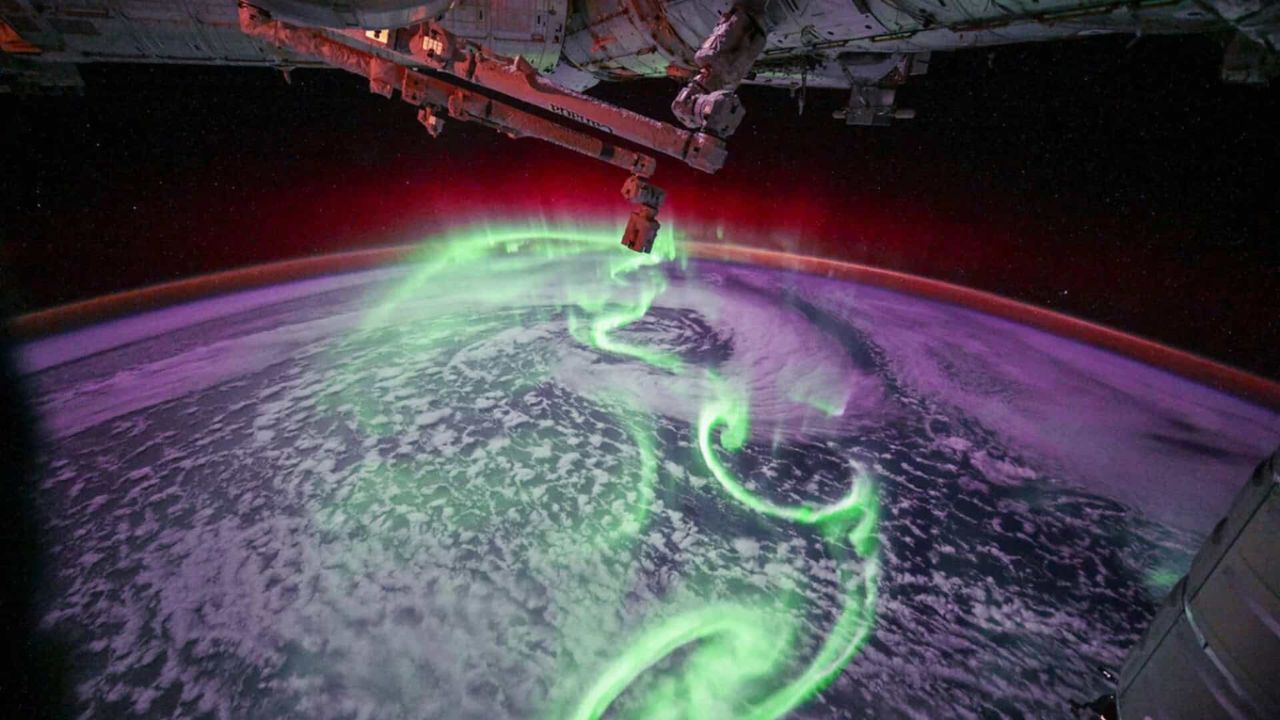
Aurora seen from space was recorded in timelapse by astronaut Sophie Adenot aboard the ISS and illuminated the station with greenish tones.
The French astronaut Sophie Adenot, from the European Space Agency, released a timelapse video on July 2, 2026, of an aurora seen from space during her first mission on the International Space Station. The phenomenon formed an extensive green band below the orbital laboratory and even reflected its luminosity on the ISS structure.
The video was published after a sequence of eight photographs taken on the 127th day of Adenot’s mission, which began in February 2026. At the time, the astronaut was on her 1,968th orbit and described the phenomenon as the most striking aurora observed during the εpsilon mission up to that point.
Adenot, 43, remains aboard the station and is approaching 137 days in space. She will celebrate her 44th birthday on Sunday still in orbit.
-
In Tasmania, a Beach Features a Natural Stone Mosaic Formed by Earth’s Cracks Millions of Years Ago
-
China’s Artificial Sun Reaches 100 Million Degrees, Six Times Hotter Than the Sun’s Core, Putting Beijing Ahead in the Race for Infinite Energy

-
Steam Machine Converts All Types of Plastic Waste into Durable Building Blocks, Processes Over 90 Tons Monthly, and Is Sold to Municipalities
-
John Deere’s Autonomous 9RX Tractor Uses 16 Cameras for 360-Degree Vision, Operates in Short Weather Windows While Monitored by Smartphone


Aurora seen from space formed a green band around the Earth
The images show the atmospheric glow extending below the International Space Station.
Due to the movement of the ISS and the use of the timelapse technique, the aurora appears to change shape throughout the recording. The green areas move across the horizon as the station travels its orbit.
Adenot reported that the glow was intense enough to reach the station itself.
“Day 127, orbit 1968 — That aurora was absolutely spectacular… twinkling and dancing below us, stretching as far as the eye could see, and so intense it illuminated the Station in shades of green,” she wrote on Instagram.
The video was presented by the astronaut as the most expressive record of the phenomenon during the εpsilon mission.
Timelapse records the movement of the aurora
The technique used gathers several photographs captured in sequence to show changes occurring over time.
In the record released by Adenot, the playback speed allows tracking the movement of the green light and its intensity variation below the station.
The astronaut compared the luminous structure to a moving ribbon.
“Watching this bright green ribbon shimmer and dance, it’s easy to completely lose oneself in the magic of the moment,” he stated.
The aurora seen from space occupies a large part of the horizon captured by the camera, while dark areas of the Earth appear in the background.
Aurora seen from space was photographed on the 127th day of the mission
Before publishing the video, Sophie Adenot shared a series of eight images of the same phenomenon.
The photographs were taken on the 127th day of her stay in orbit. At that moment, the astronaut had already completed nearly two thousand orbits around the Earth since the start of the mission.
Adenot’s experience on the ISS began in February 2026. This is her first space flight.
The video was published when she was approaching 137 days aboard the station.
Record Information
- Astronaut: Sophie Adenot;
- Agency: European Space Agency;
- Location: International Space Station;
- Video publication: July 2, 2026;
- Time of photographs: 127th day of the mission;
- Indicated orbit: 1,968;
- Technique used: timelapse.
Before joining the European astronaut corps, Adenot built a career in the French armed forces. She joined the French Air and Space Force in 2005 and reached the rank of colonel.
In 2022, she was selected for the European Astronaut Corps. Four years later, she embarked on her first space journey.
The εpsilon mission allowed Adenot to record different natural phenomena observed from Earth’s orbit, including auroras, meteors, and storms.
Aurora seen from space was also recorded by other astronauts
Sophie Adenot was not the only member of a space mission to release recent images of auroras observed from the ISS.
In early 2026, Russian cosmonaut Sergey Kud-Sverchkov also shared photographs of the phenomenon captured from the station.
At the end of 2025, astronaut Zena Cardman published a video showing an aurora below the orbit of the ISS.
Veteran astronaut Don Pettit, known for his photographic work, also produced recordings of auroras during his time at the station the previous year.
These records present the phenomenon from a different perspective than observed from the Earth’s surface, with the luminous bands following the curvature of the planet.
Astronaut also filmed meteor shower
The aurora was not the only event recorded by Adenot using the timelapse technique.
According to the European Space Agency, the astronaut also produced a sequence of Earth at night amidst the Lyrid meteor shower.
The recording was made in mid-May and gathered different visible events during the station’s passage.
In the same video, appear:
- meteors;
- auroras;
- storms;
- illuminated areas of Earth;
- changes in the landscape observed from orbit.
The combination reveals how different events can appear in the same sequence when the camera remains pointed at the planet during the ISS’s movement.
Source: Olhar Digital