






 Portuguese
  Spanish
  4 min of reading
  5 comments


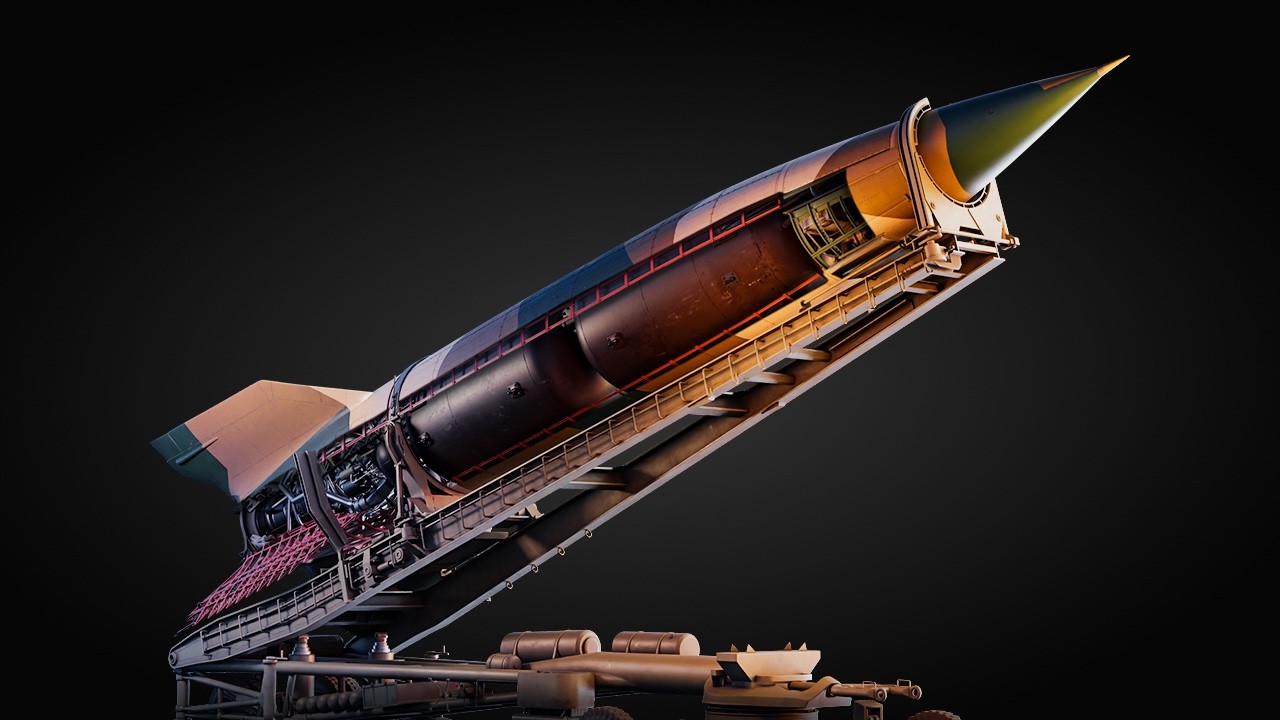


Developed in Nazi Germany, the V-2 was the first ballistic missile in history, reached suborbital space, and directly influenced the space programs of the USA and the Soviet Union.
The rocket V-2 (Vergeltungswaffe 2), also known as Aggregat-4 (A-4), was the first guided long-range ballistic missile used in combat. Developed during World War II under the coordination of the team led by Wernher von Braun at the Peenemünde research center, the V-2 marked a technological breakthrough: it not only reached targets hundreds of kilometers away but also surpassed the Earth’s atmosphere in suborbital flight.
Between 1944 and 1945, the V-2 was launched against cities such as London and Antwerp, ushering in a new era in modern warfare. At the same time, its liquid propulsion engineering would become the foundation for the development of post-war space rockets.
The First Operational Ballistic Missile in History
The V-2 was the first weapon capable of following a complete ballistic trajectory. After vertical launch by rails, the rocket would automatically tilt toward the target, reach altitudes over 80 km, and then dive at high speed.
-
Science still debates how to measure the intelligence of someone who may be one of the most brilliant Brazilians of today, with an IQ of 188 recorded in a specific test, 55 cited qualifications, and membership in high IQ societies.

-
ALMA and James Webb telescopes reveal star-forming gas in ancient galaxies, and discovery shows a rare piece of cosmic history

-
OpenAI wants to transform ChatGPT into a powerful super app with AI agents, enhanced Codex, and tools for businesses before a potential billion-dollar IPO.
-
Alibaba launches artificial intelligence for robots in China and reveals why big techs now want machines that do much more than just talk



It was approximately 14 meters tall, weighed about 12.5 tons at launch, and carried an explosive warhead of almost 1 ton.
The engine used a liquid fuel composed of ethanol and liquid oxygen. The combustion generated enough thrust to accelerate the rocket to speeds exceeding 5,000 km/h.
The V-2 was the first human-made artifact to cross the boundary of space in suborbital flight, preceding any formal scientific rocket.
Launches Against European Cities
The first operational attack with the V-2 occurred on September 8, 1944, against London. Unlike conventional bombers, the V-2 could not be intercepted.

As it reached supersonic speed on a descending trajectory, the impact occurred before any sound alert could be heard. There was no air defense capable of stopping it at the time.
It is estimated that over 3,000 units were launched during the war. Despite the significant psychological impact, the strategic military effect was limited compared to the investment made.
Engineering That Would Change The World
Although created as a weapon, the V-2 represented an unprecedented technical leap in rocket engineering. It introduced:
- Gimbaled Guidance System
- Aerodynamic Control by Moving Fins
- High-Power Liquid Propulsion
- Lightweight Large-Scale Structure
The knowledge accumulated in Peenemünde became valuable in the post-war period. After 1945, both the United States and the Soviet Union captured scientists and technology from the V-2 program, marking the beginning of the space race.
From War Weapon to the Beginning of the Space Age
In the United States, Operation Paperclip brought Wernher von Braun and part of the German team to American soil. There, the knowledge gained from the V-2 was applied in experimental rockets and later in the development of the Redstone and Saturn rockets.
In the Soviet Union, engineers also studied captured units to develop their own ballistic missiles. The concept of the intercontinental ballistic missile (ICBM) and the first space vehicles have direct roots in the technical architecture of the V-2.
The path leading to the launch of Sputnik in 1957 and the arrival of man on the Moon in 1969 began with the principles tested in the V-2.
Suborbital Flight and The Boundary of Space
A test launch of the MW 18014 model in June 1944 surpassed approximately 100 km in altitude, exceeding what would later be defined as the Kármán Line — the conventional boundary of space.
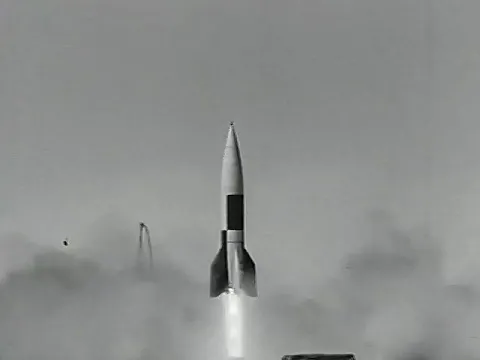
This makes the V-2 the first man-made object to reach space, albeit in a military context. From that moment on, it became evident that missile technology could transcend military use and achieve scientific applications.
Production and Human Impact
The manufacture of the V-2 took place in underground facilities such as Mittelwerk, using forced labor from prisoners of the Mittelbau-Dora concentration camp. Thousands of people died under the production conditions of the rocket.
The technological legacy of the V-2 is inextricably linked to the historical context of World War II and the human consequences of the regime that developed it.
Technical Data of the V-2
- Height: about 14 meters
- Total Weight: approximately 12.5 tons
- Range: up to 320 km
- Max Speed: over Mach 4
- Explosive Charge: about 975 kg
These numbers were unprecedented in the 1940s.
The V-2 as a Turning Point
Before the V-2, rockets were experiments limited to small altitudes. After it, it became clear that it was possible to reach space.
The project showed that liquid propulsion engineering could be scaled for larger payloads and intercontinental distances. The V-2 was not just a weapon: it was the prototype of the modern rocket.
The V-2 rocket became the first operational ballistic missile in history and also the first human-made object to reach space in suborbital flight.
Created as a weapon during World War II, its technological development paved the way directly for the space programs of the United States and the Soviet Union.
The engineering applied to the V-2 established foundations that would be used decades later in scientific rockets, strategic missiles, and space missions. Its impact crossed the war, the space race, and shaped the propulsion technology that still sustains orbital launches today.










AINDA TEM SERES PATÉTICOS QUE ACHAM QUE A RUSSIA DERROTOU A ALEMANHÃ NA II GUERRA. NÃO, SEUS ****, A RUSSIA NÃO DERROTOU NINGUEM. A ALEMANHA LUTOU SOZINHA CONTRA TRÊS PAÍSES, E AINDA OBTEVE VANTAGEM O MAOIR TEMPO QUE DUROU A GUERRA. MAS NÃO SE MANTEM TODA AQUELA TECNOLOGIA SEM RECURSOS, E A FONTE SECOU. A PERSEGUIÇÃO AOS JUDEUS FOI A MAIOR **** DE HITLER, POIS ELES SÃO MAIORES EMPRESÁRIOS E BANQUEIROS DO MUNDO. COM ISSO, QUEM FICOU NA BOA FORAM OS EUA, QUE RECEBERAM UM MONTE DE JUDEU BILHONÁRIO FUGIDOS DA ALEMANHA.
A Alemanha foi derrotada pelo conjunto Russia, EUA e Inglaterra e pleos erros que o Hitler cometeu
Os alemães foram muito espertos e inteligentes. Desenvolveram diversas armas eficazes. Só perderam a 2° guerra por serem muito gananciosos, principalmente em atacar a Rússia e a Inglaterra.
PORQUE? você queria que tivessem ganho? Eu hein
A culpa quase total foi do Hitler que por sua arrogância ignorou seus generais e criou várias frentes de batalha dividindo o exercito alemão e estendendo as linhas de suprimentos que demoravam muito a chegar aos seus destinos. Ainda bem para o mundo