






 Portuguese
  Spanish


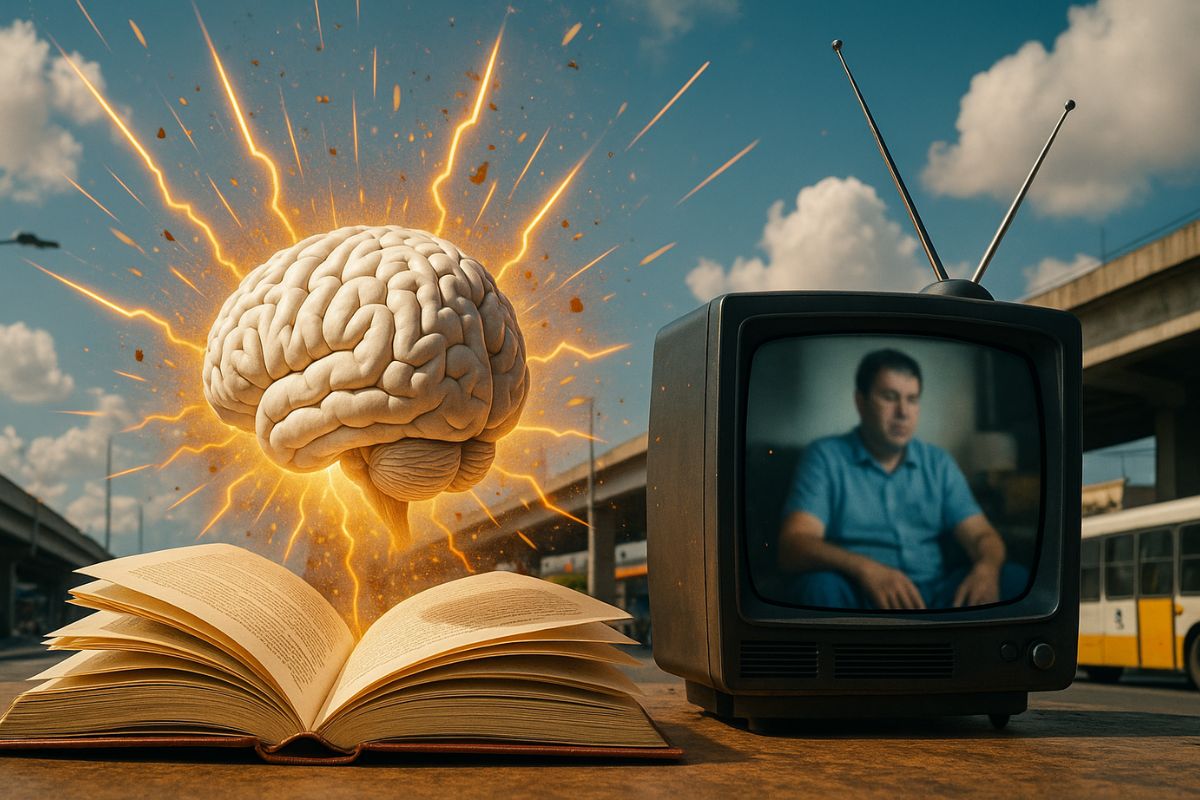


Scientific Studies Show That Reading Changes Your Brain By Activating Regions Related To Language, Attention, Memory, And Empathy, While TV Reduces Cognitive Effort And Provokes Quick And Superficial Responses That Affect Even Your Social Connections
Among the most accessible cultural activities, few have as profound an impact as reading. Various studies show that reading changes your brain for days, strengthening areas related to language and even activating sensory-motor regions that make the reader “live” mentally the actions of the story. The effects remain after the book ends, improving vocabulary, attention, and the ability to understand complex contexts.
In contrast, television acts in the opposite way. The brain receives ready-made content and reduces cognitive effort. In minutes, the body relaxes, the mind slows down, and the state becomes passive, which limits concentration and critical thinking when consumption is prolonged. The difference between reading and watching is not moral, but rather neurological and behavioral.
What Studies Reveal
Research with different age groups confirms that reading requires active participation.
-
Crab Trapped in Plastic Bottle for 62 Days Near Okinawa Highlights Little-Known Impact of Marine Pollution on Small Animals

-
Esperanza’s Bamboo Barrier in Oaxaca Redirects River and Reduces Erosion by 85% in Five Years

-
Family Builds Homemade Wind Turbine to Power Off-Grid Home, Video Reaches 555,000 Views on Ngô Thị Huyền’s Channel
-
Indian Brand Creates Sneakers from Recycled PET Bottles and Discarded Tires, Repurposing Over 1 Million Bottles and Raising $4 Million for Expansion





Each page forces the brain to decode symbols, create mental images, and organize abstract information into logical sequences.
This constant work generates connections between multiple brain regions.
TV, on the other hand, offers the complete package: image, sound, context, and emotion come ready-made. The brain simply follows along.
Studies with children have shown that the more time spent in front of the screen, the smaller the vocabulary and verbal expression. Reasoning becomes more superficial, and attention disperses more easily.
Language And Vocabulary: Why Reading Strengthens More
Reading activates frontal and temporal areas involved in understanding meaning, syntax, and idea associations.
Each decoded sentence acts as an exercise in semantic reconstruction, which expands repertoire and improves communication.
TV, in contrast, delivers ready visual and auditory stimuli. There is no need to imagine, predict, or fill in gaps.
This reduces verbal plasticity over time, especially when the content is repetitive. The result is shorter thinking focused on immediate reaction.
Attention And Memory: The Silent Training Of Reading
Reading requires sustained focus and long-range memory. The reader needs to remember names, places, dialogues, and outcomes.
This practice keeps the brain in active mode, favoring logical reasoning and prolonged concentration.
In contrast, consuming quick and sequential videos trains the mind for short distractions. With each stimulus, the brain seeks new rewards.
The cycle repeats, decreasing tolerance for slow tasks. Reading changes your brain precisely by restoring internal control of attention.
Social Connections And Empathy
Reading not only stimulates individual language but brings people closer.
Studies with parents and children have shown that by reading together, the number and quality of conversations significantly increase. Interactions become deeper and more affectionate.
In front of the TV, even educational programs generate fewer exchanges.
Adults tend to comment less and respond superficially. Reading together, on the contrary, creates dialogue, curiosity, and a sense of bonding, strengthening empathy and emotional understanding.
TV Passivity: The Effect In Minutes
It takes only a few minutes of exposure for the brain to enter automatic reception mode.
The areas of excitement and reward dominate, while the cortex responsible for complex reasoning reduces its activity. This relaxation is pleasurable, but decreases intellectual engagement.
Informative content and documentaries have value, but require moderation.
The problem lies in excess and in the routine without pause. The longer you spend in front of the screen, the harder it becomes to resume tasks that require concentration.
How To Create The Reading Habit
To read more, start small and with purpose. Choose topics that genuinely spark interest. It can be romance, biography, science, or fiction. Regularity matters more than volume.
Prepare the environment: keep a book visible, create a pleasant reading spot, and keep your phone away.
Fifteen minutes a day before bed is enough to notice changes in mental clarity and sleep quality. Reading retrains focus and reduces stress.
Balance Between Reading And TV
Not all reading is enriching, and not all TV is shallow. The balance lies in the intention and content. Reading stimulates slow and critical thinking, while TV can inform and entertain when used consciously.
The key is to define what effect you want to cultivate: depth and retention with books or quick and momentary stimulation with videos. Alternating consciously is the healthiest path.


Preciso voltar a cultivar esse hábito, pois parei a décadas.