






 Portuguese
  Spanish
  3 min of reading
  0 comments


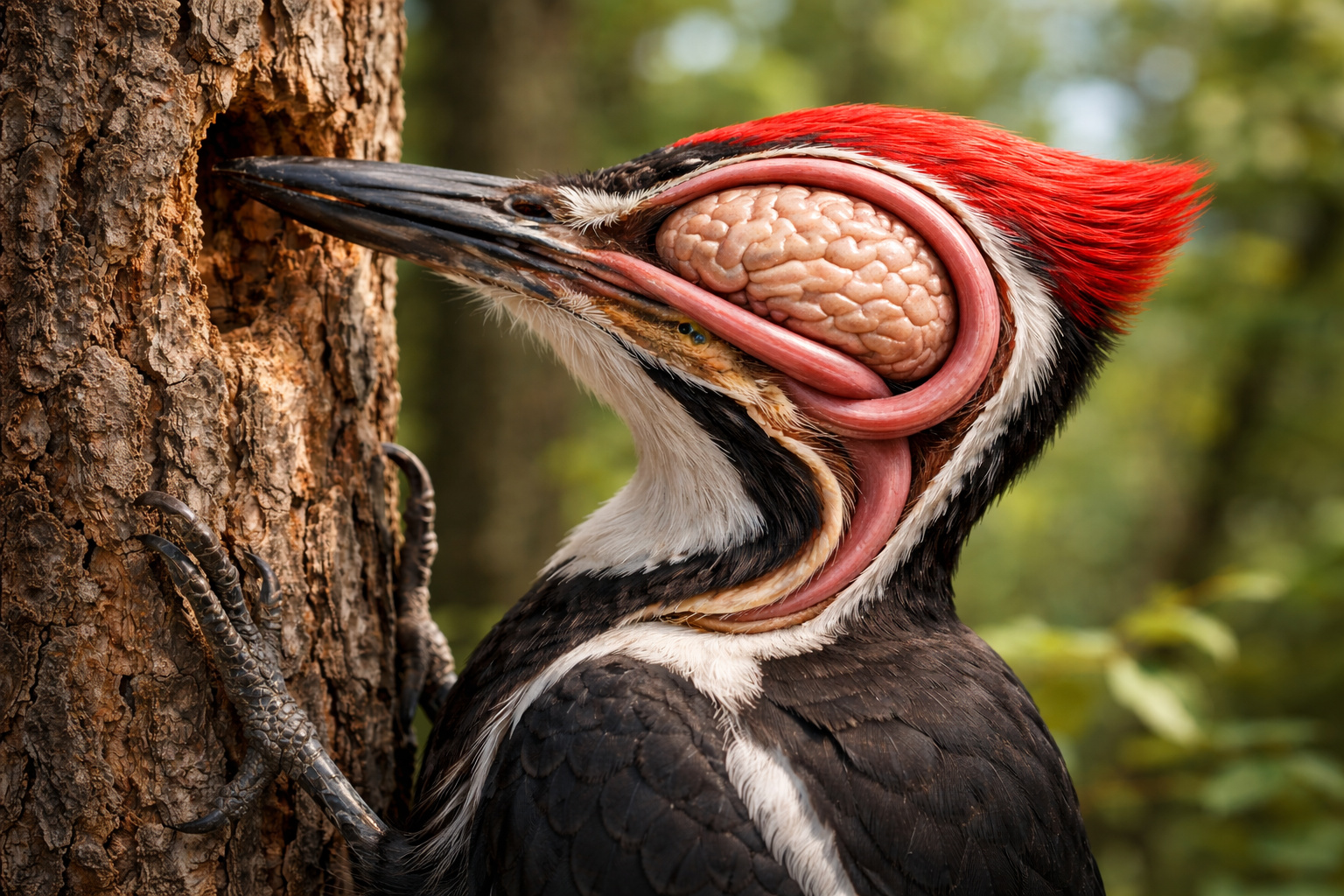
The Specialized Anatomy Of The Woodpecker Reveals How The Tongue, Skull, And Beak Work Together To Prevent Concussions Even Under Repetitive And Extreme Impacts
A biological adaptation of great scientific impact has drawn attention for decades and, more recently, has returned to the center of academic debate. The woodpecker, known for its habit of hammering tree trunks with force and speed, has an internal protection system that prevents brain damage even after thousands of daily strikes. This capability depends not only on the beak or skull but, above all, on an extremely long tongue that acts as a true natural seatbelt.
Since anatomical studies in the 20th century, researchers had pointed out that the woodpecker’s tongue performed functions beyond feeding. With the advancement of imaging techniques and biomechanical analysis, it became clear that this structure wraps around the skull, redistributes energy, and stabilizes the brain during each impact, ensuring that the bird withstands repetitive stress without suffering neurological injuries.
Natural Mechanism Reveals Highly Efficient Cranial Protection
In 2022, a study conducted by Sam Van Wassenbergh and colleagues provided new evidence about this mechanism. Using high-speed footage and biomechanical modeling, the researchers precisely analyzed how the woodpecker’s brain remains protected during hammering.
-
Mother of 7 children leaves night job in São Paulo, invests only R$ 86 in artisanal ice creams and sees income become household support: business created at the gate reaches R$ 6,000 per month and aims for a physical store.

-
An empty spacesuit was launched from the ISS and became a “ghost astronaut” in orbit: the SuitSat floated alone around the Earth transmitting radio signals before burning up in the atmosphere.

-
Dissatisfied with seeing laptop batteries go to waste, a man collects more than 650 units and transforms the electronic waste into a solar energy storage bank to power his house.
-
Accessible only by boat, an old house from 1862 is up for sale for R$ 19.4 million in the USA with a famous artist’s studio, pier, and over 10 preserved hectares.




The results indicated that the tongue extends out of the oral cavity, envelops the skull, and positions itself around the head. In this way, it acts as a containment system that reduces brain acceleration, limiting dangerous movements. Furthermore, the tongue’s movement occurs in sync with each strike, reinforcing its protective function.
Body Structure Absorbs Repetitive Impacts Without Causing Concussions
Besides the tongue, the woodpecker has a spongy skull structure and a beak with controlled flexibility, elements that contribute to dissipating the impact energy. Thus, the force generated by the strikes does not concentrate on a single point but is gradually distributed throughout the body.
Biomechanical measurements released in 2022 demonstrated that the woodpecker can strike wood up to 20 times per second. Still, it shows no signs of concussion or brain damage. This performance is only possible due to the integration of the tongue, skull, and beak, forming a highly efficient protection system.
Tongue Anatomy Differentiates The Woodpecker From Other Birds
Unlike birds with short, simple tongues, the woodpecker’s tongue exhibits extreme specialization, resulting from a long evolutionary process. This structure serves multiple functions, combining cranial protection and feeding efficiency.
Among the main anatomical characteristics are:
- Extended Extraglossal Length, which wraps around the skull and acts as an impact buffer.
- Barbed Tip, which facilitates the capture of insects in deep galleries.
- Elongated Hyoid Bone, which supports the tongue and passes behind the eyes and ears, ensuring structural stability.
This ensemble transforms the woodpecker into a true natural engineering machine, capable of withstanding extreme pressures during wood drilling.
Evolutionary Importance Of The Adaptation For Species Survival
Over millions of years, this adaptation has allowed woodpeckers to occupy a unique ecological niche, exploiting food sources inaccessible to most birds. Without this protection system, the physical effort required to reach insects inside tree trunks would be unsustainable.
Moreover, the long tongue functions as an efficient capturing weapon, coated with sticky saliva and, in many cases, equipped with microscopic hooks. Thus, it traverses narrow tunnels created by insects, ensuring enough energy to sustain the intense daily work pace in the forest.
Given such a refined system, do you consider the woodpecker’s tongue merely a feeding tool or one of the most sophisticated examples of biological protection ever observed in nature?









-

-

4 people reacted to this.