






 Portuguese
  Spanish


Technology with dormant bacteria transforms small cracks into automatic repair points in concrete, creating a mineral barrier against infiltration and corrosion. Advance studied in the Netherlands targets structures exposed to moisture, where frequent maintenance often generates high costs for governments, companies, and construction firms.
The self-healing concrete with bacteria, also called bioconcrete, advances as an alternative to reduce damage caused by small cracks in structures exposed to water, especially in bridges, tunnels, underground walls, garages, and maritime works.
The technology uses bacterial spores and nutrients incorporated into the material to form calcium carbonate when water enters through the cracks, blocking part of the infiltration and helping to protect the steel reinforcement.
The research associated with Delft University of Technology, in the Netherlands, gained prominence for testing a biological mechanism for healing concrete, based on the action of microorganisms resistant to the highly alkaline environment of cement.
-
Giant 3,600-ton Crane Breaks Two World Records by Installing World’s Largest Single-Piece Forged and Welded Hydrogenation Reactor, Weighing 3,037 Tons, in Chinese Petrochemical Plant in Just Six Days

-
$80 Million Bridge in Brazil Cuts Travel Time from 30 Minutes to 1 Minute, but Audit Reveals Major Flaws
-
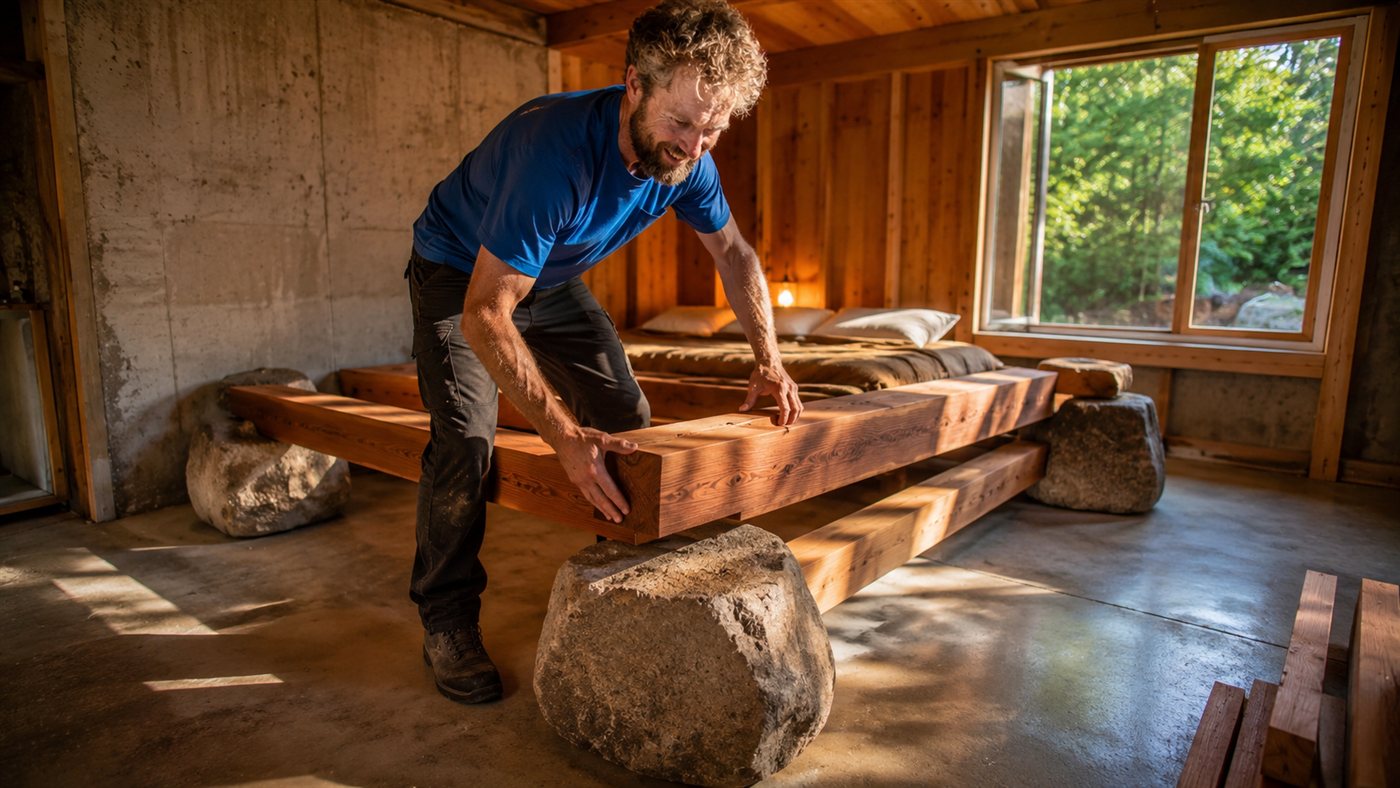
Man Builds Stone Bed with Granite Rocks and Hand-Sawn Cedar Beams, Home Extension Garners Over 437,000 Views on Bonus Bolts Channel

-
Brazilian Researcher Develops Color-Changing Roof Tile to Reduce Air Conditioning Use by Up to 15%



Studies linked to researcher Henk Jonkers indicate that dormant bacteria, combined with organic compounds like calcium lactate, can convert nutrients into limestone and seal small cracks.
How concrete with bacteria seals cracks
The system starts from a known problem in engineering: concrete resists compression well but can crack when subjected to stresses, temperature variations, shrinkage, or structural efforts over time.
These openings, even when they seem small, facilitate the entry of water, salts, and other aggressive agents that accelerate the corrosion of internal steel.
To reduce this risk, researchers incorporated spores of Bacillus bacteria into the concrete, along with calcium-based nutrients.
These components remain inactive within the cement matrix until water penetrates through a crack and creates the necessary conditions to activate the biological repair process.
When they come into contact with moisture, the spores germinate and begin to consume the available nutrient.
During this metabolic activity, calcium carbonate is formed, a mineral compatible with concrete and capable of filling microcracks, reducing the passage of water through the interior of the structure.
This mechanism can also consume oxygen at the site of the crack, a relevant factor because the presence of oxygen and moisture favors the corrosion of metal reinforcements.
Therefore, the proposal does not eliminate the need for design, inspection, and maintenance, but it can slow down the rate of deterioration in environments where access for repairs is difficult or expensive.
Bioconcrete targets bridges, tunnels, and wet works
The most cited applications for bioconcrete involve works in frequent contact with water, such as tunnels, basements, marine structures, and infrastructure elements subject to the action of salts.
In these cases, infiltration through cracks can compromise durability and increase maintenance costs over the construction’s lifespan.
Delft University of Technology reports that self-healing concrete was developed with a focus on specific products for different civil engineering markets, including tunnel linings, structural basement walls, concrete floors, road bridges, and marine structures.
However, commercial advancement depends on performance, cost, and validation on a real scale.
In tests described in industry publications, complete healing was observed in submillimeter cracks, with reference to openings of about 0.15 millimeters in samples analyzed by microscopic techniques and permeability tests.
The result indicates potential for sealing small cracks, but it does not mean that the material is capable of correcting extensive structural damage without technical intervention.
The difference is important because larger cracks may indicate design, execution, overload, settlement, or advanced degradation problems.
In these cases, concrete with bacteria does not replace reports, structural reinforcements, conventional recovery, or safety measures defined by responsible engineers.
Cost still weighs on large-scale adoption
The main obstacle to mass adoption remains economic.
A technical report from Ingenia magazine, by the Royal Academy of Engineering, noted that the first formulations of self-healing concrete could cost about twice as much as conventional concrete, although this value could be offset in works where maintenance is complex, expensive, or risky.
The financial logic is in the structure’s life cycle, not just the initial price per cubic meter.
If the technology reduces repairs, closures, infiltrations, and corrosion, the additional cost may make sense in bridges, tunnels, coastal structures, and underground constructions, where small failures tend to generate high expenses over the years.
There are also technical limitations.
One of the initial formulations used expanded clay particles to protect the healing agents, but this addition could reduce the compressive strength of the concrete in certain applications.
Researchers then began to seek more economical versions with less impact on the material’s mechanical properties.
What research has already shown about bioconcrete
Available studies support that dormant bacteria and organic compounds can act as self-healing agents in small cracks, especially through the formation of calcium carbonate.
There is also evidence of reduced permeability in bacterial concrete samples, which helps explain the construction industry’s interest in the technology.
However, there is no secure confirmation that the research has “mathematically proven” complete commercial viability for widespread use by construction companies in any type of project.
What exists is a combination of laboratory results, larger-scale tests, product development, and partnerships aimed at specific high-maintenance applications.
The technology also does not transform concrete into a “living” material in the common sense of the word.
The term appears popularly to describe the presence of dormant microorganisms in the material, but the process depends on specific conditions, such as water entering through the crack, availability of nutrients, and an opening compatible with the mineral filling capacity.
The environmental impact can be positive when the solution extends the lifespan of structures and reduces the need for repairs, replacements, or additional material production.
Even so, this gain depends on the type of project, actual performance, application scale, and comparison with conventional maintenance alternatives.
Why self-healing concrete attracts the construction industry
The construction industry has been searching for more durable materials for years because the maintenance of bridges, tunnels, buildings, and underground structures consumes significant public and private resources.
In many cases, degradation begins silently, with microcracks allowing water ingress before any visible signs of performance loss.
In this scenario, concrete with bacteria emerges as a preventive technology, not a miracle solution.
The goal is to delay deterioration, reduce infiltrations, and protect reinforcement in aggressive environments, especially where human inspection is limited or where repairs require costly shutdowns.
Research on Bacillus pseudofirmus and Bacillus cohnii indicates that alkaliphilic bacteria can precipitate calcium carbonate by utilizing organic sources, such as calcium lactate, in mechanisms studied for concrete self-repair.
This scientific line is under development and appears in reviews and experimental studies published in recent years.
Commercial adoption tends to advance first in projects where the maintenance cost exceeds the savings obtained with conventional materials.
In common buildings, the decision depends on standards, local availability, price, certified performance, and technical responsibility, factors that still condition large-scale use.


