






 Portuguese
  Spanish


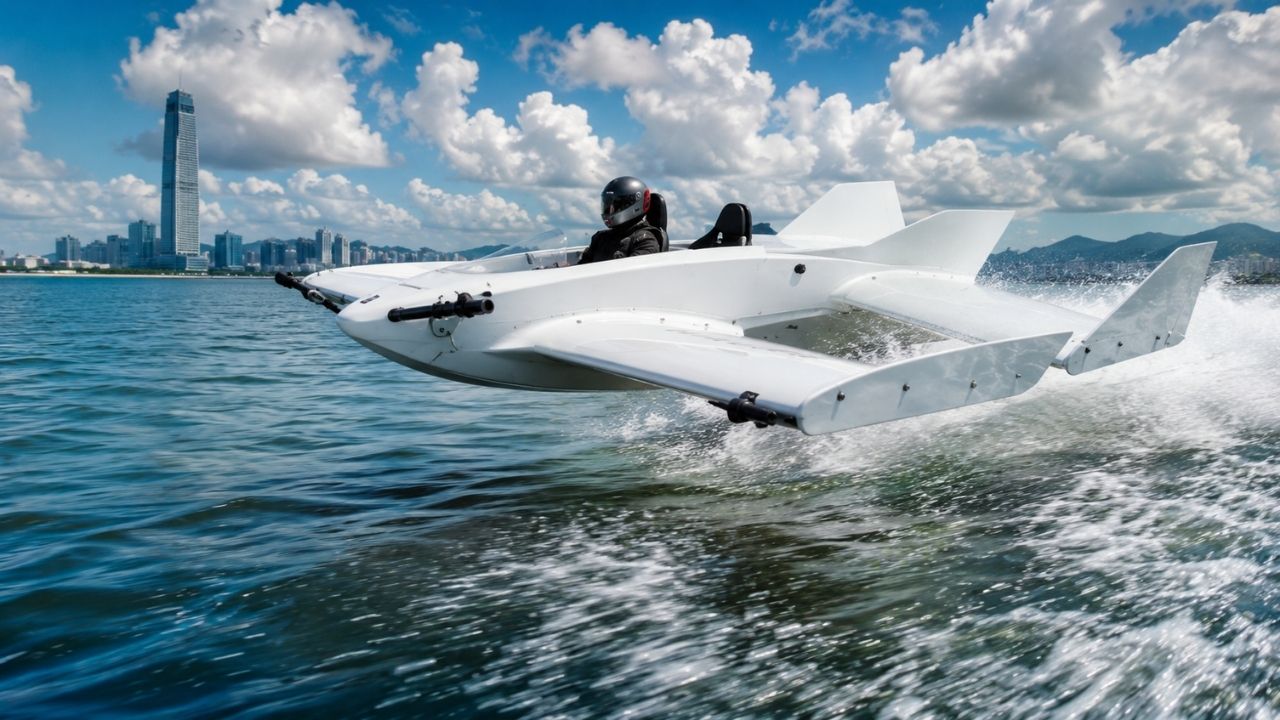

The WaveFly 5X, developed by the Chinese company Navee and described as the world’s first winged watercraft for commercial use, made its public inaugural flight in Suzhou, China, on June 4, 2026. The flying boat uses ground effect, crosses the water at up to 85 km/h, and could enter mass production later this year.
When a vehicle fits into no known category, it’s a sign that something genuinely new is in motion. The WaveFly 5X, created by the Chinese company Navee, is exactly this type of machine: a flying boat that doesn’t take off into the sky, nor does it sail through the water like a common vessel, it glides just 50 to 60 centimeters above the water surface, utilizing ground effect to reach speeds of up to 85 km/h.
The information was released by China Daily on June 8, 2026, based on data provided by Navee itself. According to the company, the WaveFly 5X is classified as the first wing-in-ground-effect vehicle intended for commercial use in the world, a technical distinction that separates this category from both conventional seaplanes and traditional high-speed boats. Navee announced plans to begin mass production by the end of 2026, with a projected production capacity of 2,000 units per year starting in 2027.
What is ground effect and why it makes the WaveFly 5X different
The principle behind the WaveFly 5X is not new in physics, but its commercial application remains largely unexplored. The so-called ground effect occurs when a wing moves very close to a surface, such as water, and the aerodynamic pressure formed between the wing and this surface generates additional lift with less drag. The practical result is that the vehicle can glide at very low heights with greater energy efficiency than it would have if flying at conventional altitudes.
-
Engineers Develop Jacket That Converts Air Humidity Into Drinkable Water, Producing Up to 900 ml Daily for Hikers, Campers, Rescuers, Rural Workers, and Military in Remote Areas

-
NASA Plans to Repurpose Mars Rover for Lunar Mission, Sending a 1-Ton Nuclear-Powered Vehicle to Explore the Moon’s South Pole Without Solar Dependence
-
Early Humans Made Beds Nearly 200,000 Years Ago in African Caves, Study Reveals

-
Japanese Smart Bike Detects Cyclist’s Intent to Turn and Potential Falls


In the case of the WaveFly 5X, this phenomenon allows the craft to maintain 50 to 60 centimeters above the water surface while advancing at up to 85 km/h, a speed considerably higher than that of common motorized boats. Unlike a plane, the vehicle does not need to gain altitude to operate; unlike a boat, it does not have direct contact with the water during movement.
This intermediate point is precisely what Navee bets on as a market differentiator. There is, so far, no public information available about the vehicle’s fuel or battery autonomy, nor about its passenger capacity.
The inaugural flight in Suzhou and what it represents


The public inaugural flight of the WaveFly 5X took place on June 4, 2026, in Suzhou, a city known for its historic canals and lakes, located in Jiangsu province, eastern China. The choice of Suzhou as the setting for the vehicle’s public debut is not described in the source as accidental: the city offers extensive water surface areas that allow demonstrating exactly the type of operation for which the WaveFly 5X was designed.
The event represented the public consolidation of a project that Navee is positioning not only as a technological demonstration but as a commercial product with large-scale production viability. The company announced that the price of the WaveFly 5X in the United States market will be $199,999, just under 200 thousand dollars per unit.
This value suggests a positioning aimed at the high-end segment, although Navee has not disclosed, up to the date of the China Daily report, the priority markets beyond the United States or the planned distribution channels.
From debut to mass production: Navee’s plan for 2026 and 2027
The ambition of Navee with the WaveFly 5X goes beyond a launch with impact. According to the data released by China Daily, the company plans to start serial production of the vehicle by the end of 2026, which means that, if the schedule is met, the first commercial units could be available for delivery in less than six months from the inaugural flight.
From 2027, the goal is to reach an annual production capacity of 2,000 units, a volume that, if achieved, would place the WaveFly 5X on a completely different scale from experimental prototypes.
This planned production pace is an indication that Navee believes there is real demand for this type of vessel, whether in the luxury aquatic tourism segment, private transportation in regions with many lakes and rivers, or high-performance recreational use. What is not clear from the available information is what safety regulations or licenses will be necessary to operate the vehicle in different countries, a relevant issue for any product that straddles the categories of vessel and aircraft without fully fitting into either.
A product that challenges classifications and opens a new segment

The WaveFly 5X is not the first vehicle of its kind to exist in the history of engineering — ground effect technology was explored militarily by the Soviet Union in the 1960s and 1970s with the so-called ekranoplanes, large vessels that operated on the same principle. What Navee claims as unprecedented is the arrival of this technology to the commercial consumer market, with scaled production, set pricing, and planned distribution for the general public.
If the plan materializes within the announced timelines, the WaveFly 5X could inaugurate an entirely new market category, that of ground effect aquatic vehicles for civilian use. The name Navee chose for the product, “flying boat,” aptly summarizes the difficulty of categorizing it: it is a machine that needs water to function, but refuses to sink into it. Whether it will establish itself as a new means of transportation, time will tell, but the inaugural flight on June 4, 2026, in Suzhou made it clear that the idea has taken off.
A vehicle that flies close to the water at 85 km/h and costs almost 200 thousand dollars: do you think the flying boat has a future as a real means of transportation, or is it just another luxury product for a few?


