Portuguese
  Spanish


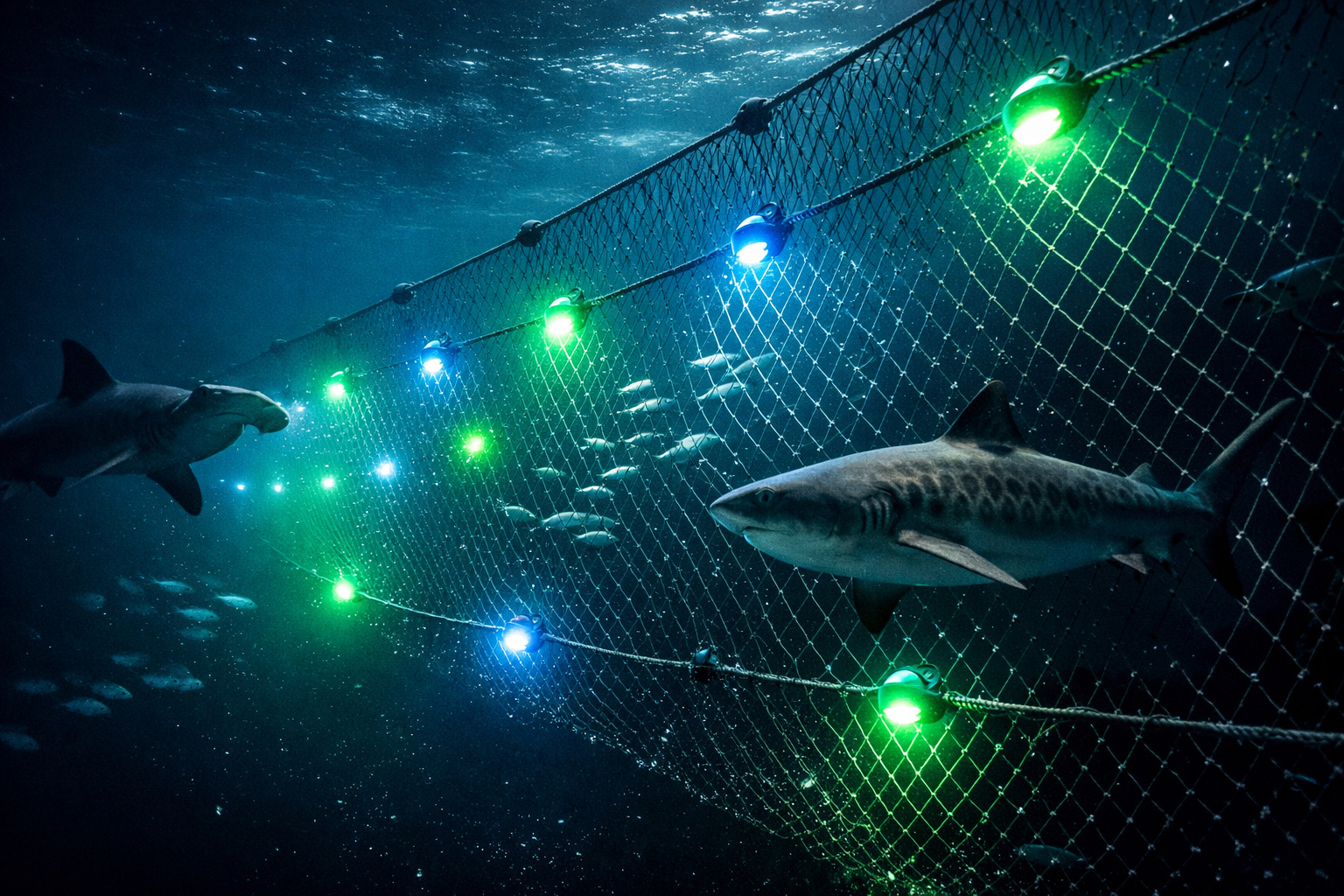


Underwater Lights from the SharkGuard Project Reduce Accidental Shark Catches Without Harming Them and Show That Fishing and Conservation Can Coexist in the Ocean.
For decades, the relationship between commercial fishing and sharks has been marked by a silent and devastating conflict. Nets used for gillnetting, widely deployed around the world, efficiently capture target fish but also accidentally ensnare sharks, rays, and other large predators. The outcome is known: millions of animals killed every year, direct impact on marine ecosystems, and economic losses for fishermen who lose equipment and working time.
It was in this context that SharkGuard emerged, a project that has caught the attention of the scientific community for a simple and unexpected reason: it does not attempt to drive away sharks with force, pain, or physical exclusion, but with light.
How Light Became an Ally of Marine Conservation
The central idea of SharkGuard stems from a little-explored characteristic of shark biology. These animals have extremely refined visual and electro-sensory sensitivity, developed to detect prey in low-light environments. Unlike common bony fish, many sharks react negatively to specific light stimuli, especially when these alter natural contrast patterns on the seabed.
-
Excavation for Solar Park in Germany Uncovers Rare Celtic “Princely Tomb” with Elite Warrior Buried with Gold, Weapons, Etruscan Jug, and Two-Wheeled Chariot in Bad Camberg

-
NOAA Scientists Discover Mysterious, Perfectly Aligned Holes on the Mid-Atlantic Ridge Seafloor, Origin Still Unknown

-
California Startup Develops Giant “Space Sling” to Launch Vehicles at Mach 6, Reducing Fuel Use and Enabling Thousands of Satellite Deployments

-
ChatGPT Alerts FBI to Prevent Planned Murder of 8-Year-Old in Brazil’s Espírito Santo



The project tested small green LED lights, powered by long-lasting batteries, attached directly to the fishing nets. These lights do not create a physical barrier or harm the animals. They simply make the net visible and uncomfortable for the shark, leading it to avoid contact before becoming ensnared.
The crucial detail is that the target fish, in many cases, does not react in the same way, allowing fishing to continue.
Open Ocean Tests and Consistent Results
The SharkGuard tests were conducted under real fishing conditions, especially in European waters, where accidental shark catch is a known problem. Nets equipped with lights were compared to traditional nets used side by side over prolonged periods.
The results drew attention because they were not marginal. The illuminated nets showed significant reductions in accidental catches of sharks and rays, while the amount of commercially captured fish remained practically stable.
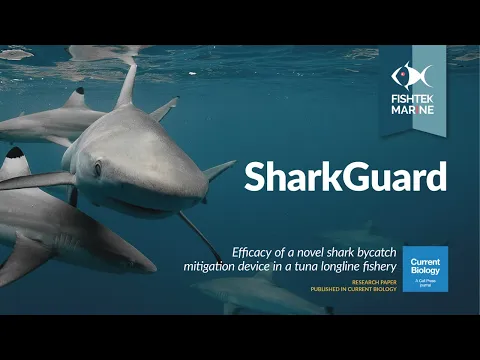

In practical terms, this means fewer dead animals, less time spent releasing unwanted catches, and less damage to the nets, which are often destroyed when large sharks become ensnared.
Why Repelling Without Harming Makes All the Difference
Many previous attempts to deal with sharks involved aggressive methods: intense electric repulsion, high-frequency sounds, or even physical barriers. While some are effective, they tend to be expensive, difficult to maintain, or cause severe stress to the animals.
The difference with SharkGuard is that it does not turn the shark into an enemy, but signals that the location is not interesting for it. There is no shock, pain, or extreme negative conditioning. The animal simply changes its route.
This detail is crucial because it avoids a common problem in deterrent technologies: behavioral adaptation. By not associating the stimulus with a direct threat, the chance of the shark “learning to ignore” the system over time is reduced.
Direct Benefits for Fishermen
Although the project has a strong environmental appeal, it was not designed solely for conservation. The fishermen involved in the tests reported clear practical advantages. Nets with fewer accidental catches require less cleaning time, less physical effort, and less risk during handling on deck.
Furthermore, the reduction of large animals caught significantly decreases the breakage of nets, one of the highest costs in artisanal and semi-industrial fishing.
From an economic perspective, this creates a rare alignment of interests: protecting sharks ceases to be a “favor to the environment” and becomes an operational advantage.
A New Type of Relationship Between Fishing and Predators
The case of SharkGuard reinforces an important shift in how marine conservation is being thought about. Instead of completely excluding human activity or treating predators as obstacles, the strategy becomes adjusting behavior, reducing conflict without eliminating either side.
This logic has already shown results in other terrestrial contexts, such as beehive fences against elephants or flashing lights against lions. In the ocean, where control is much more difficult, the success of SharkGuard gains even more relevance.
Limitations and Challenges of the System
Despite the promising results, the researchers themselves acknowledge that SharkGuard is not a universal solution. The effect may vary depending on the species of shark, depth, water turbidity, and the type of fishing practiced.
Additionally, there are still challenges related to the initial cost of the lights and the need for periodic maintenance of the batteries. These factors are especially sensitive for low-income fishing communities.
Even so, when compared to recurring losses from damaged nets and unproductive time, the investment tends to be justified over time.
Global Expansion Potential
With the positive results, SharkGuard has begun to be seen as a replicable model in other regions of the world. Countries with high rates of accidental shark capture, such as those with intense coastal gillnet fishing, are natural candidates for adopting the technology.
The principle also opens doors for new adaptations, including adjustments in color, light intensity, and patterns of light distribution along the nets, further increasing efficacy without compromising fishing.
A Simple Solution to a Complex Problem
The story of SharkGuard shows that the solution to complex environmental problems is not always found in giant technologies or radical interventions. Sometimes, a small sensory change, applied in the right place, is enough to alter an entire system.
By repelling sharks without harming them, reducing accidental catches, and keeping fishing activities viable, the project offers something rare: concrete proof that coexistence is possible, even in an environment as unpredictable as the ocean.
In the depths of the sea, away from the spotlight, small lights are quietly showing that preserving predators does not mean giving up human survival; it means rethinking how we interact with them.