Portuguese
  Spanish


The bullet train between Madrid and Barcelona has entered a new phase in Spain with aerodynamic sleepers to reduce turbulence, vibrations, and ballast effect above 300 km/h; the goal is to reach 350 km/h, shorten trips, recover punctuality, and overcome failures affecting passengers on the Spanish national strategic line under renovation.
The bullet train between Madrid and Barcelona has entered a new stage after Spain advanced in contracting aerodynamic sleepers for the high-speed line connecting the country’s two largest cities. The Spanish government’s goal is to allow trains to reach 350 km/h and for the journey to take less than two hours.
According to Xataka Movilidad, the plan gained momentum in June 2026, with the awarding of a contract valued at around €112 million to provide the new track components. The intervention will be applied in strategic sections of the corridor, but it occurs at a delicate moment, marked by speed restrictions, vibrations, and delays affecting passengers and operators.
Bullet train attempts to transform the Madrid-Barcelona corridor into a journey of less than 2 hours
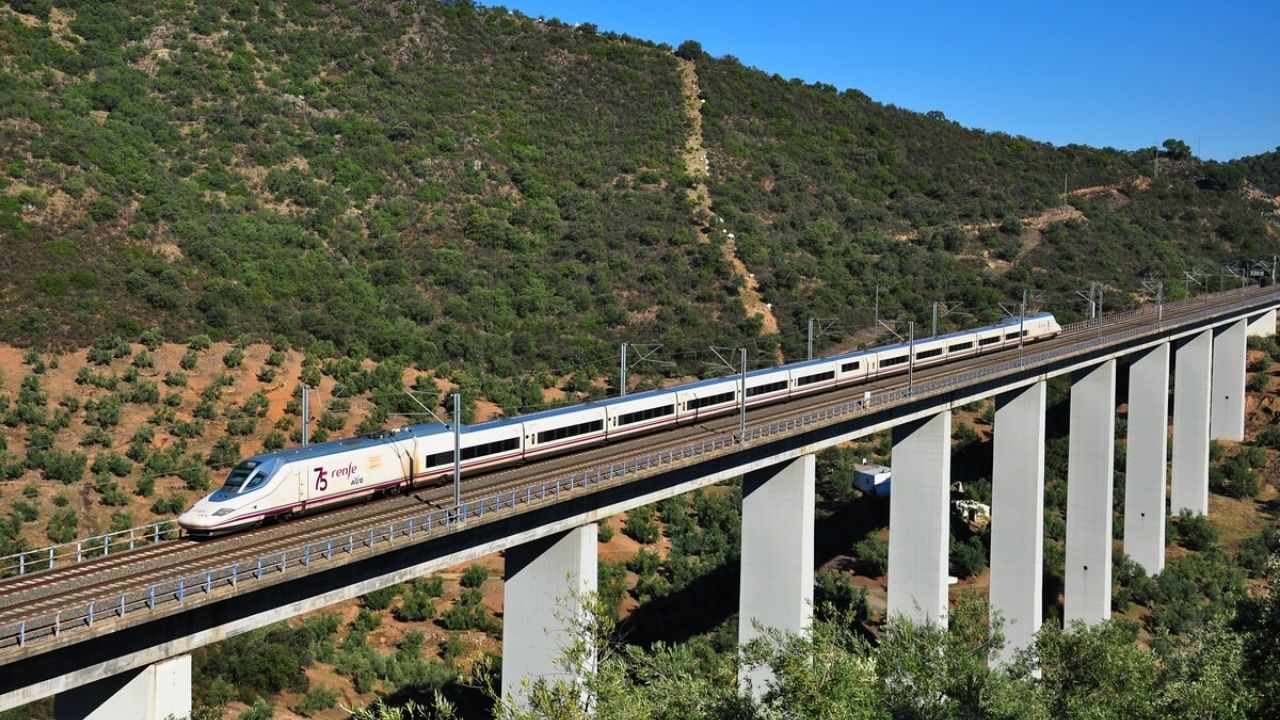
The connection between Madrid and Barcelona is one of the most important railway routes in Spain. Currently, the shortest scheduled time for the journey is approximately 182 minutes, but the official goal is to reduce the trip to less than 120 minutes, creating an even more competitive high-speed connection compared to air transport.
-
The Trap of Modern Technology: How Screen Overload and Digital Connections Can Impact Your Mental Health and Well-being

-
Wyoming Couple Grows Tropical Fruits Year-Round in -40°C Using Geothermal Greenhouse, Demonstrating Earth’s Heat Can Produce Oranges and Lemons in Snow Without Traditional Heating

-
Ship Returns from Brazilian Coast with Thirty Newly Discovered Life Forms
-
Nigerian Professor Invents Electricity-Free Refrigerator Using Clay Pots and Wet Sand, Extending Shelf Life of Vegetables to 27 Days; 7,000 Units Distributed in Energy-Deprived Villages



For this, it is not enough to just speed up the trains. The infrastructure needs to support higher speeds with safety, stability, and operational predictability. The project involves interventions on the track, technical studies, and changes capable of allowing the bullet train to travel at a peak speed higher than regularly practiced today.
The promise to cut about an hour from the journey is strong, but it depends on a complex combination of engineering, maintenance, and daily operation. Any temporary speed limitation, track failure, or train problem can negate part of the expected gain.
The Spanish ambition also has a symbolic dimension. Connecting Madrid and Barcelona in less than two hours would place the corridor on a new level within European high-speed, reinforcing the role of the train as a practical alternative for travel between large urban centers.
Aerodynamic sleepers promise to reduce turbulence under the trains
The most technical point of the project is the aerodynamic sleepers, called aerotraviesas in Spain. At first glance, they look like conventional sleepers, but they have a rounded design to reduce turbulence formed under the carriages when the train runs above 300 km/h.
This detail is crucial because, at very high speeds, the underside of the train experiences greater aerodynamic load. The turbulence presses the train against the track, increases energy consumption, and makes it more difficult to maintain the desired maximum speed efficiently.
The innovation attempts to solve an invisible problem for the passenger, but crucial for railway engineering. What happens under the train can determine if the line will be able to operate with stability, less wear, and lower risk of impacts caused by the ballast.
According to the calculations released about the project, the new sleepers can reduce the aerodynamic load on the layer of stones and allow more favorable circulation at high speed. In practical terms, the technology seeks to create conditions for the bullet train to reach 350 km/h with less interference from the air under the train.
Stones thrown by the tracks become an obstacle for the speed of 350 km/h
One of the most sensitive challenges of the line is the so-called “ballast flight.” The ballast is the layer of stones that supports the track. When the train passes at very high speed, the turbulence can cause these stones to vibrate, move, or be projected against the underside of the train.
This phenomenon is not just a technical detail. Stones thrown by the tracks can cause impacts, wear on equipment, holes, and additional vibrations on the track. In a corridor that intends to operate at 350 km/h, this type of risk needs to be reduced before any consistent speed increase.
The goal of the fastest bullet train precisely depends on controlling what happens in the space between tracks, sleepers, and carriages. If the track does not respond well, increasing the speed may compromise comfort, maintenance, and regularity.
The aerodynamic sleepers aim to reduce this effect by altering the airflow near the ballast. The solution does not eliminate all the challenges of the line, but it represents one of the technical bases chosen to prepare the infrastructure for speeds higher than the current ones.
€112 million contract will be applied to specific sections of the line
The awarded contract provides for the supply of the first batches of aerodynamic sleepers for sections of the Madrid-Barcelona line. The installation is expected to occur in segments such as Mejorada del Campo-Brihuega, Brihuega-Alcolea, Alcolea-Ariza, and Ariza-Calatayud, areas considered important within the infrastructure renewal.
In addition to the new sleepers, maintenance services related to track fastening were also contracted. The intervention includes replacing support plates and improvements in elements that ensure track stability, an essential step for any high-speed operation.
The investment is not just about replacing parts: it is about preparing the corridor for greater physical demands. When a train runs faster, each component of the line starts to withstand higher stresses, from track fastening to bridges, viaducts, and control systems.
Improvements are also planned for viaducts in the Guadalajara-Calatayud section. This type of work reinforces that increasing speed depends on a chain of interventions, not just a single component installed under the tracks.
Line is going through a critical moment, with delays and speed restrictions
The attempt to accelerate the corridor comes precisely during a period of operational difficulties. The Madrid-Barcelona line faced speed restrictions, increased travel times, and complaints related to vibrations, a scenario that affects passengers and reduces service predictability.
Reports from the Spanish press indicate that the railway sector already considers the possibility of extended times continuing for longer while the works progress. The coexistence between infrastructure renovation and daily train circulation creates an additional challenge for operators and users.
The paradox is evident: Spain wants to take the bullet train to 350 km/h while still needing to recover regularity on a route that currently suffers from delays. Before delivering a trip of less than two hours, it will be necessary to stabilize the operation and reduce the problems that already impact the corridor.
The situation has also reignited competition with air transport. If travel times remain longer than expected, some passengers may reconsider flying, especially for business trips that depend on reliable schedules.
Vibrations expose the limit between speed, comfort, and safety
The vibrations reported on the line are not just a nuisance for passengers. In high-speed systems, this type of behavior can indicate the need for maintenance, track adjustments, rolling stock review, or changes in the mode of operation.
Spain also deals with problems in train models that have faced difficulties on this route. The scenario makes the project even more sensitive because increasing speed without addressing the causes of vibrations could increase wear and compromise user confidence.
Speed only has value when it comes with stability. A train capable of reaching 350 km/h, but subjected to constant restrictions, delays, or discomfort, does not deliver the expected experience of a strategic high-speed line.
Therefore, investment in aerodynamic sleepers should be understood as part of a broader response. The goal is not just to hit a technical number, but to allow the bullet train to run consistently, safely, and competitively between the two largest Spanish cities.
Less than 2 hours between Madrid and Barcelona still depends on execution
The goal of reducing the journey to less than two hours is ambitious and depends on several factors: installation of new sleepers, completion of works, technical tests, operational adaptation, availability of trains, and control of temporary speed restrictions.
There are also other projects under discussion, such as the creation of new stations in areas near Madrid and Barcelona to alleviate congestion and offer alternative routes. These interventions show that reducing total time does not depend solely on maximum speed on open lines.
Reaching 350 km/h is one part of the problem; maintaining reliable service every day is another. For passengers, what matters is not just peak speed, but the combination of boarding, regularity, comfort, actual travel time, and predictability.
If Spain manages to resolve these points, the corridor could become even stronger against short flights. Otherwise, the promise of ultra-fast travel may continue to be limited by delays, works, and operational restrictions.
Spanish bullet train bets on engineering to overcome its own limit
The Spanish project shows that the race for high speed does not depend solely on modern locomotives or more powerful trains. The difference between 300 km/h and 350 km/h involves engineering details hidden under the carriages, such as sleepers, ballast, fastenings, viaducts, and aerodynamic flow.
The investment in aerodynamic sleepers reveals an attempt to tackle the problem through infrastructure. By reducing turbulence and the risk of thrown stones, Spain is trying to create the conditions to transform an already strategic line into an even faster corridor.
The challenge now will be to prove that the technology can deliver speed without sacrificing punctuality, comfort, and safety. For those traveling between Madrid and Barcelona, the promise of less than two hours will only be convincing if it comes with real regularity.
Do you think it’s worth investing millions to transform the bullet train between Madrid and Barcelona into a journey of less than two hours, or should the priority be to first resolve delays and vibrations before increasing speed? Leave your opinion in the comments.