






 Portuguese
  Spanish



Researchers at NIST Break Global Record with an Aluminum Ion Atomic Clock Capable of Measuring Time with 19 Decimal Places. Understand How This Technology Can Revolutionize Science.
The quest for maximum precision in time has just reached a new level. Scientists at the National Institute of Standards and Technology (NIST) have developed the most accurate clock in the world, surpassing all previous versions — including their own records — with a 41% improvement in precision and 2.6 times more stability than any other known ionic clock.
The secret lies in a single trapped aluminum ion, carefully manipulated by lasers and ultracontrolled vacuum systems. The new atomic time machine can measure time with precision up to the 19th decimal place, an achievement so meticulous that it is equivalent to being off by just one second every 30 billion years — more than double the estimated age of the universe.
What Is an Atomic Clock and Why Is It So Important?
Atomic clocks do not have hands or gears. They measure time by counting the regular oscillations of atoms — like cesium, traditionally used to define the second. However, optical atomic clocks, like the new model with aluminum ion technology, operate at much higher light frequencies, allowing for more “ticks” per second, drastically increasing accuracy.
-
Russia and India Lift 320-Ton Pressure Vessel into Kudankulam Nuclear Plant Reactor, Advancing Project That Has Already Prevented 112 Million Tons of CO2 Emissions

-
Brazilian Student Wins Global Science Fair in the U.S. with Sound Wave Method to Alter Alzheimer’s-Linked Genes
-
Bosch Unveils Revolutionary 2.3 kg Hub Motor for E-Bikes with 45 Nm Torque and 400 Watts Power, Eliminating Resistance Above 25 km/h in Historic Shift for German Manufacturer
-
Brazilian Engineer Develops Marine Bacteria from Ubatuba into a Mini Power Plant Generating 227 mW per Square Meter, Cleans Air by Capturing CO₂ and Releasing Oxygen


These instruments have fundamental applications in GPS, telecommunications networks, weather satellites, fundamental physics, quantum computing, and even high-precision gravity measurement, a field known as relativistic geodesy.
Why Aluminum?
The aluminum ion (Al⁺) is exceptionally stable and ticks with a regularity that is difficult to disrupt, even in environments with temperature and magnetic field variations. This makes it more accurate than cesium, but there is a problem: aluminum is difficult to manipulate with lasers.
The solution found was to pair the aluminum ion with a magnesium ion (Mg⁺) in a technique called quantum logic spectroscopy. Magnesium acts as an “optical interpreter,” cooling the aluminum and allowing its states to be read indirectly without disturbing its stability.
Extreme Engineering: From Trap to Laser
Building a clock with such precision required 20 years of continuous improvements. Among the challenges was excess micromovement caused by imperfections in the trap holding the ions in place. Small electrical imbalances altered the frequency of the ticks. To correct this, scientists redesigned the trap with diamond chips and thicker gold electrodes, stabilizing the electric field around the ions.
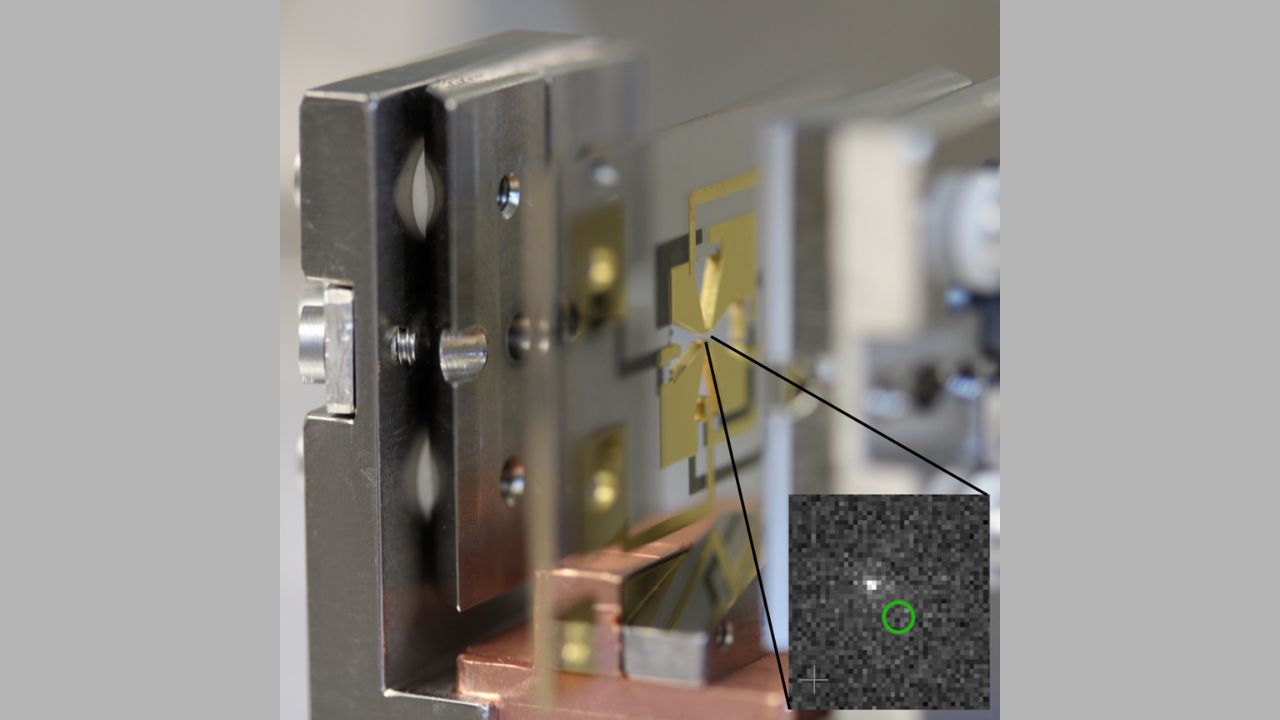
Another obstacle was the vacuum. Traditional steel chambers release small amounts of hydrogen, which collide with the ions and interfere with the measurement. The team changed the material to titanium, which reduced the presence of residual gas by 150 times, allowing the clock to operate for days without intervention — previously, it was necessary to recharge the trap every half hour.
The Most Stable Laser in the World Takes Center Stage
Even with the most stable ion and the most precise trap, there was still a need for a reference laser with minimal quantum noise. For this, NIST turned to Jun Ye from the JILA laboratory (affiliated with NIST and the University of Colorado), creator of the previous world record holder: the optical strontium clock.
Through underground optical fibers, the team connected Ye’s ultra-stable laser, located 3.6 km away, to the aluminum clock laboratory. A frequency comb — a kind of optical ruler — allowed the stability of Ye’s laser to be transferred to the new clock. The result: the measurement time to reach 19 decimal places dropped from three weeks to just a day and a half.
What Does This Change in Practice?
In addition to breaking a scientific record, the new aluminum ion atomic clock may have profound impacts:
- Redefinition of the Second: the international system is already discussing updating the definition of the second based on optical clocks that are more accurate than cesium;
- Exploration of Fundamental Physics: this level of precision can detect variations in the fundamental constants of nature, such as the fine-structure constant, paving the way for testing theories beyond the Standard Model of physics;
- Relativistic Geodesy: the clock can sense small variations in the Earth’s gravitational field, allowing for millimeter-precision altitude mapping — something useful in monitoring climate change, tectonism, and even space exploration;
- Quantum Technology: the quantum logic used can be adapted for quantum computers and ultra-precision sensors.
Time as a Tool for Discovery
“We are ready to explore new clock architectures — such as the entanglement of multiple ions — that could further elevate our measurement capability”, said Willa Arthur-Dworschack, a graduate student and co-author of the study published in Physical Review Letters.
Beyond seconds and tenths, this clock is a window into the invisible. By refining the way we measure time, scientists can reveal subtleties of the universe that have so far eluded human observation.








-

2 people reacted to this.