Portuguese
  Spanish


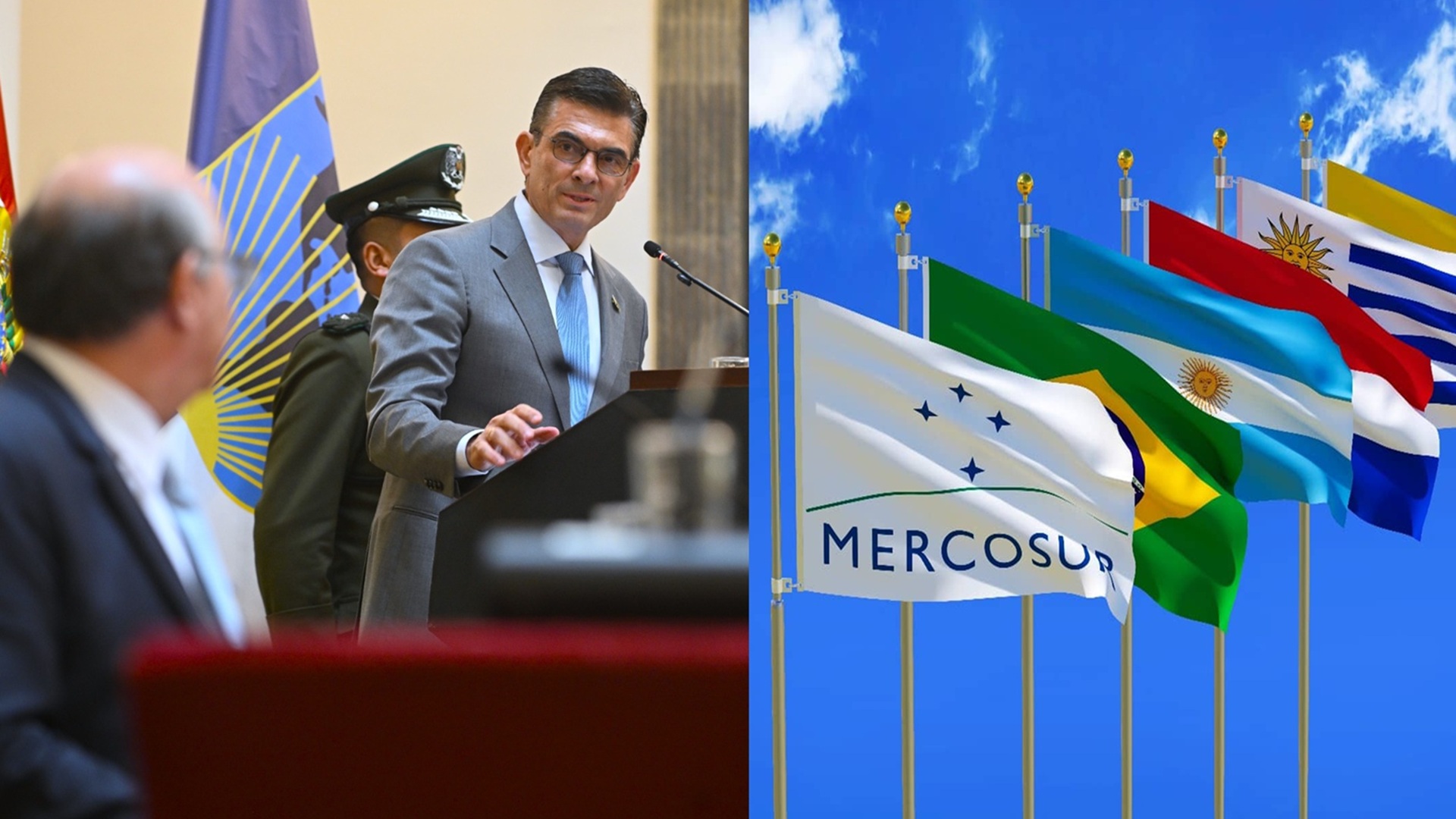

The Declaration Exposes the Discomfort of a South American Country That, Outside Mercosur, Points Out Economic Impacts, Trade Limitations, and Loss of Regional Influence, Stating That It Also Geographically, Politically, and Historically Integrates South America, but Remains Excluded from the Main Bloc of the Continent
The President of Bolivia, Rodrigo Paz, participated this Saturday in Asunción in the signing ceremony of the association agreement between Mercado Común del Sur and European Union, declaring a priority to break the country’s isolation and affirmed efforts to achieve full member status in the bloc.
Ceremony in Asunción Formalizes Key Stage of the Agreement
The signing took place in Paraguay, hosted by President Santiago Peña, and gathered European and Latin American authorities. The event follows decisions made on January 9 by the Council of the European Union, which authorized the signing of the association agreement and a provisional trade agreement between the parties.
With the formalization, a cycle of negotiations that extended over years between the two blocs comes to an end. The agreement foresees the creation of one of the largest free trade areas in the world, bringing together 720 million people and an estimated economic weight of about 22 billion dollars.
-
Ayatollah Ali Khamenei’s Funeral Draws 15 to 20 Million in Tehran, Calls for Revenge Against Trump After Joint Israel-U.S. Attack

-
U.S. Establishes Permanent Embassy in Jerusalem, Reigniting International Debate Over Israel’s Capital
-
The world has nearly 12,000 nuclear warheads, with the majority held by the United States and Russia; see the figures for China, France, and the United Kingdom.

-
Venezuela Faces UN Alert for Hunger, Disease, and Service Collapse After Earthquakes Cause Nearly 2,000 Deaths and $6.7 Billion in Damages


The ceremony was attended by the President of the European Commission, Ursula von der Leyen, and the head of the European Council, António Costa, along with other regional leaders, reinforcing the political and economic nature of the event.

Paz’s Speech Highlights Continental Integration and End of Isolation
In his speech, Paz stated that he would make “all efforts” for Bolivia to become a full member of Mercosur and that the country must emerge from the isolation it has faced over the last 20 years. The president declared that regional integration is part of a shared future project.
According to the leader, Mercosur integrates a continent that stretches from the North Pole to Patagonia, which represents economic and political power to be exercised for national development. He emphasized that Bolivia will soon join the bloc in the agreement with Europe.
Paz also stated that the first priority of his government is to break the isolation, a declaration that was met with applause from the leaders present. The speech linked full adherence to Mercosur with opportunities for development and greater international insertion.
Regional Projection and International Agenda of the New Government
According to an official statement, Paz’s participation in the event represents the first international commitment after taking office and is considered strategic for the regional and international projection of the country.
The message emphasizes stability, productive vocation, and job and investment generation.
The government stated that these meetings serve as tools to transform international opportunities into direct benefits for the population.
The announced agenda aims to position Bolivia as a reliable and predictable partner in regional and global value chains.
Paz declared that he would work to promote industrialization, productive modernization, and smart integration into international trade.
The approach, according to the statement, aims to bring Bolivia to the world and attract the world to the country through governability and responsible decisions.
Diplomatic Monitoring and Economic Priorities
The president traveled accompanied by Chancellor Fernando Aramayo. Bilateral meetings and dialogues focused on trade, investment, infrastructure, and regional cooperation are planned, reinforcing the practical dimension of the visit beyond the political symbolism.
On the eve, Paz announced the cancellation of his trip to the World Economic Forum in Davos, Switzerland. According to him, the circumstances of the economy require prioritizing internal organization, reserving international trips for moments considered necessary.
The decision was presented as part of a strategy with a domestic focus, without abandoning external integration.
The government reiterated that the presence in Asunción meets the premise that integration is only valid when it produces concrete results.
Situation of Bolivia in Mercosur and Obstacles to Full Membership
Despite favorable political signals, Mercosur still does not count on Bolivia as a full member. The country remains an Associated State, a condition that ensures cooperation and trade agreements, but without the right to vote on central decisions or the full adoption of the Common External Tariff.
The accession process made progress but has not been completed. Bolivia signed the Accession Protocol in 2015; however, full entry requires ratification by all national parliaments of the bloc, which did not occur simultaneously.
Internal political crises and changes in government in Mercosur countries have affected the pace of approvals. Accession depends on continuous political consensus among Brazil, Argentina, Paraguay, and Uruguay, a factor that has caused delays over the years.
Moreover, the condition of full membership requires the harmonization of external tariffs, customs regulations, and trade rules. Some of these adjustments are technical and take time, especially for smaller economies, which contributed to the prolongation of the process.
Prospects After the Signing with the European Union
With the signing of the Mercosur-European Union agreement, the regional scenario gains new momentum. Politically, the bloc signals openness to Bolivia, while, in practice, final ratifications and regulatory adjustments for complete formalization remain pending.
The Bolivian government assesses that the new context increases the relevance of integration and strengthens the argument for accelerating full membership.
The official expectation is that participation in the agreement with Europe will strengthen the country’s position in internal negotiations within Mercosur.
In summary, Bolivia is not excluded but is in an unfinished process. The signing in Asunción repositions the debate, associates regional integration with economic results, and reestablishes full membership as a declared objective of the new government, despite remaining obstacles and the need for procedural advances.