Portuguese
  Spanish


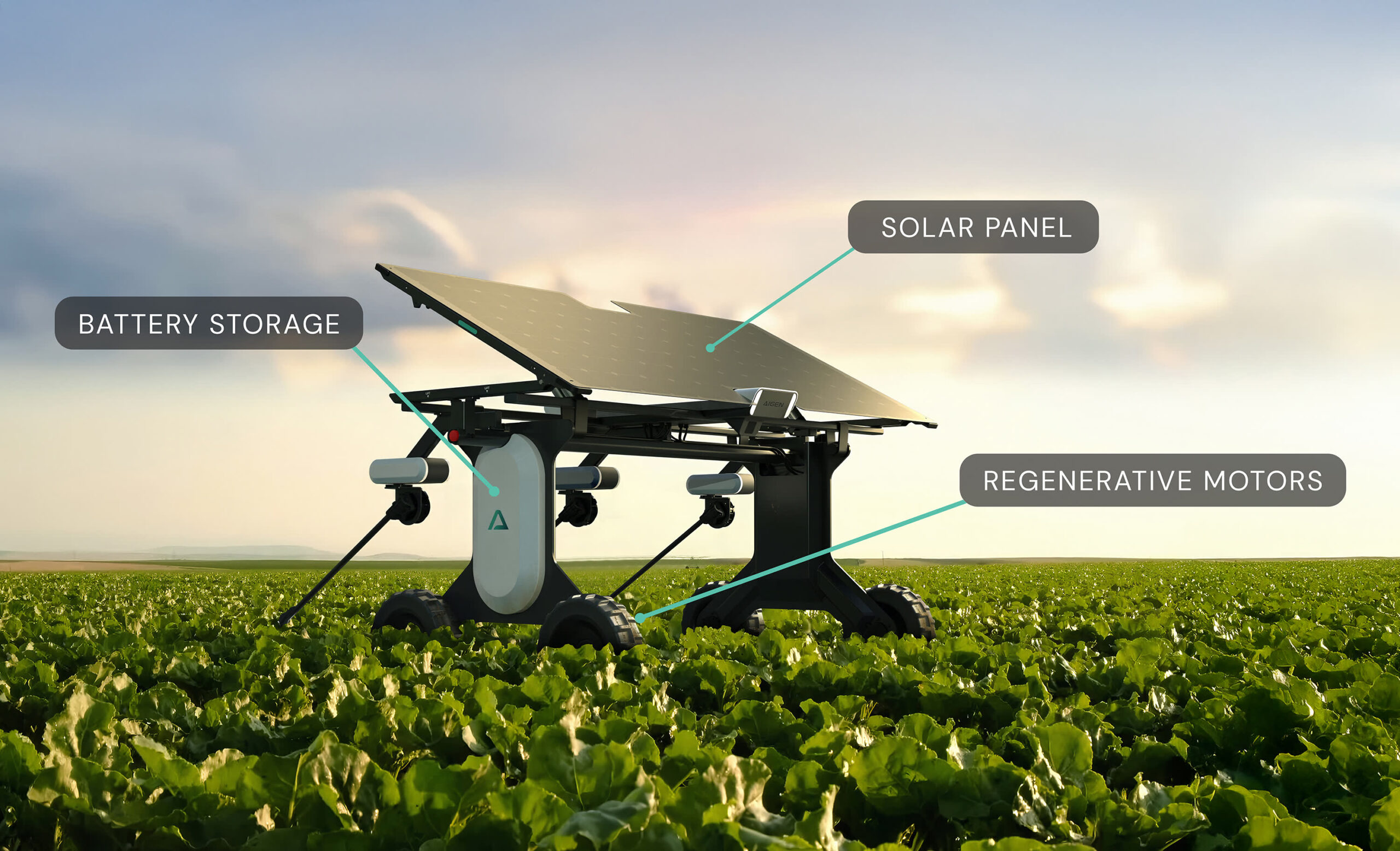

Aigen places solar robots with AI to weed without herbicide, enhance field precision, and tackle resistant weeds.
Aigen, an agricultural technology startup from the United States, has deployed a system of autonomous solar-powered robots in the field for daily weed control. Named Element, the platform uses computer vision, embedded AI, and mechanical action on the soil to eliminate invasive plants without applying herbicides, in an attempt to simultaneously address chemical resistance of weeds, pressure to reduce inputs, and labor shortages in the field.
The proposal has already moved beyond the concept phase. In April 2025, the company announced the arrival of Element gen2, a version based on more than 10,000 hours of real use on farms, with expansion to cotton, soybean, and beet crops, while Tech Brew reported that there were 50 units being tested and that the company was seeking to expand the commercial presence of the technology in the United States.
Solar robots for resistant weed control gain ground in precision agriculture
The advancement of Element is linked to an increasingly costly problem for agribusiness: the rise of herbicide-resistant weeds.
-
Brazilian Farmer Invents Low-Cost Tractor Using Motorcycle Parts, Efficiently Working 2 Acres on 1 Liter of Diesel

-
Regenerative Farmers Use Keyline Plow to Improve Pasture Hydration, Storing 1 Gallon of Water Every 30 Centimeters

-
Bicolor Pumpkin Resembling Hand-Painted Art Discovered by Brazilian Researchers in the Capital Due to “Spontaneous Mutation”

-
In China, a 26-story building produces 1.2 million pigs annually, revolutionizing livestock farming with tube feeding and AI surveillance.


Tech Brew reports that the repeated use of chemicals over the years has helped select plants that no longer respond in the same way to traditional products, increasing costs and complicating management in various agricultural areas.
It was in this scenario that Aigen positioned its technology. On the company’s website, Element is described as an autonomous team of robots that patrols the field every day, uses AI to locate and precisely target weeds, and reduces dependence on chemical products, with the promise of maintaining continuous weed control.


The logic of the project is to replace broad spraying with surgical intervention. Instead of spreading herbicide over the crop, the robots identify the target and execute precise mechanical strikes on the soil, aiming to preserve the main crop and reduce the use of chemical inputs.
Element combines solar energy, batteries, AI cameras, and mechanical action on the soil to weed without herbicide
Aigen claims that its robots operate with 100% solar energy, supported by onboard battery storage.
The company also highlights that the system is designed to work in real farming conditions, including rain, mud, slopes, and uneven terrain, with all-wheel drive and a structure designed to last several harvests.
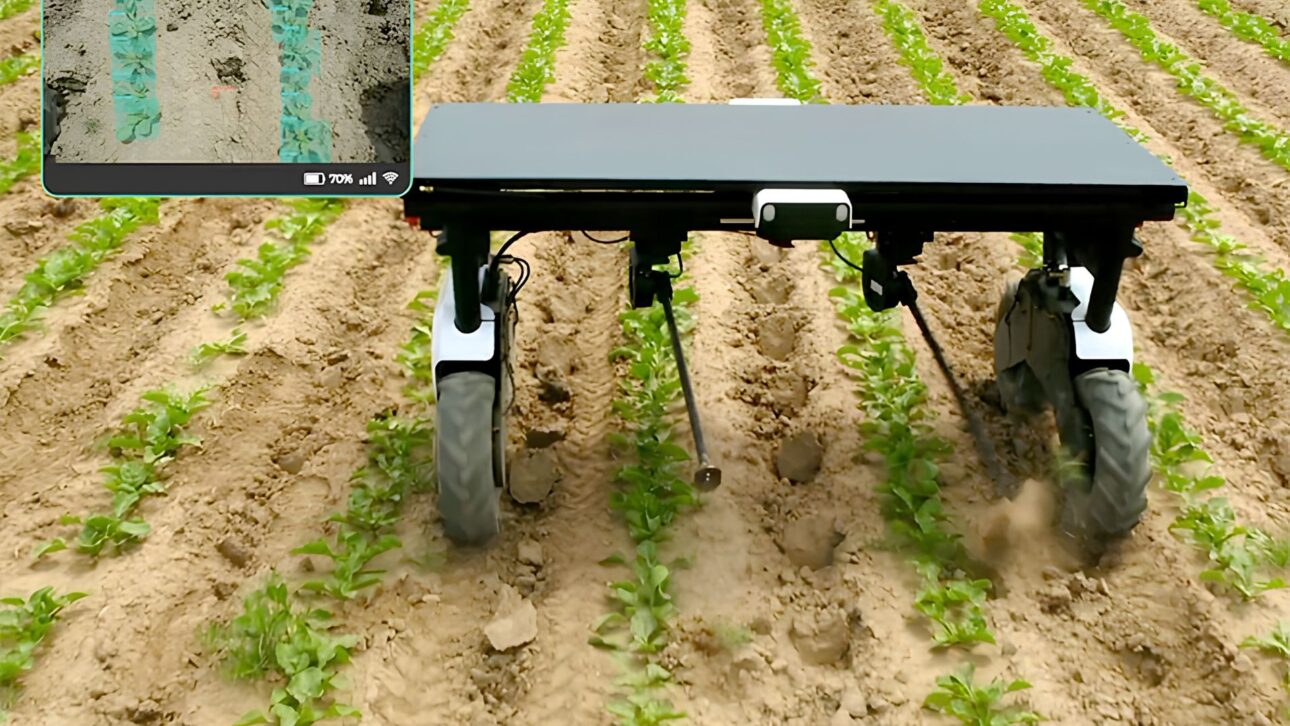
The weed identification part relies on computer vision. Tech Brew reported that Element uses AI cameras to distinguish invasive plants from commercial crops and understand plant anatomy, allowing the system to select the target and send control signals to the motors that perform mechanical removal.
In the second generation, Aigen reported that the robot gained 50% more solar capacity, 4 times more onboard computing power, and stereo depth vision, a technical package created to improve detection and precision in attacking weeds at different growth stages.
Mesh network and continuous data collection transform weeding into daily crop monitoring
Besides weeding, the company presents Element as a field coordination platform. On the official website, Aigen says that the robots communicate via a smart mesh network, allowing them to act as a team, adapt to areas with higher weed pressure, and operate with little or no human intervention.
Tech Brew adds that the system also collects agronomic data while navigating the field. According to the publication, the robots build detailed maps of the area and generate metrics such as stand count and weed pressure, expanding the machine’s role beyond simple mechanical removal.

This design helps reposition the equipment within precision agriculture. Instead of entering the field only for a one-time operation, Element is designed to circulate daily, observe the crop, record variations, and perform continuous management based on automated environmental readings.
Element gen2 now operates in cotton and expands Aigen’s presence in soybeans and beets
On April 22, 2025, Aigen officially announced the Element gen2 in partnership with the Bowles Farming Company, a family farm in California. According to the statement, the robotic teams started working in cotton fields during the 2025 season, marking the company’s entry into new types of crops.
Future Farming reported that the new model was designed with a wider and taller structure, which increased compatibility with cotton, soybean, and beet rows. The publication also stated that each robot can cover up to 20 acres autonomously and that, in 2025, the company had 50 operational units, of which 30 were running on three farms.
The expansion reinforces that Aigen is already in the commercial validation phase, not just technical demonstration. The company itself put the system up for sale with deliveries expected in 2026, while the use in cotton has become a showcase to test performance on a real agricultural scale.
Cost and scale are still the main bottlenecks for solar robots in agribusiness
Despite the technical advancement, scale remains the biggest challenge. Tech Brew reported that Aigen’s robots could weed between 20 and 40 acres per season, a performance that is still far from the size of many American farms, which limits widespread adoption without forming larger fleets.
The cost of operation also weighs in. Future Farming reported a price of US$ 50,000 per unit, plus an additional fee of US$ 20,000 per fleet for system coordination and software services, a cost that requires a clear efficiency gain to justify large-scale investment.
Even so, the technology has already established itself as one of the most visible bets of the new phase of robotic agriculture. By combining solar energy, embedded AI, mechanical weed removal, and continuous field operation, the Element enters the race for a production model less dependent on herbicides and more driven by automation, data, and precision.