Portuguese
  Spanish


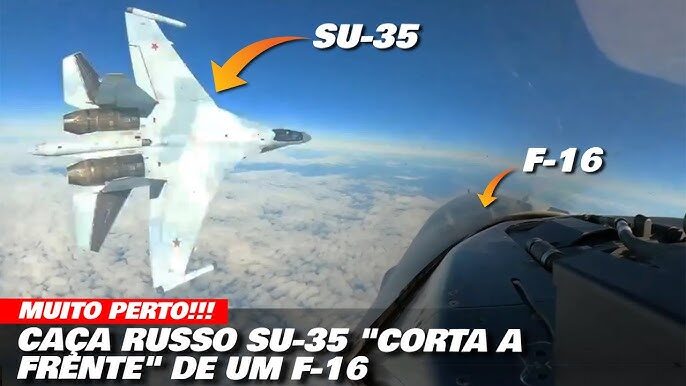

Russian Su-35 Nearly Collides With American F-16 in Dangerous Maneuver off the Coast of Alaska. The Action, Labeled as “Unprofessional” by NORAD, Occurred During a Routine Intercept and Reignites Concerns Over Safety in Military Operations. Tensions in the Arctic Rise With Frequent Russian Interceptions.
In the vast and icy sky over the coast of Alaska, a breathtaking incident exposed the fragility of peace among the world’s major military powers.
The tension in international airspace reached new heights when, in a split second, a Russian Su-35 fighter jet almost collided with an American F-16, prompting what experts describe as a true “air duel.”
According to the portal Aeroin, this confrontation, which could have ended in disaster, is now sparking heated discussions about security limits and the dangers of risky maneuvers among the armed forces.
-
U.S. Navy’s Ticonderoga-class Cruiser Becomes a 9,800-Ton Missile Fortress with Advanced Aegis System Capable of Tracking Hundreds of Targets

-
France’s Charles de Gaulle: The Sole Nuclear-Powered Aircraft Carrier Outside the US, Weighing 42,500 Tons and Equipped with Two Atomic Reactors

-
The military spaceplane that almost took the Cold War into orbit: Boeing X-20 Dyna-Soar was designed to re-enter above Mach 20, fly for up to 40 hours, land like a plane, and transform Titan rockets into a gateway to a new era of orbital warfare.
-
FAB bets on national drones and increases investments to strengthen the Brazilian aerospace industry



The Confrontation That Shook the Skies
On September 23, 2024, the North American Aerospace Defense Command (NORAD) reported a dangerous incident involving a Russian Su-35 aircraft and an F-16 from the United States Air Force.
The incident occurred during a routine intercept in international airspace, specifically in the Alaskan Air Defense Identification Zone (ADIZ), where NORAD fighters were monitoring the presence of Russian military aircraft.
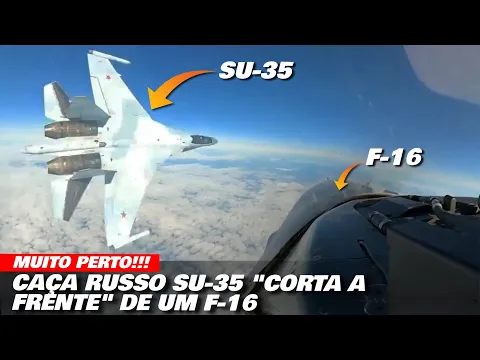
According to NORAD, the operation was proceeding relatively smoothly until the Russian Su-35 executed a reckless maneuver known as a “headbutt,” dangerously cutting in front of the F-16.
The action, classified as “unprofessional” and “unsafe,” was deemed to be a move that endangered both the lives of the involved pilots and the aerial safety of the region.
NORAD’s Reaction and the American Response
Immediately following the incident, General Gregory M. Guillot, NORAD commander, took to social media to express his concern and condemn the actions of the Russian air force.
“NORAD aircraft executed a safe and disciplined intercept, but the behavior of the Su-35 was reckless and dangerous,” Guillot stated, highlighting that this type of conduct does not align with the standards expected of a professional air force.
This episode gained even more attention as it occurred amid a significant increase in Russian and Chinese military activities in the region.
Only in September, Russian aircraft violated the Alaskan ADIZ on four occasions, according to NORAD, highlighting a pattern of behaviors that heighten tensions in the Arctic.
Risky Maneuvers: Imminent Danger?
This was not the first time Russian fighters engaged in risky maneuvers near Western aircraft.
According to NORAD sources, similar incidents have occurred in other scenarios, such as Syria in 2023, where Russian planes came dangerously close to American fighters and drones.
However, these aggressive encounters had decreased in recent months in the Middle East, while the focus seems to have shifted to the Arctic.
The “headbutt” maneuver performed by the Russian pilot, which involves sharply cutting in front of another aircraft, is extremely dangerous due to the high speeds at which these aircraft operate.
Images captured by the F-16 show the exact moment when the Su-35 swiftly passed in front of the American fighter, provoking a reaction of surprise from the American pilot, who could be heard clearly exclaiming his disbelief over the proximity of the Russian aircraft.

Increase in the Frequency of Interceptions
The F-16 involved in the incident likely belongs to the 18th Fighter Interception Squadron, a military unit of the US based at Eielson Air Force Base in Alaska.
This unit is responsible for conducting interceptions of Russian and, recently, Chinese aircraft entering the Alaskan ADIZ.
Intercepts of this nature have become increasingly frequent, with Russia and China conducting military flights in international airspace near US territory.
According to Lieutenant General Case Cunningham, head of NORAD’s Alaska Region, the US Air Force is prepared to respond whenever foreign forces violate the Alaskan ADIZ, ensuring that these interceptions occur safely and in a disciplined manner.
He added that although the action was dangerous, the Russian aircraft remained in international airspace, an important detail to avoid greater diplomatic conflicts.
What Lies Behind the Rising Tensions in the Arctic?
This type of incident is not isolated and is part of a larger scenario involving the competition for control of strategic areas, such as the Arctic, where global warming has opened new maritime routes and access to vast natural resources.
For many experts, the increase in Russian and Chinese military activities in the region is a direct reflection of this new geopolitical context.
With the growing militarization of the Arctic, NORAD has intensified its operations and increased surveillance of any suspicious movements in the region.
According to military analysts, the contest for influence in the Arctic may intensify even further in the coming years, especially as maritime routes become increasingly navigable.
What Does the Future Hold?
The incident between the Russian Su-35 and the American F-16 highlights the fragility and inherent danger of military operations in sensitive areas such as the Arctic.
The frequency of risky encounters and dangerous maneuvers raises the question of how far these confrontations might escalate.
Reckless actions in international airspace, such as that of the Russian pilot, increase the risk of serious accidents or even international conflicts.
Do these incidents represent just a glimpse of a more dangerous and unpredictable future among global military powers?