






 Portuguese
  Spanish


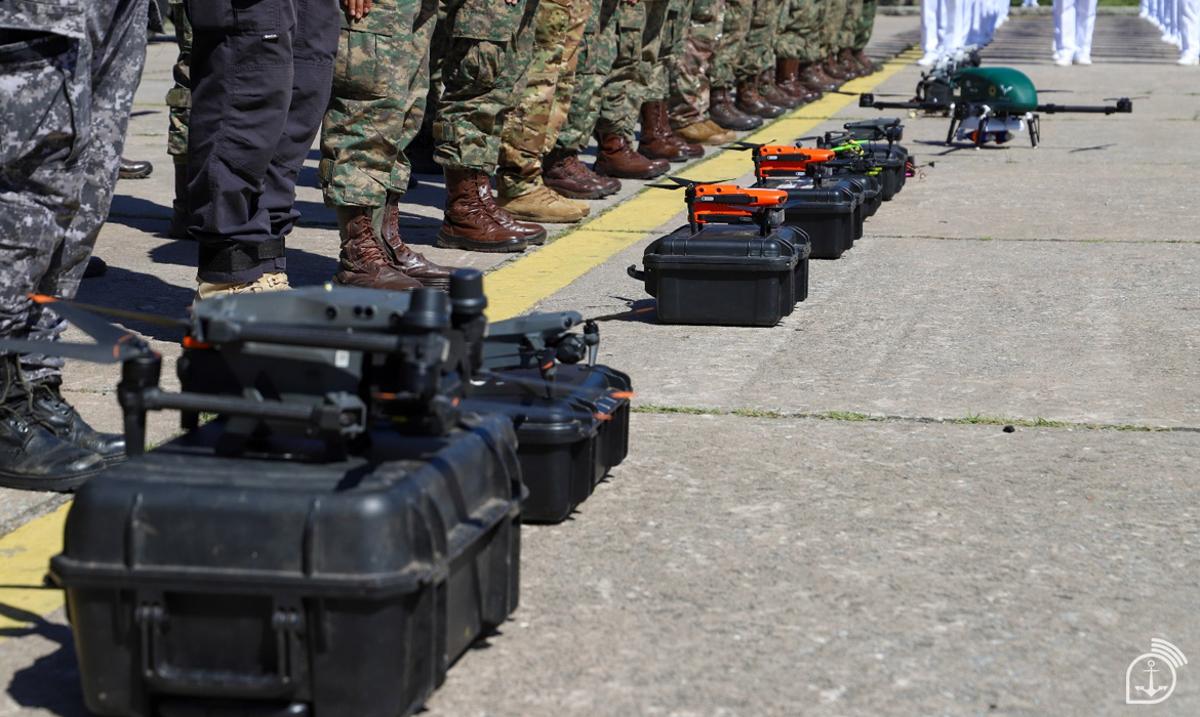
The Navy Prepares To Establish A Drone School After Workshops And Competitions Held In November 2025 That Reinforce The Technological Evolution Of The Marines
The Brazilian Navy announced, on November 26 and 27, 2025, during the 1st Workshop on the Employment of Drones and the 1st Military Drone Championship, held at the Almirante Sylvio de Camargo Instruction Center (CIASC) in Rio de Janeiro, that it will create, in 2026, the Drone School of the Marines. Rear Admiral Luis Manuel de Campos Mello, commander of CIASC, explained that the lessons learned from the event will structure the new training.
Course Structure And Technical Criteria
According to the Admiral, the initial course will cover drones of types 0 and 1, used by operators who do not hold professional qualifications. Thus, the training will expand the mastery of technology across different Navy units. Although the course will initially be exclusive to military personnel of the Force, it may serve other institutions in the future, demonstrating a gradual strengthening of operational capacity.
The event brought together over 400 national and international participants, which consolidated the workshop as a space for integration, innovation, and doctrinal testing. As highlighted by Corvette Captain Diego Sabá, a researcher at the Command of Doctrinal Development, all tactics observed, adaptations presented, and creative solutions displayed will be transformed into Lessons Learned, which will feed curricula and manuals.
-
U.S. Navy’s Ticonderoga-class Cruiser Becomes a 9,800-Ton Missile Fortress with Advanced Aegis System Capable of Tracking Hundreds of Targets

-
France’s Charles de Gaulle: The Sole Nuclear-Powered Aircraft Carrier Outside the US, Weighing 42,500 Tons and Equipped with Two Atomic Reactors

-
The military spaceplane that almost took the Cold War into orbit: Boeing X-20 Dyna-Soar was designed to re-enter above Mach 20, fly for up to 40 hours, land like a plane, and transform Titan rockets into a gateway to a new era of orbital warfare.
-
FAB bets on national drones and increases investments to strengthen the Brazilian aerospace industry



Thematic Panels And Institutional Cooperation
The workshop was organized into three panels. The first discussed the use of drones in contemporary conflicts and included representatives from the United Nations, CTDDCFN, and the French Navy. The second panel then addressed employment in different Brazilian Armed Forces, bringing together officers from the Army, Navy, and the Joint Peace Operations Center. Shortly after, the third panel covered the use in urban environments, with participation from the Civil Police, Military Police, and national drone manufacturers.
Agent Brunna Lopes from the Civil Police of Rio de Janeiro highlighted the advancement of police operations with drones and reinforced the importance of technical training. She emphasized that technology has transformed investigations and enhanced the accuracy of intelligence actions.
Competitions And Military Performance Evaluation
The 1st Military Drone Championship included the categories Manoeuver, Simulated Attack, Reconnaissance, and Innovation. Thus, teams were evaluated based on precision, creativity, and adaptability. As Sabá explained, the goal was to test not only technique but also cognitive ability and efficient use of onboard sensors.
Among the highlights, Soldier Gabriel de Ávila from CIASC won the Manoeuver category, while Soldier Ryan Pereira Santos from the Air Combat Battalion won Reconnaissance. Both emphasized that the competition raised the level of operational readiness.
Technological Exhibitions And Practical Applications
In addition to the competitions, companies such as Condor, Modirum/Gespi, and Macjee showcased national aircraft and systems. According to Sabá, drones act as force multipliers, as they enhance situational awareness, reduce risks, and can deliver precise effects in real operations, as observed in recent conflicts in Eastern Europe.
He also highlighted that drones strengthen Civil Defense actions because thermal sensors identify victims in hard-to-reach areas, even at night. Thus, technology proves essential for humanitarian missions and expeditionary operations of the Marines.
Expected Impact With The Establishment Of The Drone School
Based on the lessons from the 2025 event, the Navy anticipates that the Drone School, planned for 2026, will strengthen operational capacity, standardize tactics, and enhance integration among units. Additionally, the project consolidates the adoption of remotely piloted aerial systems as a central part of modern military training.








-

1 person reacted to this.