






 Portuguese
  Spanish


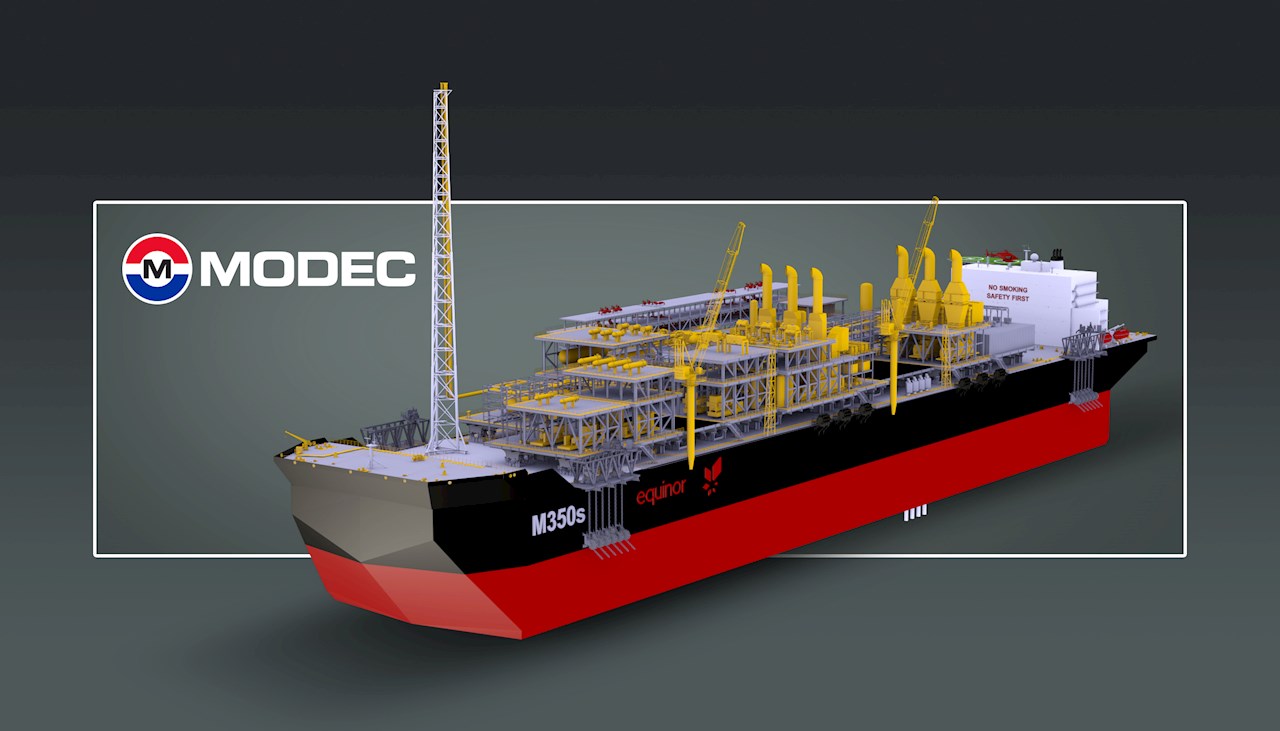

Modec Was Hired by Equinor, Aiming to Construct an FPSO to Be Installed in the Campos Basin
MODEC, a Japanese FPSO provider, has signed a Sale and Purchase Agreement (SPA) with Equinor Brasil Energia Ltd to provide a floating production, storage and offloading vessel (FPSO) intended for the cluster formed by the Pão de Açúcar, Seat, and Gávea fields in the Campos Basin offshore Brazil. This project, recently sanctioned by Equinor, Norway has recoverable natural gas and condensate oil reserves exceeding one billion barrels of oil equivalent, with investments of around US$ 9 billion.
Complex FPSO in the Campos Basin Focusing on Greenhouse Gas Emission Reduction
The FPSO to be provided by MODEC for Equinor in the Campos Basin offshore project is described as “one of the most complex installations in MODEC’s history.” It will have the capacity to handle large volumes of exported gas, with a primary focus on reducing greenhouse gas (GHG) emissions in the Campos Basin. The project is expected to begin operations in 2028 in the Campos Basin, with the selected concept based on an FPSO capable of processing gas and condensate oil and specifying them for sale without the need for further processing onshore.
The BM-C-33 block, where MODEC’s FPSO and Equinor will operate, in the Campos Basin, was discovered by Repsol Sinopec in 2010, and Equinor took over the operation in 2016. Equinor’s stake in this block is 35%, while Repsol Sinopec Brasil and Petrobras hold 35% and 30% stakes, respectively. In March 2021, the partners approved the development concept for BM-C-33, and Equinor made the final investment decision to develop the project in May 2023.
-
France Revamps 530 Social Housing Units with Large Balconies and Glass Facades Without Demolishing Existing Buildings

-
10-Year-Old Max Makes History with Paris Fashion Show, Launches Own Brand, Hires Staff, and Sets World Record as Youngest Runway Designer

-
Bolivian Female Construction Workers Form Association to Combat Discrimination and 38% Pay Gap in the Industry
-
Near Amsterdam, residents buy land and discover they must also build streets, manage drainage, handle waste, and grow food on half their plot.




Greenhouse Gas Emission Reduction and the Role of MODEC’s FPSO
The FPSO provided by MODEC for Equinor in the Campos Basin offshore project is designed with the capacity to reduce greenhouse gas (GHG) emissions in the atmosphere. The floating facility will be able to handle large volumes of exported gas, which is crucial for the project. With MODEC’s selection to provide this complex vessel, the Japanese company reinforces its leading position in the global FPSO market. The project in the Campos Basin also emphasizes the importance of the offshore industry in the energy transition, focusing on sustainable and efficient operations.
With the contract signed, MODEC and Equinor Brasil Energia are working together to ensure that all project specifications are met. MODEC’s FPSO will be crucial to the success of the Campos Basin offshore project, providing the capacity to process large volumes of gas and oil/condensate while reducing GHG emissions.








