






 Portuguese
  Spanish
  5 min of reading
  0 comments


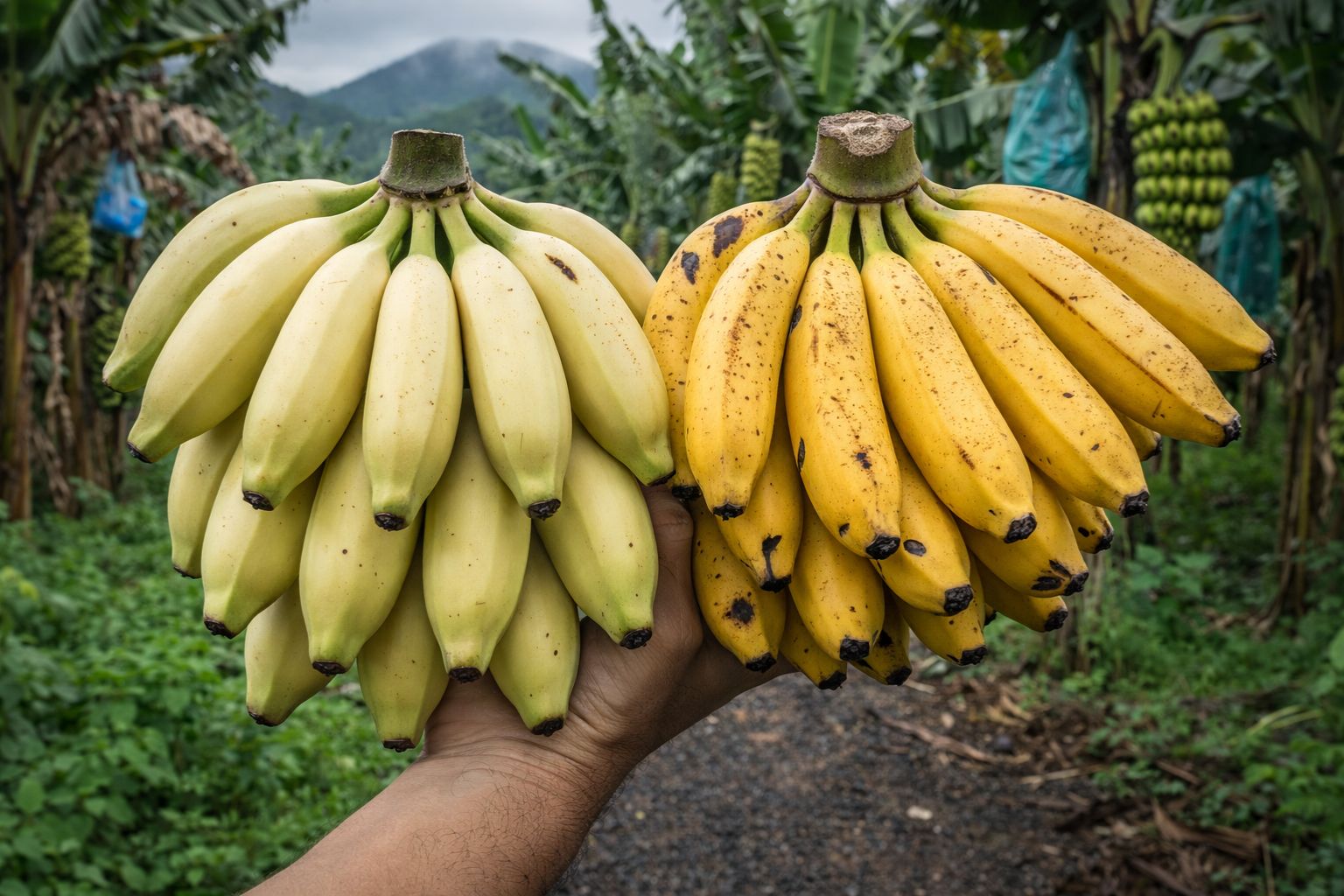
The Clarinha banana was discovered in Luiz Alves, in the Itajaí Valley, as a natural mutation of the caturra. With 43% less chlorophyll in the peel, the new variety darkens more slowly after harvest and has just received official registration from the Ministry of Agriculture for commercialization throughout Brazil.
A new variety of banana has just received official registration in Brazil, and the most surprising thing is that no one created it in a laboratory. The Clarinha banana (SCS455) emerged spontaneously in the municipality of Luiz Alves, in the Itajaí Valley, Santa Catarina, one of the main fruit-producing regions in the country. Originating from a natural mutation of the caturra banana, the Clarinha has a lighter and shinier peel, with approximately 43% less chlorophyll, a characteristic that significantly delays the darkening of the fruit after harvest. The cultivar is now registered in the National Cultivar Registry of the Ministry of Agriculture (RNC-Mapa), under number 58,447.
The identification of the Clarinha banana was not a result of careless chance. Epagri (Agricultural Research and Rural Extension Company of Santa Catarina) began validation studies in 2018 when it noticed that some plants in Luiz Alves produced fruits that were visibly different from the others. The trials confirmed that the Clarinha maintains productivity equivalent to traditional caturra bananas but adds an aesthetic differential that can transform the commercialization of the fruit, especially in winter when darkening on the shelves is more pronounced and commercial losses increase.
What makes the Clarinha banana different from traditional varieties

According to information from the portal Canal Rural, the most evident difference is in the peel. The Clarinha banana has a lighter and shinier color than the conventional caturra, a direct result of the 43% reduction in chlorophyll content. This lower concentration of chlorophyll is what delays the darkening process after harvest, a problem that affects the entire commercialization chain of bananas in Brazil, from the rural producer to the supermarket shelf.
-
Low-Demand Brazilian Beef Offal Gains Popularity Abroad: Indonesia Purchases $19.5 Million, Boosting Revenue and Reducing Waste

-
Soy Expansion in Former Brazilian Savanna Sparks Water and Land Conflicts in Major Agricultural Frontier
-
Mexican Pest Threatens U.S. Cattle Herds at Historic Lows, Potentially Boosting Brazilian Beef Exports as Burger Prices Soar

-
Avocado Boom for European and U.S. Markets Fuels Water Crisis in Drought-Stricken Chilean Region




In practice, this means that the Clarinha banana remains visually appealing for a longer time after being harvested, reducing the losses that occur when the fruit darkens too quickly and the consumer rejects it for being considered old. For producers and retailers, this characteristic has direct economic value: less banana discarded means more banana sold with the same amount produced. The mutation that nature created in Luiz Alves biologically solves, without genetic manipulation, one of the oldest problems in the trade of this fruit.
How nature created the Clarinha banana without human intervention
The Clarinha is the result of a spontaneous somatic mutation, a biological process in which the genetic material of a plant undergoes natural alteration during cell division. This type of mutation occurs without any human interference and can produce plants with new characteristics, such as different color, altered size, or, in the case of the Clarinha, lower chlorophyll content in the peel. The caturra banana, from which the Clarinha originated, is one of the most cultivated varieties in Santa Catarina and Brazil.
At some point, a caturra plant in Luiz Alves underwent this mutation and began to produce bunches with visibly lighter fruits. Local producers noticed the difference and reported it to Epagri, which began studies in 2018 to determine if the variation was stable, reproducible, and commercially viable. After years of field and laboratory trials, researchers confirmed that the mutation is maintained in the plants propagated from the original, which means that the Clarinha banana can be multiplied and cultivated on a commercial scale without losing its distinctive characteristics.
What the official registration at the Ministry of Agriculture means for the Clarinha banana
With the registration in the National Cultivars Registry under number 58,447, the Clarinha banana is now eligible for commercial use throughout Brazilian territory. The seedlings can be purchased from registered producing companies in the National Seed and Seedling Registry (Renasem), which ensures traceability and quality control in the propagation of the new variety. Without this registration, the commercialization of Clarinha seedlings would be irregular.
The registration also positions Santa Catarina as a reference in banana cultivar diversity. With the Clarinha, the state now has six identified varieties, with highlights for municipalities like Luiz Alves and Corupá, which are already recognized as production hubs for the fruit. “The registration of new cultivars demonstrates the innovative capacity of Santa Catarina’s agriculture and the role of the Ministry of Agriculture in ensuring safety, traceability, and competitiveness for the sector,” emphasized Ivanor Boing, superintendent of Mapa in Santa Catarina.
Why the Clarinha banana could change the market in winter
The darkening of bananas on the shelves is a seasonal problem that worsens in winter. With lower temperatures and less light, the ripening and darkening process of the peel accelerates, causing the banana to lose visual appeal in less time. For supermarkets and markets, this means losses that can reach significant percentages of the purchased volume, especially in the South and Southeast regions of Brazil.
The Clarinha banana offers a natural advantage for this scenario. Since its peel darkens more slowly due to the lower chlorophyll content, the fruit maintains a commercial appearance for longer, which can reduce losses in retail and increase the profitability of producers in Santa Catarina, especially during the cold months. If the Clarinha confirms the performance observed in Epagri trials on a commercial scale, it could become the preferred variety for marketing in winter, when conventional bananas suffer more from darkening.
What producers interested in the Clarinha banana need to know
For those wishing to cultivate the new variety, the first step is to wait for the availability of certified seedlings. The Clarinha banana can only be commercially propagated by companies registered with Renasem, which ensures that the seedlings sold maintain the genetic characteristics of the original cultivar. Buying seedlings from uncertified sources may result in plants that do not reproduce the light peel and delayed darkening that define the Clarinha.
The productivity equivalent to the traditional caturra banana is an important factor for the planting decision. Producers do not need to sacrifice production volume to achieve the aesthetic differential, making the transition from caturra to Clarinha economically viable without increased risk. For banana cultivation in Santa Catarina, which already accounts for a significant share of national production, the new variety could represent a competitive advantage that literally emerged from the ground, without investment in biotechnology or conventional genetic improvement.
Nature has created a banana that darkens more slowly on its own, and now the Clarinha has official registration to be sold throughout Brazil. Would you buy a banana based on the appearance of its peel? Do you think varieties like this can reduce food waste? Leave your opinion in the comments.





Be the first to react!