






 Portuguese
  Spanish


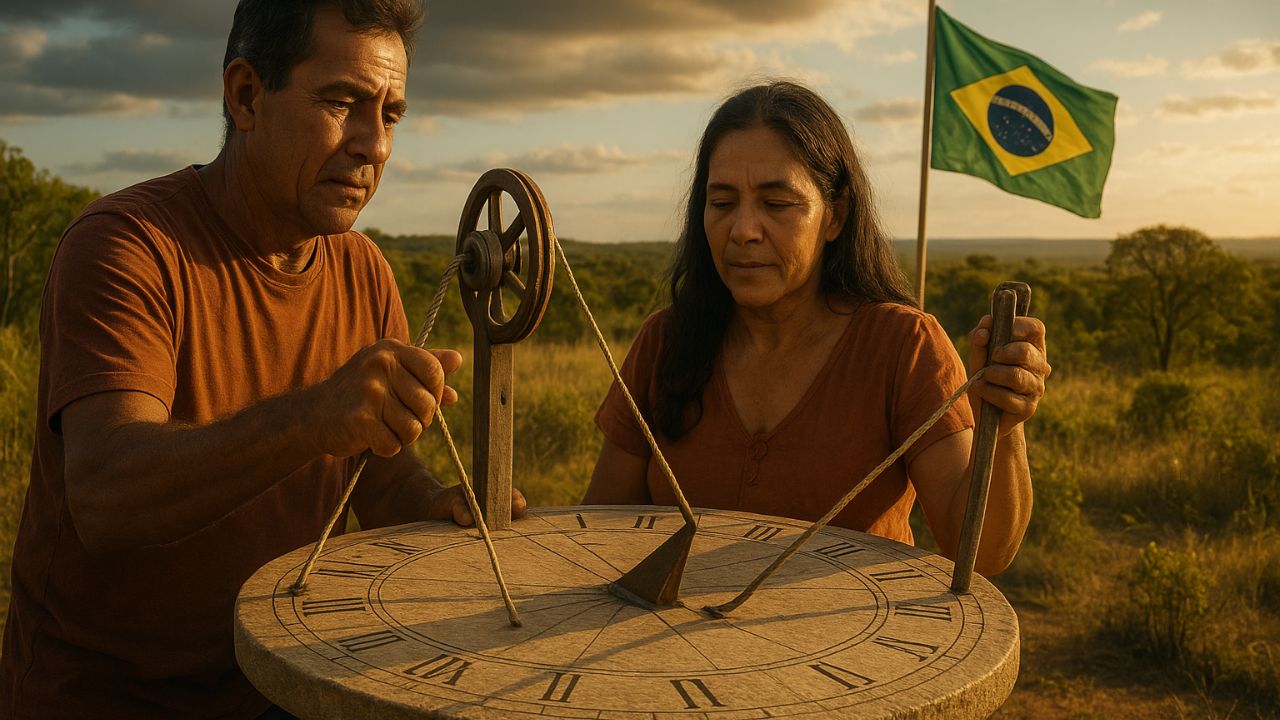


The “Sundial of Goiás” Is an Experiment in Temporal Sovereignty: Life Guided by the Cycles of the Earth and the Moon, Challenging the Tyranny of Chronological Time and Modern Technology.
The lifestyle adopted by a Brazilian couple in the interior of Goiás, who deliberately rejects the modern calendar, clocks, and all technological infrastructure (including electricity and media), transcends the simple choice for an off-grid life. It is a profound existential and practical manifesto that repositions human experience of time, transferring control of the rhythm of life from social conventions (measured time) to the immutable cycles of nature (lived time). This sociological experiment in the Cerrado is a radical quest for self-sufficiency and psychosocial health, proving that it is possible to live productively guided only by observation of light and lunar cycles.
The decision to abandon clocks and calendars is the ultimate manifestation of a broader global movement, Slow Living, but the Brazilian couple radicalizes it, seeking total temporal sovereignty. The absence of a clock becomes more than a matter of convenience; it becomes an existential statement, altering the very foundation of life. This change implies a migration from the paradigm of imposed precision and linearity (Chronos) to that of perceived opportunity and cyclicality (Kairos). The rejection of quantified time allows the focus of well-being to shift from the metric of “doing more in less time” to the wisdom of “doing the right thing at the right moment”.
The Temporal Compass: The Gnomon and the Distinction Between Chronos and Kairos

The reengineering of temporality is the central challenge of the experiment. The couple needed to replace the precise measurement systems of industrial society with natural markers, not just knowing whether it is day or night but determining the exact moment for agricultural and subsistence tasks.
-
Brazilian Town Known for Its Steady Winds Impresses with Cutting-Edge Hospitals, Clean Air, and Peaceful Living Just Three Hours from São Paulo

-
Animal Thought Extinct for 130 Years Reappears in Brazil, Exciting Scientists with Rare Comeback
-
German Sailor Found Mummified on His Boat in the Philippines, Leaving Scientists Puzzled by an Unbelievable Detail
-
Brazilian Couple Trades Motorhome for “Houseboat” Adventure on Historic Welsh Canal with Unique Challenges


The Sun, through the sundial or gnomon, is the direct substitute for the mechanical clock. The gnomon marks the hour by the shadow cast. However, if the Brazilian couple rejects the mathematics of modern time (Chronos) and legal conventions (such as time zones), their gnomon is not a legal precision instrument, but rather a tool of observation and approximation.
Its value does not lie in second precision, but in alignment with the cyclical and biological time of the body, functioning as a marker of Kairos, the opportune moment to begin or end an activity. As explained by the Izabella Camargo Channel, Chronos is linear and measurable time, the primary generator of stress in modernity, while Kairos represents qualitative time, the “opportune moment” that should be seized at the exact instance. The couple’s life is a continuous search for this Kairos – there is no fixed deadline, but there is the right moment dictated by nature’s signals.
Rejection of the Tyranny of Arbitrary Deadlines
The transition from dependence on the clock to dependence on the natural cycle is fundamentally a philosophical transformation. The Brazilian couple seeks to escape the “tyranny of Chronos”, the linear time that governs social interaction and work schedules.
The ineffective management of Chronos is linked to task overload and anxiety in modern life, where important opportunities (Kairos) go unnoticed, according to the analysis of the Izabella Camargo Channel. By eliminating external Chronos, the couple manifests an extreme subjective time where the present, with its circumstances, tends to occupy total focus, dissolving imagined urgencies of the future.
Ancient Precision Agriculture: The Lunar Compass and Agroecology
The modern calendar is replaced by the 29.5-day lunar cycle and the seasonal rhythm of the Cerrado, which primarily divides into dry and rainy seasons. Ancestral agriculture in Brazil traditionally uses the lunar cycle as a practical guide.
This practice is based on the principle that the gravitational force of the Moon induces the movement of sap in plants, making certain phases more conducive for specific activities. The Equipa Center Blog details the practical use of the lunar calendar in agroecology, which becomes the pillar of the “Rhythm of the Earth” for the Brazilian couple:
- Waxing Moon: The upward flow of sap is crucial for the superior development of the plant, making this phase ideal for planting crops that are harvested above ground, such as fruits (tomato, pumpkin) and fast-growing greens.
- New Moon: The concentration of sap occurs more in the stems and roots. This makes it the ideal period for planting tubers and roots (cassava, potato) and leafy greens that develop closer to the soil.
The full adoption of these natural rhythms validates the complexity of traditional knowledge. Such systems are not “archaic,” but rather resilient agroecological production systems, often more innovative in their resource management than intensive models.
The Cost of Disconnection: Improvisation and Informational Vacuum
The decision to live without clocks and calendars is inseparable from the rejection of modern technology. This technological boundary defines the scope of the couple’s world and imposes significant logistical challenges in managing safety, comfort, and information.
Living without electricity requires a complete reengineering of basic functions. The absence of electric pumps necessitates mastery of manual techniques or the utilization of gravity for water management. The Chico Abelha Channel details concrete examples of the couple’s self-sufficiency: they use wires and pulleys to operate commands from a distance and rely on maintenance of essential goods, such as chainsaws, without resorting to the electrical grid.
The rejection of all electricity, even clean and sustainable, positions the Brazilian couple at the most radical extreme of self-sufficiency, where the comfort and safety derived from technology are actively sacrificed in favor of temporal and ecological freedom.
The Psychological Exchange: Anxiety for Risk
The rejection of radio, television, and the internet establishes a deliberate “informational vacuum”. Living without news eliminates the “noise” of global Chronos – crises, political deadlines, and the constant pressure of reported events. This filtering has direct implications for mental health: the elimination of these stimuli potentially reduces chronic anxiety induced by the news cycle of modernity.
However, this peace comes at the cost of increased risk. The price of self-imposed ignorance is amplified vulnerability in the face of emergencies, diseases, or critical real-time weather information. Disconnection is therefore a barter mechanism: the couple trades the chronic anxiety of modern life (stress) for a rise in acute risk (isolation and lack of preparedness), relying on their observational skills to compensate for the absence of global information.
The Legacy of the Sundial of Goiás
The experiment of the Brazilian couple in the Cerrado offers a robust conclusion about the nature of human temporality. Their radical disconnection proves that it is possible to sustain productive life using systems of traditional knowledge (lunar/solar calendar), rejecting technological and financial dependence in favor of a system of barter and self-sufficiency.
The most significant implication for the accelerated society lies in the psychological dimension: the total elimination of deadlines and informational noise functions as an extreme cognitive therapy, reducing stress and enhancing the capacity for focus and creativity, demonstrating the high mental cost of our unrestricted adherence to Chronos.
The Sundial of Goiás is not just a primitive measuring instrument, but rather the symbol of a reclaimed existential sovereignty. Its legacy lies not in its technical precision, but in its ability to inspire reflection: how much of our anxiety is self-inflicted by the obsession with measuring and controlling time, and how much can we reclaim by simply allowing the rhythm of the Earth to dictate our purpose.
Do you agree with this change? Do you think the pursuit of the “right time” (Kairos) instead of the “hurry” (Chronos) affects your daily productivity? Leave your opinion in the comments; we want to hear from those who live this in practice and what you would do to “slow down” your life without leaving the city.





Nem índio quer viver mais assim. Querem caminhonetes drones, celulares. Esse casal tem que se preocupar o dia todo em manter as coisas funcionando. Não devem ter tempo para nada. Uma bomba elétrica enche uma caixa d’água em 40 min. Uma máquina lava 13 kg de roupa em uma hora. Nessa hora e meia dá para assistir um bom filme, alguma coisa ou simplesmente curtir a natureza.
Essa fórmula pra quem consegue, é a melhor, parabéns a esse casal, se conseguir.
Eu vivo assim, como quando tenho fome,durmo quando tenho sono, estou ignorando calendário e relógio.