Portuguese
  Spanish


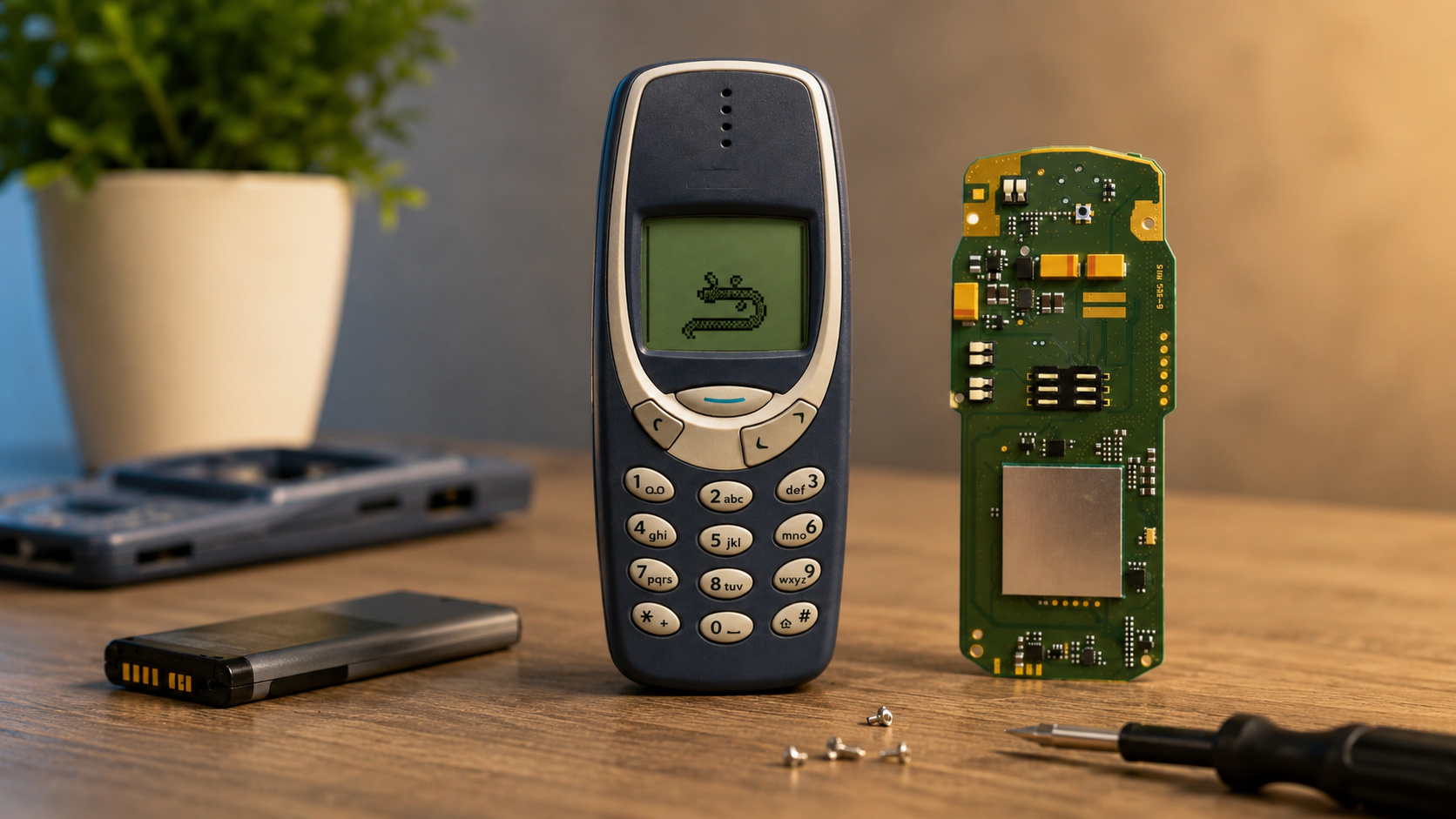

Discover how the Nokia 3210 gained new features at the hands of a modder, combining retro technology and innovation in a classic phone that returned to the spotlight.
A revolutionary project recently shared on Reddit is redefining the boundaries of technological preservation and the “dumbphone” movement. According to an article published by the Xataka Brasil portal on July 5, 2026, a visionary modder developed a completely new and custom-made motherboard for the legendary Nokia 3210, originally released in 1999.
The engineering allows the device to maintain its iconic aesthetics and monochrome screen intact, while its interior now supports modern 4G networks and is powered by stable lithium-ion batteries. This initiative emerges as a direct response to the global shutdown of old connectivity networks, offering an authentic alternative for those seeking disconnection without losing essential functionality in 2026.
The Nokia 3210 phenomenon and the blackout of old networks
The mobile phone market experiences a cycle of constant saturation and nostalgia. Released more than 25 years ago, the Nokia 3210 marked an entire generation as a symbol of durability, iconic design, and functional simplicity. However, over the decades, this classic phone ended up relegated to drawers and collectors’ shelves.
-
Off-Grid Family in Brazil Solves Water Supply with 5,000-Gallon Tank and Automated Pump System

-
U.S. Rotates 11,000-Ton Building 90 Degrees Over 31 Days While Keeping 600 Employees Inside With Uninterrupted Utilities

-
67-Year-Old Brazilian Woman Fulfills Lifelong Dream of Wearing Lipstick After Cleft Lip Surgery, Showcased in Emotional Exhibition

-
Father Lives with 3 Children on a 15-Meter Off-Grid Houseboat, Reduces Living Costs to £500 a Month, and Filters Canal Water with a £300 System He Built



The main obstacle to its contemporary use was not physical wear but the obsolescence of its communication infrastructure, based on second-generation (2G) networks that are in the process of accelerated global deactivation by telecommunications operators.
Recently, this narrative changed drastically. Instead of opting for modern commercial replicas produced by HMD Global (holder of the brand rights), a talented modder decided to create an innovative method of preservation through retro technology.
Through a detailed post on the Reddit platform, the enthusiast introduced to the world the development of a customized motherboard that fits perfectly into the original chassis of the 1999 device. This hardware modification project transforms what would be a piece of nostalgic electronic waste into a fully operational retro phone, capable of transmitting data and voice over contemporary mobile networks.
Surgical engineering in the classic 1999 phone
The major differentiator of this structural modification project lies in the absolute respect for the original industrial engineering. While the official relaunch of the Nokia 3210 4G in 2024 disappointed purists by featuring a design far removed from the original, this enthusiast’s proposal goes in the opposite direction.
The new printed circuit board was meticulously designed to reuse the classic plastic casing, the original button membrane, and the iconic monochrome display panel of the Nokia 3210.
- Perfect fit: The board was custom-designed to use the original buttons and casing.
- Visual fidelity: The monochrome screen and the 1999 visual identity remain intact.
The hardware developed by the modder successfully incorporates a modern cellular modem compatible with 4G networks. This solves the biggest engineering challenge around retro technology communication: the reliance on obsolete radio spectrums.
By updating the internal core, the device no longer depends on the 2G or 3G signal (whose shutdowns would render the device unusable) and starts connecting with current telephony antennas, ensuring stable call reception and SMS message exchange in compliance with the technical requirements in 2026.


The challenges of programming and hardware in retro technology
Implementing physical modifications in a classic cellphone involves overcoming complex barriers of electrical engineering and power supply. The old nickel-metal hydride (NiMH) batteries that powered the original device at the end of the last century are obsolete, hard to find in the replacement market, and present severe chemical degradation over time. To solve this supply limitation, the new motherboard was designed to accept standard lithium-ion (Li-ion) batteries, which are much safer, more compact, efficient, and easier to acquire today.
However, the project creator points out that the hardware represents only half of the work. The true test of skill is centered on the development of the control software.
The developer is meticulously recreating from scratch the entire user interface of the original operating system. This includes the precise styling of the low-resolution bitmap typography, hierarchical menu navigation, and the complete rewriting of the code for the legendary Snake game — the popular “snake game,” an inseparable element of the identity that established this iconic retro cellphone in pop culture.
Why put a 4G heart in a 1999 Nokia?
The motivation for developing this customized engineering in a Nokia 3210 goes far beyond mere aesthetic whim or nostalgic pastime. It touches on a practical connectivity need that directly affects the market of collectors and enthusiasts of old electronics. First and second-generation analog and digital cell phones become completely dysfunctional the moment telecommunications companies shut down their old frequency antennas to redirect bandwidth to 5G and future technologies.
For this reason, inserting a module with 4G support inside this historic model becomes a measure of active preservation. Without the creative intervention of this modder, the device would be doomed to be an inert paperweight. By coupling modern chips to the old interface, the creator demonstrates that retro technology can indeed remain relevant, sustainable, and fully integrated with contemporary networks, redefining the concept of the life cycle of consumer electronics.
The minimalist movement and the search for authentic connections
Alongside the technical aspects, this unprecedented modification of the Nokia 3210 meets a growing social and psychological demand in contemporary society: the digital well-being movement and the adoption of “dumbphones.” More and more users are actively seeking communication alternatives that limit the constant bombardment of notifications, social networks, and attention algorithms designed to retain an individual’s focus for consecutive hours.
Using an authentic retro phone — which preserves the typing experience on a physical alphanumeric keyboard and a monochrome screen that doesn’t strain the eyes — emerges as the perfect solution for those wishing to make a selective disconnection.
The user benefits from distancing themselves from the distractions of modern smartphones but has the security of carrying a reliable device approved to function stably on mobile networks in 2026. It is the ideal balance between nostalgia, utility, and mental health.
The future of electronic sustainability and the legacy of portables
In short, the project developed by this enthusiast definitively proves that the fate of a technological product considered obsolete does not have to be disposal in landfills or definitive oblivion.
By opening the chassis of a Nokia 3210 launched over 25 years ago and surgically updating only the necessary electronic elements for current communication, the responsible modder not only resurrected a classic but also opened a fascinating precedent for the culture of “right to repair” and advanced hardware customization.
- Technical advancement: Maximum fusion of two eras of personal computing with the 4G heart and modern lithium-ion batteries.
- Next steps: The project author promised the upcoming release of a full demonstration video detailing the practical operation of the rebuilt interface.
The advancement of retro technology from this perspective teaches a valuable lesson: with creativity, technical knowledge, and dedication, humanity’s technical past can continue to surprise us and operate perfectly in the present.