Portuguese
  Spanish


Low presence of concessions in the Northeast reignites debate on financing, road quality, and the public sector’s ability to maintain essential corridors for freight, passengers, and regional development.
The low presence of road concessions in the Northeast has returned to the forefront of the infrastructure debate by highlighting the investment difference between roads managed by the public sector and those operated by private entities.
According to the National Transport Confederation (CNT), federal highways under concession received, between 2016 and 2022, 2.3 times more investment per kilometer than roads under direct public administration.
In 2022, the difference reached 3.8 times.
-
As Brazil Expands Social Welfare, Survey Reveals 40% Blame Poverty on Laziness, While 58% Cite Lack of Opportunities

-
China Tightens Control on Antimony, Driving Prices from $22,000 to Nearly $40,000 per Ton as U.S. Rushes to Bolster Strategic Reserves

-
BlackRock Freezes $1 Billion in Brazilian Renewable Energy, Impacting 1.5 GW of Planned Projects and Highlighting Investor Concerns Over Infrastructure Bottlenecks Cutting Up to 25% of Solar and Wind Generation
-
Labor Shortage: Despite Record Average Salary, 90% of Brazilian Bar and Restaurant Owners Struggle to Hire Key Roles Like Sushi Chefs and Head Cooks


The topic was addressed in the series “Nordeste Sem Pedágio” (Northeast Without Tolls), published by Jornal do Commercio, which discusses the low expansion of this model in the region and the difficulty of financing the road network solely with public resources.
The analysis stems from a scenario where road transport remains the basis for national freight and passenger circulation but faces budgetary constraints for maintenance, recovery, and capacity expansion.
According to the CNT, the road mode accounts for about 65% of freight transport and 95% of passenger transport in the country.
Therefore, the entity considers road quality as a factor directly linked to logistical costs, supply regularity, and travel safety.
Investment difference between concessioned and public roads
The comparison between the two management models shows a significant gap in resources applied per kilometer.
In 2022, concessionaires invested R$ 486.55 thousand per kilometer in federal highways under concession, while federal public investments reached R$ 127.42 thousand per kilometer on sections under the direct responsibility of the Union.
This difference also appears in the assessment of road conditions.
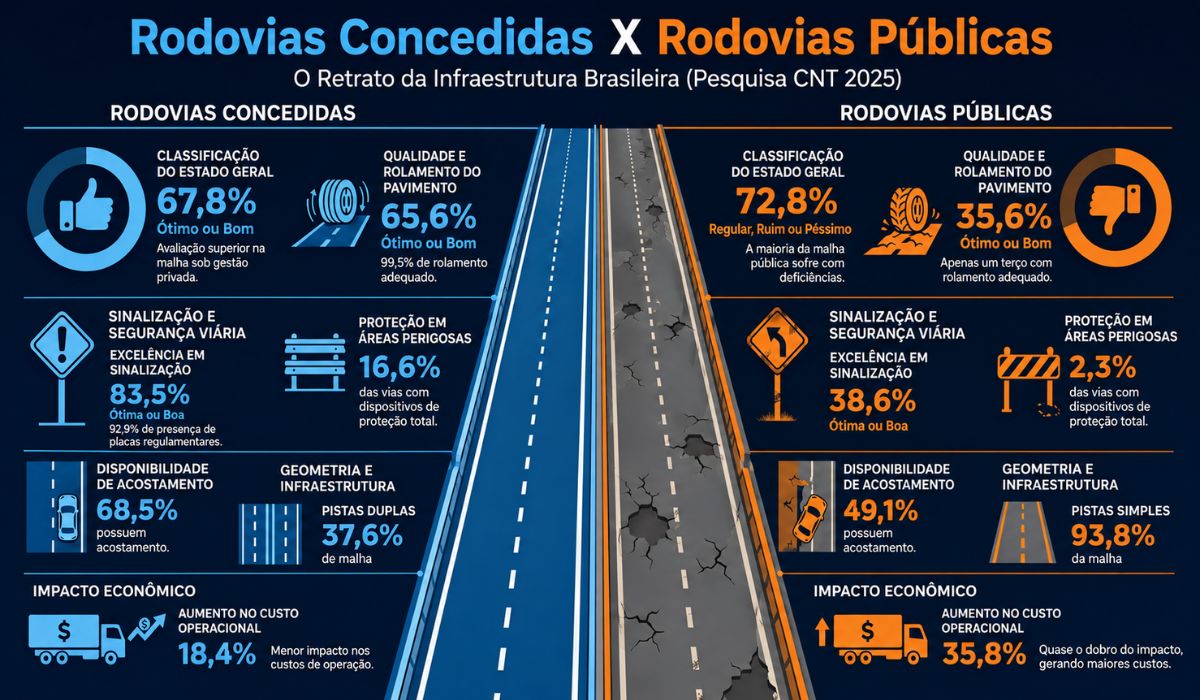
In the CNT Road Survey 2022, 67.1% of the concessioned network was classified as excellent or good.
Among public roads, the rate was 32.4%.
The survey relates the performance of concessioned roads to the greater regularity of investments and the obligations outlined in concession contracts.
According to industry rules, the concession does not transfer ownership of the highway to the private operator.
The National Land Transport Agency (ANTT) states that it is the agency’s responsibility to regulate and oversee the execution of concession contracts for federal highways handed over to the private sector.
Meanwhile, non-tolled federal highways are under the responsibility of the National Department of Transport Infrastructure (DNIT), while state highways depend on their respective governments.
In practice, the model provides that the concessionaire assumes obligations for operation, conservation, maintenance, and improvements of the road during the contract period.
In return, toll collection finances part of the investments and services provided to the user.
This structure is different from direct public management, which depends on budget allocations and the annual execution of resources.
Concessions in the Northeast and the Advancement of the Rota dos Sertões
The expression “Northeast without tolls” summarizes the discussion about the low presence of concessions in the region, but does not correspond to an absolute absence of tolled highways.
There are state and federal projects in operation or in structuring, especially in sections of Bahia and Pernambuco.
Even so, the participation of the model is smaller than that observed in areas where concession programs started earlier and reached a greater network extension.
A recent example is the Rota dos Sertões, a concession of BR-116/324/BA/PE auctioned on May 28, 2026, at B3, in São Paulo.
According to the Ministry of Transport, the section connects the ring road of Feira de Santana, in Bahia, to the municipality of Salgueiro, in Pernambuco, crosses 16 municipalities, and totals about 502 kilometers of highways.
The contract has a term of 30 years and foresees more than R$ 8.5 billion between investments and operational costs.
The auction was won by the Consórcio 116 Sertões, which offered a 19.60% discount on the basic toll rate.
According to BNDES, the concession covers approximately 429 kilometers of BR-116 in Bahia, 66 kilometers in Pernambuco, and 7.2 kilometers of BR-324 on the ring road of Feira de Santana.
The project includes pavement recovery, capacity expansion, operational modernization, and user services.
Among the interventions planned by the Ministry of Transport are duplications, additional lanes, rest and stop points, ambulances, tow trucks, and intelligent transport systems.
These items are part of the contractual obligations and are monitored by the granting authority.
Poor roads increase transportation costs
The condition of the roads has a direct impact on transportation costs, according to the CNT.
The survey cited by the entity indicates that roads with poor pavement increase operational costs by 37.1%.
On concession roads, this impact is estimated at 17.8%.
The difference is due to factors such as fuel consumption, mechanical wear, travel time, and the need for vehicle maintenance.
For carriers, this cost can be reflected in the freight price.
For the common user, poor road maintenance results in slower trips, greater exposure to potholes, poor signage, and sections with lower service levels.


The CNT associates regular maintenance of the network with reduced operational costs and improved traffic conditions.
The entity also reports that, in the first five years of concession, the length of roads rated as excellent usually increases from 16.7% to 29.4%, a 76% increase in the highest classification.
This data is attributed to the initial recovery cycle provided for in the contracts, during which concessionaires must carry out interventions to raise the quality standard of the road.
This result does not eliminate the need for oversight.
Since toll collection depends on the adequate provision of service, contracts need to include goals, deadlines, control mechanisms, and penalties in case of non-compliance.
ANTT reports that it oversees the execution of federal concession contracts, a function that keeps the public authority as the regulator of the service.
Tolls also generate revenue for municipalities
Road concessions generate fiscal effects for municipalities crossed by tolled sections.
According to CNT’s analysis of 30 years of granted road infrastructure in Brazil, the federal concession program collected R$ 362.47 million in ISSQN in 2021 for municipalities intersected by the granted roads.
The Tax on Services of Any Nature is collected on the activity provided by the concessionaires and can increase municipal revenue.
The use of these resources, however, depends on budget legislation and the priorities set by each city hall.
Thus, the additional revenue does not automatically guarantee improvements in specific areas, but it can strengthen the local treasury.
The discussion about tolls, therefore, involves more than the fee paid by the driver.
This also includes the quality of the service delivered, the transparency of contracts, the predictability of investments, public oversight, and the impact on frequent users, transporters, and municipalities.
In regions with lower income or less vehicle flow, this balance tends to require more careful modeling to avoid fees incompatible with the local reality.
In the Northeast, the expansion of concessions still depends on the economic viability of the sections, the structure of the contracts, and user acceptance.
High-traffic highways tend to have a greater capacity to attract private operators, while lower-traffic corridors may require models with public participation, tariff adjustments, or specific contractual combinations.
This analysis should be done on a case-by-case basis, based on technical studies and official projections.
Private participation also does not fully replace state investment.
Even in concession contracts, the State remains responsible for setting rules, overseeing execution, ensuring contractual balance, and protecting the public interest.

On non-concession roads, the public authority remains responsible for maintenance, works, and services, especially through DNIT on non-tolled federal roads.
The difference pointed out by CNT between public and private investments shows that the debate on concessions should consider both the State’s fiscal capacity and the final cost to the user.
In the case of the Northeast, the low presence of tolls does not eliminate the need for continuous investment in the roads.
The question is to define which models can finance works, conservation, and service without compromising tariff moderation and public oversight.