






 Portuguese
  Spanish


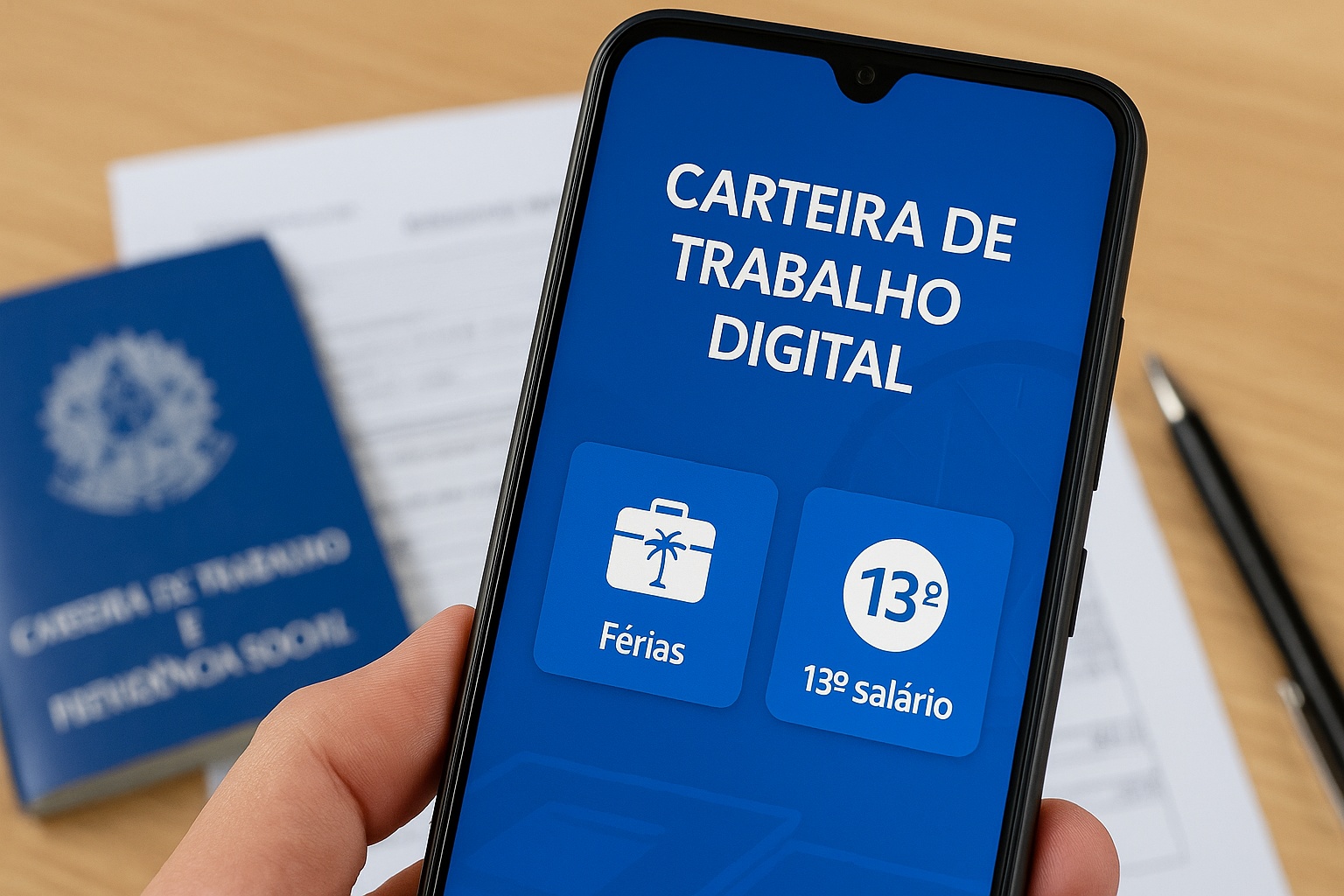


The Digital Work Card Gained a New Function: Now It Shows Vacation and 13th Salary Recorded by the Employer Directly in the App, Ensuring More Transparency and Security for the Worker.
The Digital Work Card, an app that already brings together all formal employment ties of Brazilians, has just received an update that promises to change the way millions of workers track their rights. Now, it is possible to view directly in the app information about vacation and 13th salary recorded by employers, without needing to contact the company’s HR or keep physical receipts.
The novelty adds to a series of features that have transformed the Digital CTPS into a true monitoring panel of the citizen’s work life, reinforcing transparency and practicality in accessing essential data.
What Changed with the New Function
Until recently, the Digital Work Card only showed basic information: admission, position, CBO (Brazilian Classification of Occupations), salaries, terminations, and history of ties.
-
James Webb Telescope Uncovers Unexpected Clues on Mysterious Moon, Potentially Redefining Planetary Origins

-
$1.5 Billion Sleipnir Vessel Transforms Ocean into Floating Construction Site with 12 Hybrid Engines and Capacity to Lift 20,000 Tons

-
23 Years After Tragedy, Brazil’s Alcântara Space Center to Launch New Suborbital Rocket in 2026 with South Korean SEBIT Project Targeting Near-Space Tests
-
Entrepreneur Turns Neighbor’s Coffee Grounds Waste into Eco-Friendly Pellets, Earning Up to $40,000 Monthly in Brazil


With the 2025 update, workers can view:
- Vacation periods already recorded by the employer in the system.
- Information about the 13th salary, including amounts and recorded entries.
- Contractual changes, such as promotions or salary changes, which were already available but now appear integrated into the benefits panel.
This integration is possible thanks to eSocial, a government platform that consolidates all labor information sent by companies. What was once restricted to the employer’s internal system is now transparently available to the worker.
How to Access the New Feature
To check the new information, simply:
- Download or update the Digital Work Card app, available for free on Android and iOS.
- Log in with your gov.br account.
- Access the “Contracts” tab and select the current link.
- View the records of vacation and 13th salary recorded by the employer.
If the company has not yet sent the data to eSocial, the information may not appear immediately. In this case, the worker should request the update from the HR or accounting department of the company.
The Impact on Workers
The main advantage of the novelty is transparency. Workers now have real-time access to information that was previously restricted to the employer’s system. This reduces the chance of errors and increases security regarding rights guaranteed by law.
Among the positive impacts are:
- Control of vacations: workers can verify if their rest period has been correctly recorded.
- Monitoring of the 13th salary: it is possible to check if the amount was duly recorded and is in accordance with the contract.
- Security in labor disputes: in case of discrepancies, the official record in the system can serve as evidence.
- Autonomy: workers no longer depend on printed paychecks or internal reports to access basic information.
What Changes for Companies
If for workers the novelty represents more security, for companies it means greater responsibility. As all records must be sent to eSocial, any delay or error can be easily identified by the employee.
This increases the pressure on human resources and accounting departments to keep data updated. Companies that fail to send records run the risk of fines and facing labor claims reinforced by official information in the system.
Relation with Other Digital Benefits
The update of the Digital Work Card adds to a trend of digitalization that is already underway in other government services:
- Meu INSS already allows for online retirement requests.
- FGTS Digital facilitates tracking of deposits.
- Meu SUS Digital is starting to allow medical appointment scheduling.
Together, these initiatives point to a model in which workers will have more and more autonomy to monitor their rights directly on their cell phones.
Challenges for Implementation
Despite the progress, the novelty also faces challenges. Many workers are still not familiar with government apps or authentication via gov.br. Additionally, the functionality entirely depends on companies correctly sending information to eSocial.
There is also an issue of digital inclusion: part of the population that depends most on these rights, especially older workers and those in regions with low connectivity, may face difficulties accessing the tool.
What to Expect for the Coming Years
The Ministry of Labor and Employment forecasts that by 2027, all records related to employment ties — including terminations, allowances, benefits, and even approval processes — will be available within the application.
This centralization should further reduce bureaucracy and facilitate access to reliable information. In the long term, the Digital Work Card is expected to consolidate as the sole official source for monitoring the work life of citizens, eliminating the need for printed documents.
The new function of the Digital Work Card, which shows vacation and 13th salary recorded by the employer, represents a significant advance in the transparency of labor relations in Brazil.
More than just a simple app update, it is a structural change that places the worker at the center of the process, allowing them to track their rights in real time and reduce reliance on information provided solely by the employer.
While companies will have to comply more rigorously with legal obligations, workers gain more control and security. A digital transformation that promises to impact millions of Brazilians and strengthen trust in the labor protection system.


