






 Portuguese
  Spanish


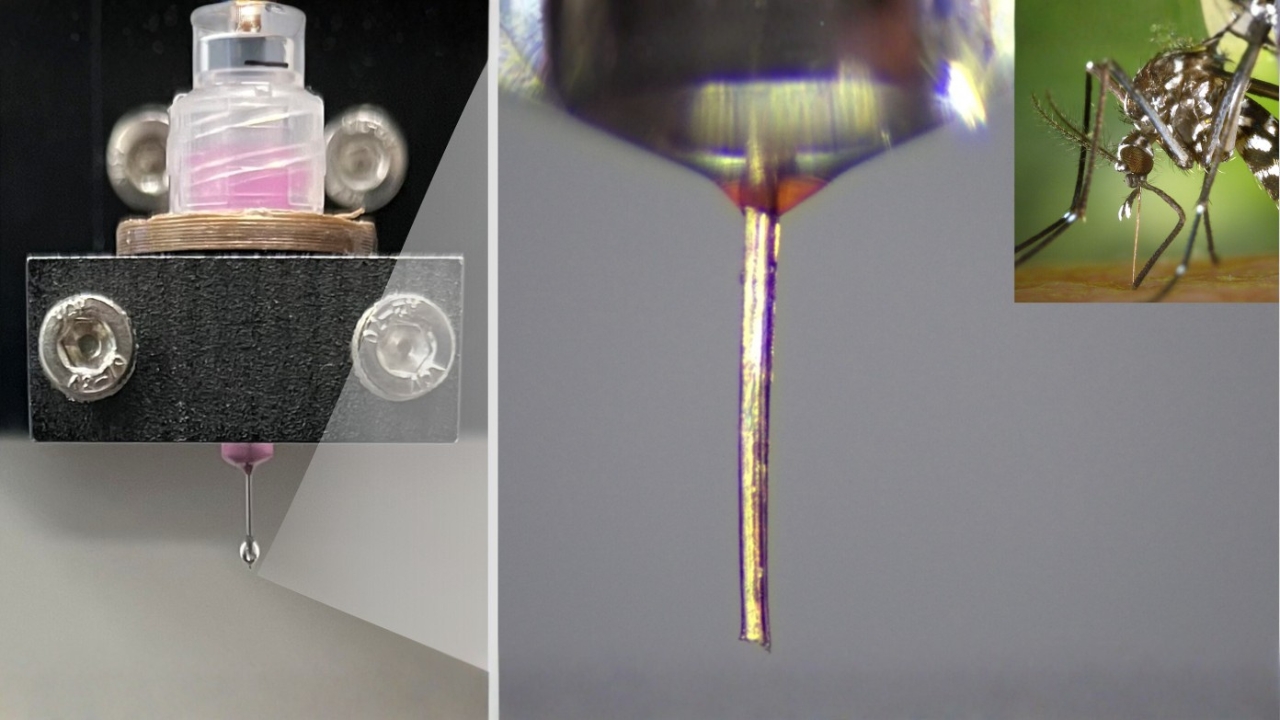


Method Transforms Mosquito Proboscis into Printing Nozzle and Paves the Way for Fabricating Microscopic Structures with Greater Precision
Mosquitos are often remembered as pests, but a striking feature of these insects has turned into a high-precision manufacturing tool. A team from McGill and Drexel universities adapted the feeding tube of female mosquitoes to function as a 3D printing nozzle.
The advancement allows material to be deposited in lines with a width of 20 microns, a level of detail smaller than the typical size of a white blood cell. This takes 3D printing to a new level for applications on a microscopic scale.
The proposal targets areas where every micrometer counts, especially in biomedicine, where the manipulation of cells and gels requires fine control and low risk of clogging.
-
Pennsylvania Mine Creates Ice in Summer Heat and Melts in Winter, Turning a Mountain Crevice into a Reverse Natural Refrigerator

-
China Accelerates Global Expansion of Robotics: From Smart Vacuums to Industrial and Humanoid Machines, Millions Exported to Over 150 Markets
-
Polar Air Mass to Hit Brazil: Temperatures to Plummet in Nine States, Near Freezing in the South with Frost Risk Until Monday
-
Chinese “dark factories” produce electric cars 24/7 with minimal human intervention, as Zeekr assembles 800 units daily, raising concerns in Brazil.





What Happened and Why This Caught Attention
The team transformed the proboscis of the mosquito, the structure used to puncture and suck fluids, into an ultra-thin nozzle for 3D printing. The technique has been named 3D necroprinting because it uses a non-living biological structure directly as a functional component.
Common commercial nozzles tend to have limitations in achieving such small details. With the proboscis, deposition now occurs with more precise control, expanding manufacturing possibilities on a microscale.
The result also draws attention for repurposing a natural element that has already evolved to puncture efficiently and conduct liquids stably.

How the Process Works with the Mosquito Proboscis
The proboscises were removed from mosquitoes and prepared in a controlled environment. Then, each feeding tube was removed under a microscope and attached to a standard plastic dispensing tip filled with resin.
In practice, the proboscis becomes the final outlet of the system, through which the material passes during printing. This natural geometry helps reduce clogging and better control pressure, two critical points in ultra-thin nozzles.
The term proboscis may sound technical, but it is simple: it refers to the structure that functions as a microscopic needle of the mosquito, designed to penetrate and transport fluids.
Why the Technique Achieves Details Below Cellular Scale
The highlight of the method is the resolution achieved, with lines of 20 microns. This range is close to the size of biological structures, making the process useful for printing tiny patterns and delicate components.
The team evaluated geometry, strength, and pressure limits before integrating the biological nozzle into a customized printing system. The goal was to ensure stability for repeating printing cycles without breaking the structure.
Jianyu Li, associate professor and Canada Research Chair in Tissue Repair and Regeneration at McGill, stated that traditional ultra-thin nozzles, made of metal or glass, tend to be expensive, difficult to manufacture, and can raise environmental and health concerns.
What Has Been Printed and Why This Matters

With the system assembled, patterns and structures on a microscale were printed, including honeycomb-shaped designs, maple leaf patterns, and small bioscaffolds. A bioscaffold is a type of microscopic scaffold used to support cells, very common in tissue regeneration and engineering research.
Some of these scaffolds encapsulated cancer cells and red blood cells without causing damage, showing that deposition can be gentle enough for sensitive materials.
Changhong Cao, assistant professor and Canada Research Chair in Small Scale Materials and Manufacturing at McGill, highlighted that the proboscis allows for creating very small and precise structures that are difficult or very expensive to obtain with conventional tools.
Where Necroprinting Can Be Practically Applied
The technique can support tissue engineering, printing gels with cells, and microscopic positioning of materials. These uses often require fine nozzles, pressure control, and stable flow, exactly where the proboscis proves efficient.
There is also potential for handling fragile components in the area of semiconductors, where small parts may require precise and repeatable deposition.
For microdispensing, which is the controlled release of very small volumes of material, the biological nozzle can serve as an alternative when the goal is to reduce cost and complexity without losing definition.
Sustainability, Reuse, and What Could Happen from Now On
Besides the technical advantage, the proposal brings an argument for sustainability. Proboscises are biodegradable, which could reduce the disposal of specialized nozzles, depending on the context of use.
The team also evaluated durability: proboscises withstood repeated printing cycles when the pressure was maintained within safe limits. With proper handling and cleaning, the same tip can be reused multiple times.
The study was published in Science Advances, and the line of research points to a scenario where biological materials could replace complex components in microfabrication, paving the way for more sustainable and innovative solutions in advanced manufacturing.






