Portuguese
  Spanish


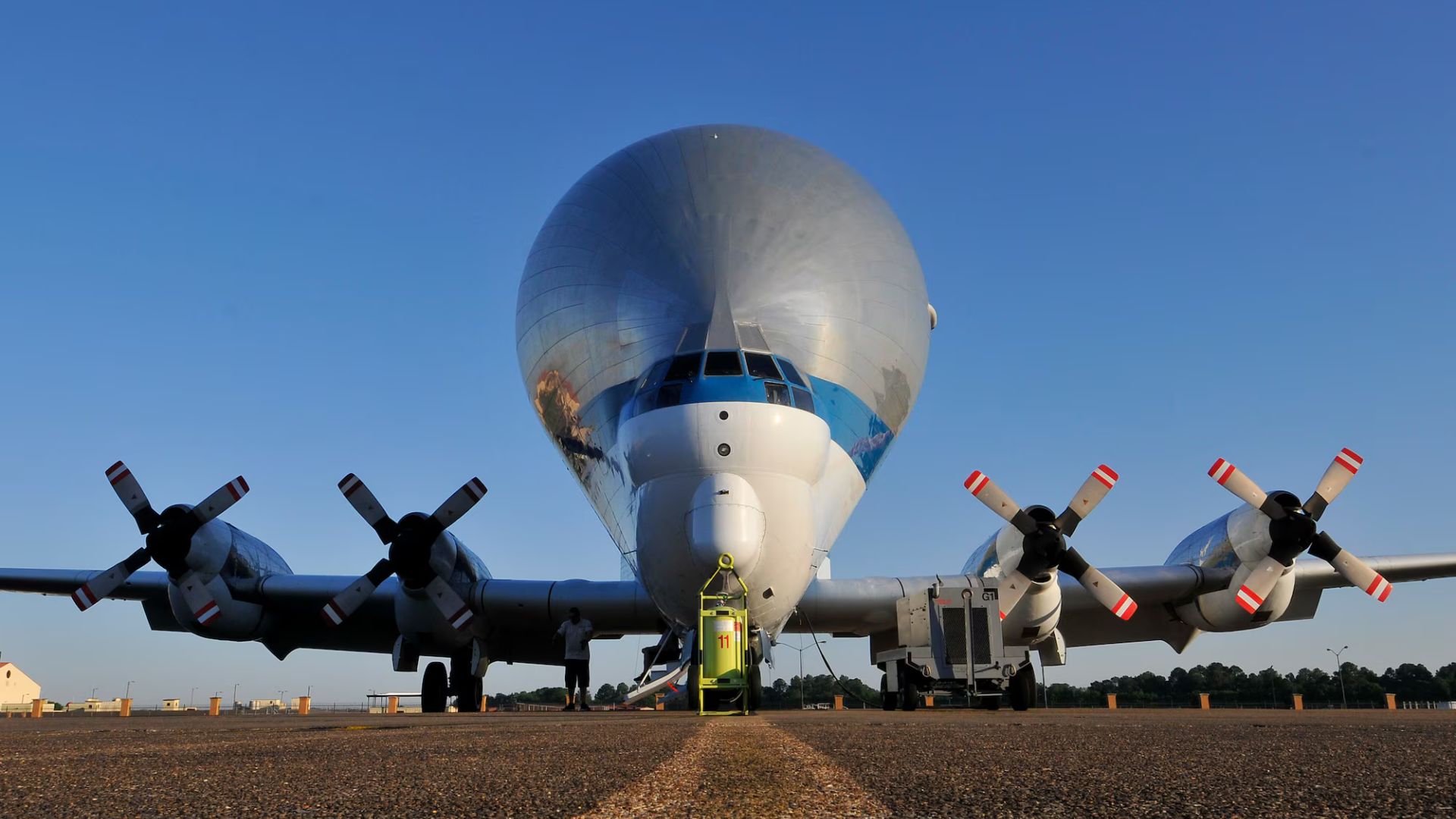


NASA’s Unusual Cargo Plane Is Used To Transport Bulky Components That Will Not Fit On Conventional Aircraft, With A Nose That Articulates To Open To Insert Entire Structures, Reducing Handling Steps And Connecting Test And Assembly Centers In Operations Related To The Artemis Program.
Among the aircraft used by NASA in logistics operations, one stands out for its unusual shape and specific function it performs.
With an enlarged fuselage and the ability to open the front like a large gate, the Super Guppy is used when the challenge involves transporting components too large to fit in conventional cargo planes.
According to NASA itself, the aircraft was designed to carry bulky structures associated with rockets and spacecraft by air, offering an alternative to road or maritime routes that may require disassembly and additional steps.
-
Coastal City in Rio de Janeiro Faces Slow Destruction as Sea Claims 500 Homes and Businesses

-
48-Year-Old Woman Wins Million-Dollar Prize, Gifts Neighbor First International Trip as Thanks for Years of Support

-
Women Once Mocked for Collecting Trash Form Group to Turn Organic Waste into Compost, Generate Daily Income, and Improve Market Cleanliness in One of the World’s Lowest GDP per Capita Countries
-
Archaeologists Uncover 40,000 Roman Bronze and Copper Coins from the 3rd Century in Fire-Destroyed French Neighborhood



Internal Volume Is The Main Differential Of The Aircraft
Unlike cargo planes that prioritize only weight capacity, the Super Guppy was conceived with a focus on the available space in the cargo hold.
NASA’s institutional documents describe the aircraft as capable of accommodating items that could not be transported on other planes due to width and height limitations.
In practice, this internal volume allows large components to be transported in one piece, avoiding disassembly processes that could increase costs, extend deadlines, and require additional care during handling.

Articulated Nose Allows Direct Access To The Cargo Hold
One of the most characteristic aspects of the Super Guppy lies in its loading system.
Instead of side doors or rear ramps, the aircraft has an articulated front section that opens to allow direct access to the interior of the cargo hold.
According to NASA, this opening occurs at the separation point of the fuselage, creating a wide entrance for placing structures with large dimensions, something that would not be possible in planes with conventional doors.
Internal Dimensions Explain Usage In Space Missions
The configuration of the Super Guppy results in a cargo hold with unusual dimensions in civil and military aviation.
Technical information released by NASA indicates that the interior of the aircraft is approximately 25 feet in diameter and 111 feet long, and has the capacity to transport loads over 48,000 pounds.
These numbers help explain why the plane is used in missions involving large, heavy, and sensitive parts that require special care during transport.
Transport Of Structures Linked To The SLS And The Artemis Program
The role of the Super Guppy becomes evident in operations related to the Space Launch System (SLS) and the Orion spacecraft, central elements of the Artemis program.
In one of these missions, NASA teams recorded the transport of a structural test article from the Orion stage adapter to the Marshall Space Flight Center in Alabama.
According to the agency, this article was developed to support testing and evaluations of the SLS, and the use of air transport was part of the logistical strategy to keep the component available as an engineering resource.
Fewer Steps Reduce Risks During Transport

Structural components of rockets often require strict tolerances and specific transport conditions.
The greater the number of transfers between different means, the greater the exposure to vibrations, impacts, and variations in the fastening system.
In this context, NASA points out that using a cargo plane with a large internal volume and wide frontal access helps to reduce the number of handling steps, which simplifies security procedures and minimizes risks associated with transport.
Flights With The Orion Spacecraft Between Agency Centers
In addition to test articles, the Super Guppy has already been used to transport the Orion spacecraft itself.
Institutional records from NASA mention a landing of the aircraft at Kennedy Space Center in Florida, after flying Orion back to the site for continued testing and preparation phases.
This type of operation illustrates how the plane is used to connect different centers of the agency, avoiding long land routes for structures that were not designed to cope with road infrastructure limitations.
Detailed Planning Is Necessary For Each Mission
Despite the advantages offered by the aircraft’s design, using the Super Guppy requires rigorous technical planning.
NASA’s operational guides emphasize the importance of proper load positioning, center of gravity control, and maintaining safety margins during flight.
Thus, in addition to fitting in the hold, each item must be secured and distributed in a way that meets the aircraft’s operational safety requirements.
Alternative To Complex Land And Maritime Routes
The contrast with other forms of transport helps contextualize the use of the Super Guppy.
Road transport can be limited by lane width, bridge heights, the need for escorts, and specific traffic windows.
Maritime transport, on the other hand, tends to require more time and intermediary steps between ports and technical facilities.
By operating as an air bridge for large volumes, the Super Guppy helps to reduce steps and shorten the journey between testing and assembly centers.
Specific Project For A Logistical Need

In air cargo operations, attention often focuses on more modern aircraft or those with greater range.
In the case of the Super Guppy, the highlight is the fact that it was developed to meet a specific logistical need of aerospace engineering.
Maintaining this model in operation reflects the importance attributed by NASA to the safe transport of oversized components, considered essential for the progress of its programs.
Logistics As Part Of The Operation Of The Artemis Program
With teams distributed across different centers and an industrial chain scattered, the Artemis program relies on logistical solutions capable of maintaining the flow of components.
In this scenario, the Super Guppy continues to be used to transport structures that do not fit traditional cargo standards.
If transporting such large parts influences the pace of testing and assembly, to what extent does air logistics define the real progress of large-scale space programs?