Portuguese
  Spanish




Veerabhadran Ramanathan’s Journey Highlights How Scientific Discoveries Transformed Global Policies and Understanding of Greenhouse Gases
The path that led Veerabhadran Ramanathan to become one of the most influential voices in global climate science began improbably, amidst youthful dreams, scientific curiosity, and a series of discoveries that redefined the understanding of global warming.
His journey combines persistence, chance, and a keen eye for connections that went unnoticed for decades.
Simple Dreams and a Distant Start
In the 1960s, while growing up in southern India, Ramanathan nurtured what he called the American dream: to own a Chevrolet Impala, a powerful car he learned about through his father, a tire salesman.
-
Engineers Develop Fridge-Sized Machine to Produce 95-Octane Synthetic Fuel from Air and Water, Aiming to Sustain Combustion Engines Without Oil

-
Two-Armed Robot Uses AI to Reassemble Destroyed Pompeii Frescoes, Solving an “Impossible” Puzzle
-
New Law in Brazil Requires Breaks for Type 1 Diabetes Management at Work, School, and Public Exams

-
Scientists Confirm “Greening” of Antarctica: Ice on the World’s Coldest Continent Turns Green as Mosses Multiply Over Tenfold in Four Decades


He arrived in the United States in his early twenties but never acquired the vehicle. His involvement in the study of global warming quickly overshadowed any financial possibility of affording a gas-guzzling car.
This contrast between personal desire and scientific vocation would mark his entire career. Even at a young age, he realized that knowledge could have a far greater impact than any material achievement.
Quiet Nights at NASA
In the 1970s, as a newly graduated postdoctoral researcher in planetary sciences, Ramanathan worked as a visiting researcher at NASA’s Langley Research Center in Hampton, Virginia.
During the day, he fulfilled his official duties. At night, however, he dedicated himself to a side project, kept secret even from his supervisors.
It was during this time that he identified something surprising: chlorofluorocarbons, or CFCs, widely used in refrigerators, air conditioning units, and spray cans, had a strong greenhouse effect.
His calculations indicated that a single molecule of CFC could warm as much as up to 10,000 molecules of carbon dioxide.
Doubt, Repetition, and Conviction
For three months, Ramanathan recalculated numerous times, searching for an alternative explanation. None appeared. Even so, he hesitated to publish the result.
“I was just an immigrant postdoc from India. I didn’t know whether or not to tell NASA about this. I just sent the paper,” he recalled.
The journal Science published the study, and The New York Times highlighted the discovery in 1975.
The initial reaction was one of disbelief, including from the author himself, who started the investigation purely out of curiosity at a time when climate change was not yet seen as urgent.
Expanding the Concept of Greenhouse Effect
Over time, Ramanathan established that greenhouse gases other than CO2 are significant contributors to global warming.
This understanding became one of the cornerstones of the first successful climate change mitigation policy.
On Thursday, the Royal Swedish Academy of Sciences awarded him the Crafoord Prize, considered by some winners a possible precursor to the Nobel Prize.
The recognition came with a value of 8 million Swedish kronor (about US$ 900,000).
Ilona Riipinen, a professor at Stockholm University and a member of the prize committee, stated that Ramanathan “<strong-expanded our view of how humanity is affecting the composition of the atmosphere, climate, and air quality, and how these three factors interact.”
A Scientist by Happy Accidents
Ramanathan describes his path as the result of a series of “happy accidents.” He studied engineering in Bengaluru, India, and later worked at a refrigeration company, ensuring that CFCs did not leak.
At 26, he moved to the United States and began a PhD at the State University of New York at Stony Brook.
An unexpected change in his advisor’s research focus led his dissertation to address the greenhouse effect in Venus’s atmosphere.
Later, at NASA Langley, he encountered studies by Mario Molina and Frank Rowland, which demonstrated the destruction of the ozone layer by CFCs. The duo won the Nobel Prize in 1995.
Accelerating the Clock of Warming
Before 1975, Ramanathan was not concerned about climate change. However, as researchers identified other trace gases, such as methane and nitrous oxide, he became fearful that global warming would manifest sooner than previously thought.
An article co-authored by him in 1985 concluded that these gases were potentially as important as CO2 for long-term warming.
Spencer Weart, a science historian, stated that the climate community realized that “global warming is going to happen twice as fast as we thought.”
From Theory to Direct Observation
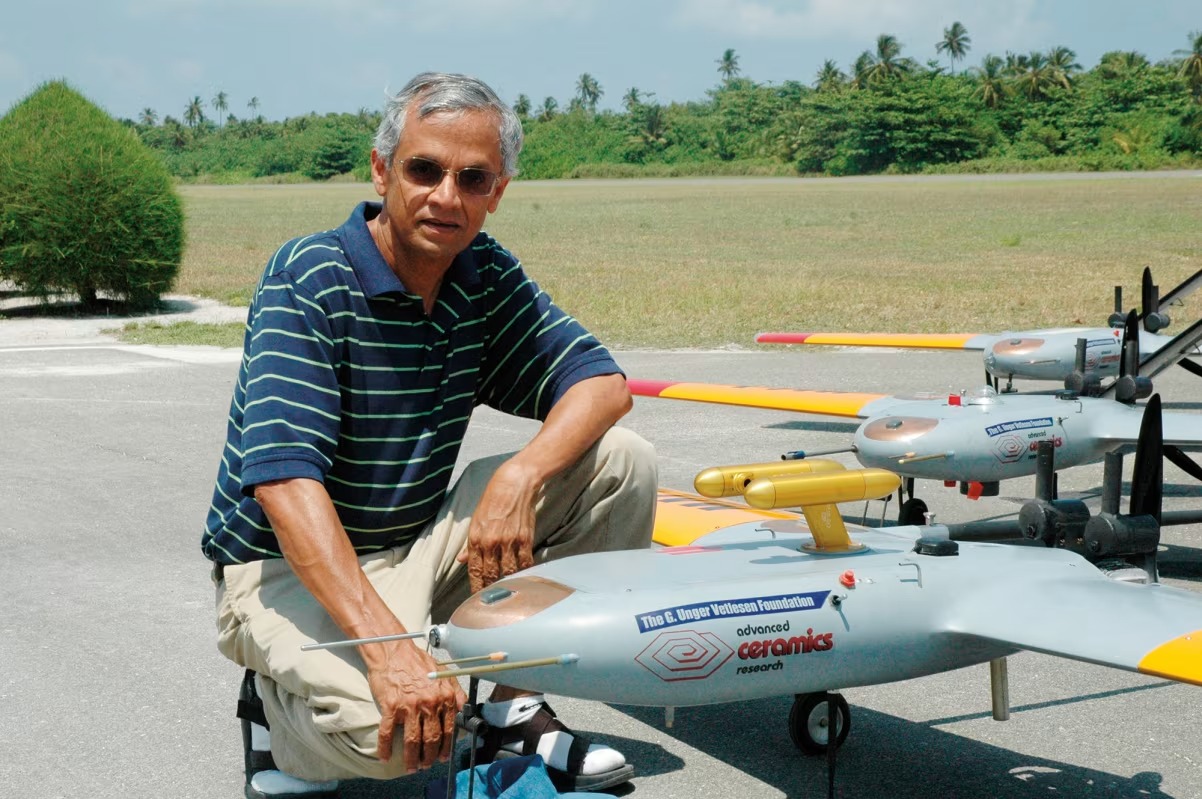
Throughout his career, Ramanathan used satellites, balloons, drones, and ships to study the atmosphere directly.
He demonstrated for the first time that clouds have a cooling effect on the planet and helped explain how water vapor amplifies warming caused by carbon dioxide.
He also led a project that measured a cloud of atmospheric pollution with a thickness of 3 kilometers (about 2 miles) over much of the Indian subcontinent.
This work revealed that pollution masked part of global warming, creating a dynamic that scientists are still trying to understand.
Revolutionary Scientist: Science, Ethics, and Political Action
A member of the Pontifical Academy of Sciences since 2012, Ramanathan has advised three consecutive popes on climate policies.
According to him, this experience reinforced the ethical dimension of the crisis, which will disproportionately affect the poorest.
Örjan Gustafsson, a professor at Stockholm University, highlighted his “discreet yet effective” communication style, capable of engaging scientists and decision-makers.
Today, at 81 years old, Ramanathan drives a Tesla Model Y, keeps a red model of a Chevy Impala by the fireplace, and has converted his home in California to solar energy.
Although he has given up walking or taking the bus to work for being too time-consuming, he rarely advocates for isolated individual actions.
He prefers to encourage young people to elect “the right politicians” and to spread the message using data-driven science, not nonsense.
These seemingly everyday details help compose the portrait of a scientist who transformed curiosity into global impact, connecting discoveries, policies, and social awareness over decades.
With information from CNN.