






 Portuguese
  Spanish


European Megaproject Promises to Reduce Impacts of Climate Change. Europe Plans to Build Dams to Prevent Flooding, check out the details!
The consequences of climate change are already affecting millions of people around the world and the outlook is not promising. According to estimates, in the next three decades, about 570 coastal cities are expected to see a rise of at least 50 cm in sea level, which could directly impact a population of 800 million people worldwide and a significant portion of those affected is in Northern Europe. Thus, a European megaproject promises to build dams and save millions of residents.
Impacts of Climate Change Lead to an Unprecedented Megaproject in Europe
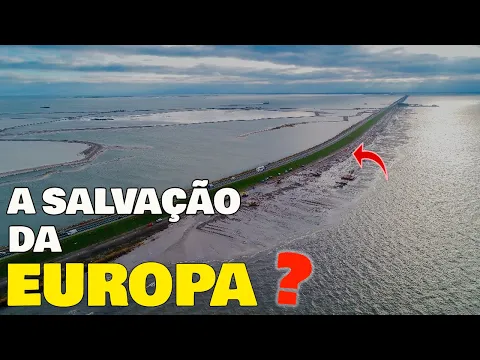

To reduce the effects of rising sea levels and to try to protect more than 25 million residents from 15 countries, engineers from Germany in partnership with professionals from the Netherlands came up with a rather bold proposal to build enormous dams that would separate the North Sea from the Atlantic Ocean, potentially mitigating or even permanently solving the problem of rising ocean levels.
Since 1980, sea level has risen by about 23 cm, and nearly half of that increase was recorded in just the last 25 years, and it is estimated that it will continue to rise at an average rate of 3.4 millimeters per year.
-
France Revamps 530 Social Housing Units with Large Balconies and Glass Facades Without Demolishing Existing Buildings

-
10-Year-Old Max Makes History with Paris Fashion Show, Launches Own Brand, Hires Staff, and Sets World Record as Youngest Runway Designer

-
Bolivian Female Construction Workers Form Association to Combat Discrimination and 38% Pay Gap in the Industry
-
Near Amsterdam, residents buy land and discover they must also build streets, manage drainage, handle waste, and grow food on half their plot.




According to recent studies, this increase is accelerating, and it is believed that the United States will have to face an increase of more than 30 cm in the next 30 years, putting numerous cities at risk of flooding and other natural disasters.
If the rise in sea levels is irreversible, which is still a matter of debate, several countries will need to take measures to protect their coastal cities or, as a last resort, relocate residents from coastal areas to inland regions.
Revealed: Megaproject to Build Dams in Europe
To avoid such a massive shock, Engineers from both countries presented a European megaproject, which aims to build dams. In total, there would be three, and together they would have about 637 km in length, reaching depths of up to 330 meters and would protect 25 million residents from Northern France to Norway.
The European megaproject, which has been nicknamed Need, proposes that the project be divided into three dams that together will prevent the advance of the Ocean.
The first dam would be built in the English Channel, between France and England, with a projected length of 161 km undoubtedly the easiest and least dangerous part of the construction, as it would deal with depths between 85 and 102 meters below sea level. The other two dams will be built further north, with the first connecting Scotland to the Orkney Islands.
This stretch, about 165 km long, would handle an average depth of 49 meters, making it easy to construct, given the technologies we currently have. However, the third dam is the largest and also the most complicated, as it presents technical challenges unmatched by the others, connecting the city of Bergen in Norway with the island of Nós.
The third dam would have a total length of 331 km, with a average depth of 161 meters, reaching up to 321 meters in the Norwegian trenches.
Challenges Encountered
Despite being an unprecedented major project in history, the European megaproject aimed at building dams is considered viable, as similar but smaller-scale projects have been carried out previously, which provided invaluable technical knowledge for this project.
The greatest difficulty without a doubt is the stretch between the Islands of Nós and Norway, but the outlook is still promising, as fixed oil platforms are already built in average depths of 500 meters, which encourages the researchers and engineers involved in the project.







