






 Portuguese
  Spanish


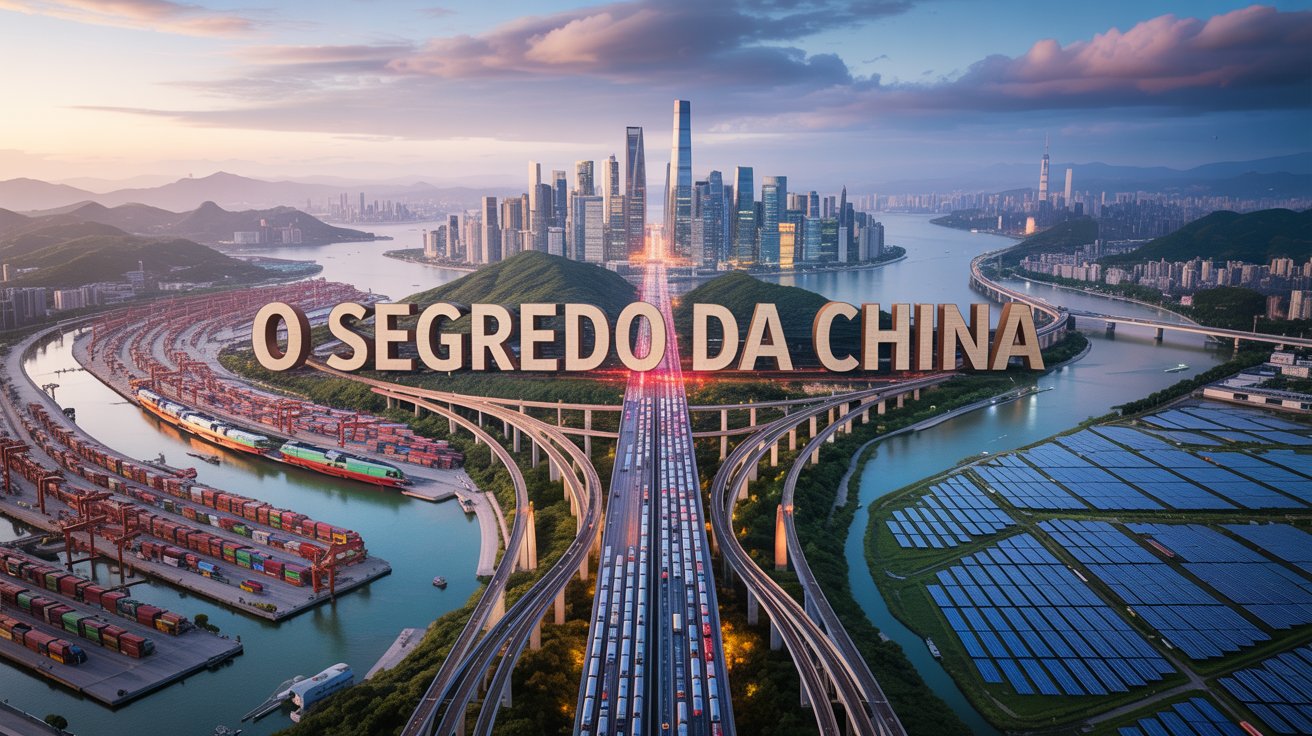


In Just Over 40 Years, China Multiplied Its Currency by 5,300% and Erected Giant Structures on a Global Scale, Using an Economic Method Little Exploited by Other Countries, That Financed Internal Infrastructure and Projects in 140 Nations.
China, which just over four decades ago was among the lowest per capita income nations in the world, has established itself as one of the largest global economies.
The country has built, according to official data, 41,800 kilometers of high-speed rail, the largest hydroelectric power plant in operation, 161,000 kilometers of expressways, the largest subway network, and seven of the ten busiest ports on the planet.
It has also achieved over 35% of the world’s installed capacity for solar and wind energy.
-
Brazil Harvests Record 358 Million Tons of Grain but Lacks Storage for 134 Million Tons

-
A New Bakery Opens Every Six Minutes in Brazil, Highlighting a Surge of 26,400 Small Businesses in Early 2025
-
Brazil’s Lula Government Allocates $463 Million Quota for Electric Car Parts, Waives Import Tax Until December, Sparking Competition Among BYD, Automakers, and Unions as Consumers Question Impact on Prices and Local Industry
-
Clarification and Right of Reply Notice


Quantitative Easing and Monetary Expansion
An article from the website Outras Palavras shows that this set of works was financed by various mechanisms, including a method little discussed outside the country: a unique policy of quantitative easing.
From 1996 to 2024, the amount of yuans in circulation increased by about 5,300%, rising from 5.84 billion to 314 billion CNY, according to data from the People’s Bank of China (PBOC).
The functioning of this process involved exporters who received payments in foreign currencies, mainly US dollars, and exchanged them for yuans at local banks.
The PBOC issued the national currency and kept foreign currencies as foreign exchange reserves.
The platform Investopedia describes that “one of the main tasks of the PBOC is to absorb large inflows of foreign capital resulting from China’s trade surplus, by buying foreign currency from exporters and issuing local yuan”.
Inflation Under Control and Price Policy
Despite the significant increase in liquidity, inflation rates remained under control.
After reaching 24% in 1994, the average annual inflation from 1996 to 2023 was approximately 2.5%, according to official records.
To contain price pressures, open market operations and price control policies were implemented on strategic products such as iron ore, copper, grains, meat, eggs, and vegetables, as established in the 14th Five-Year Plan (2021-2025).
Additionally, according to economists, directing capital towards productive sectors such as infrastructure and industry helped balance supply and demand.
With production expansion keeping pace with consumption growth, the risk of high inflation was reduced.
Economic Reforms and Entry into the WTO
The change in the economic landscape began in 1978, with Deng Xiaoping’s reforms, which included partial liberalization of agriculture, encouragement of foreign investment, and incentives for the creation of private enterprises.
In the 1990s, the country established itself as an exporter of low-cost products, supported by a large workforce, investments in public transport, and professional training programs.
Entry into the World Trade Organization (WTO) in 2001 accelerated export growth and resulted in the formation of large foreign exchange reserves.
By 2010, trade data indicated that China had surpassed the United States as the world’s largest exporter.
From 2013, the Belt and Road Initiative was launched, financing ports, highways, railways, and energy projects in 140 countries.
Banking Network and Internal Credit
The expansion also relied on a vast banking network, currently composed of over 4,500 institutions, including regional banks, credit unions, and community banks.
Economist Richard Werner states that this structure facilitated credit to local businesses, strengthening the economy without relying on large-scale foreign capital.
During the Asian financial crisis of 1997, the country maintained exchange rate stability and control of capital flows.
In the late 1990s, it faced high banking delinquency rates, addressing part of the problem through the transfer of troubled assets to specialized companies and the recapitalization of strategic banks.
Development Banks and Strategic Investments
In recent years, the PBOC continued to financially support the three main development banks — China Development Bank, Export-Import Bank, and Agricultural Development Bank.
According to a Bloomberg report from January 2024, the monetary authority injected US$ 50 billion into these institutions, which finance projects defined in the five-year plans.
For Professor Li Wei of the Center for Chinese Economy and Sustainable Development, “quantitative easing can quickly generate enough liquidity to address debt issues and create a stable environment for economic growth”.
Comparison with Other Economies
In other economies, quantitative easing has already been applied in crisis situations, but with a focus on the private financial sector.
Experts say that the Chinese experience shows that monetary issuance, when directed to productive investments, can occur without causing price increases, as long as accompanied by fiscal control and transparency rules.
Historical records from the United States indicate that, during periods like the New Deal and post-war reconstruction, similar models of public banks and state financing were used to boost infrastructure and economic growth.
Given this scenario, the question remains: if the method was able to sustain large-scale investments in China without causing high inflation, what factors prevent other economies from adopting a similar strategy to finance their own development programs?




Com o interesse público acima do interesse privado, com planejamento e controle, com certeza é o melhor fundamento de financiamento para o crescimento e desenvolvimento, sem gerar bolhas inflacionárias !!!