






 Portuguese
  Spanish


Australian Lyrebird Imitates Chainsaws, Alarms, and Cameras With Stunning Accuracy and Challenges Scientists With Its Complex Sound Ability.
The scene seems straight out of a movie: in the middle of a humid forest in Australia, a complex song echoes among the trees. The sound resembles a chainsaw in operation. Shortly after, a car alarm goes off. Then, the identical noise of a camera shutter clicking. It is not a recording, nor is it a human playing with devices; it is the Superb Lyrebird, considered by researchers to be one of the animals with the greatest sound imitation capacity ever recorded in nature.
How Does This Bird Manage to Imitate Such Complex Sounds?
The lyrebird has an extremely developed vocal organ called the syrinx, located at the base of the trachea. In common birds, the syrinx already allows for a wide variety of sounds, but in the lyrebird, the structure is more robust and controlled, allowing for:
• rapid frequency variations
• fine volume modulation
• almost perfect reproduction of metallic and vibrating timbres
-
NOAA Scientists Discover Mysterious, Perfectly Aligned Holes on the Mid-Atlantic Ridge Seafloor, Origin Still Unknown

-
California Startup Develops Giant “Space Sling” to Launch Vehicles at Mach 6, Reducing Fuel Use and Enabling Thousands of Satellite Deployments

-
ChatGPT Alerts FBI to Prevent Planned Murder of 8-Year-Old in Brazil’s Espírito Santo
-
Scientists Discover 125-Million-Year-Old “Pregnant Fossil” with Preserved Embryos and Microscopic Larvae Inside Mollusk in England





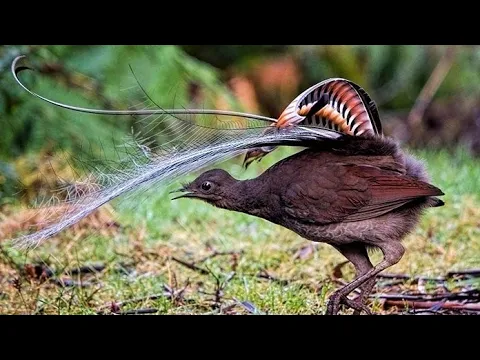

This precision explains why it can mimic urban signals, tools, mechanical sounds, songs of other birds, and even human footsteps in the vegetation.
Imitation Is Not A Game: It Is An Evolutionary Strategy
The ability to imitate did not arise by chance. It is linked to the courtship ritual of the species. During the breeding season, males display their lyre-shaped tails, fan their feathers like a peacock, and produce highly complex sound sequences to attract females and fend off rivals.
A single individual can imitate up to 20 different species of birds, as well as environmental sounds. The greater the sound complexity and accuracy, the higher the chances of the male being chosen — a classic case of sexual selection.
Real Recordings That Surprised The World
The most famous recordings were made in Australian forests over the last 50 years, including documentaries from the BBC and National Geographic. In scientific and audiovisual recordings, the lyrebird has already reproduced:
• chainsaws operating in tree cutting
• car alarms going off
• shutter and film advance of analog cameras
• various sirens
• human footsteps on leaves
• distant hammering
• door clicks
• dog barks and cat meows
• cries of predatory birds
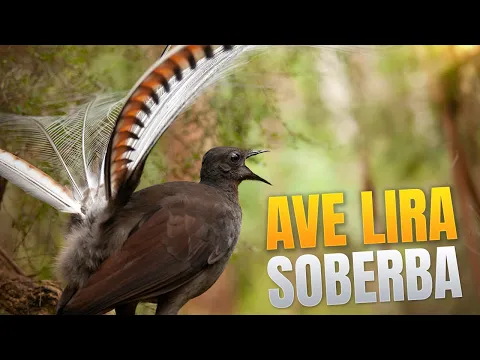
In more remote environments, where human impact is lower, it mainly imitates predators, rival birds, and natural sounds, showing how behavior changes according to the environment.
Musical Intelligence And Auditory Memory
Bioacoustics researchers describe the lyrebird as a “sound architect.” This is because, in addition to imitating, it organizes sounds into coherent sequences, inserting repetitions, pauses, and variations — a behavior compared to rhythmic structures.
The species also possesses long-lasting auditory memory, being able to reproduce sounds years after the first exposure.
The Connection With The Australian Forest
The lyrebird does not rely solely on its sound ability to survive. It inhabits dense, humid forests in eastern Australia, where it uses its tail and feet to turn over the soil in search of insects, spiders, and small invertebrates.
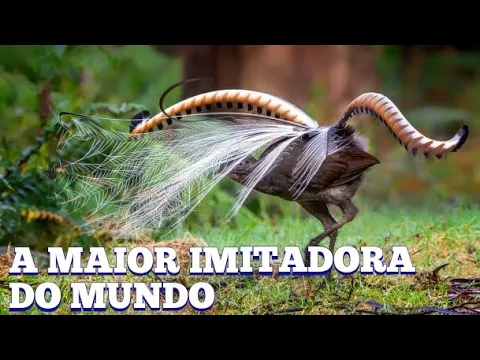
Its ornate feathers — especially in males — are considered one of the most impressive structures in the animal kingdom, with patterns that resemble curved metallic wires.
Despite its modern fame as an urban imitator, historical records show that Australian Indigenous people have known of its capability for centuries, using the lyrebird’s song as a reference to identify the presence of predators and movement in the bush.
In the end, the question remains: how far can nature go in creating complex and highly specialized behaviors? And how many species still hide capabilities that we can scarcely imagine?


