






 Portuguese
  Spanish


In La Gomera, In The Canary Islands, Residents Maintain A Whistled Language Capable Of Transmitting Phrases Over Kilometers That Intrigues Linguists And Neuroscientists.
Few people imagine that a human language can exist without articulated words, without open vowels, without consonants produced by the mouth, and without visual contact between speakers. In parts of the Canary Islands, a Spanish territory in the Atlantic, this has been a reality for centuries. There, shepherds, farmers, and residents developed a unique form of communication: a language entirely based on whistles, capable of being heard over long distances between valleys, ravines, and mountains. What makes this case even more curious is that it is not a “simple code,” but a structured linguistic system, with sounds equivalent to the phonemes of Spanish and the capacity to convey complete sentences.
This language is known as Silbo Gomero, and its existence challenges conceptions of what is necessary for a signaling system to be considered “language” in the academic sense. Unlike military codes or signals used by scouts, Silbo does not just serve to identify actions or objects.
It allows for complete conversations, the exchange of information, and even daily discussions. It is no exaggeration to say that it proves how the human brain can adapt language to extreme environmental contexts.
-
In Los Angeles, Young Adult Opts for Garage Living with Bed, Kitchen, and Bathroom to Avoid Rent, Highlighting Comfort and Organization Challenges in Compact Housing

-
Brazil Faces Crisis as New Data Reveals Alarming Rates of Youth Unemployment and School Dropouts, with Joblessness More Than Double the National Average and High Informality Among Teens

-
Former Flamengo player and coach Filipe Luís gives up $1.4 million Rio mansion with 5 suites, private soccer field, and pool with hot tub to pursue a dream.
-
New Tourist Complex in Brazil’s São Paulo Coast Features 500-Meter Pier, James Bond-Themed Museum, Parking for 600 Vehicles, and 3,000 Jobs Expected After Opening


The Geography Of The Canary Islands And The Birth Of A Whistled Language
To understand why a people started to “speak by whistling,” one must look at the environment. La Gomera, one of the islands of the Spanish archipelago, is made up of deep valleys, canyons, and steep slopes. Since European colonization and the presence of ancient indigenous peoples, communication between communities had to overcome long distances and significant physical barriers. The human voice does not reach such distances, and walking along trails can take hours. Whistling, on the other hand, traverses kilometers and remains intelligible when echoing between mountains.


Before the arrival of the Spaniards, historical accounts indicate that indigenous peoples of the Canaries already had forms of whistled communication. Over time, Silbo adapted to the phonology of Spanish, becoming a rare case where a spoken language is completely “translated” into whistles while maintaining functional structure.
For centuries, Silbo was a working tool for shepherds and farmers who needed to coordinate animals, warn about visitors, report fires, or simply talk between valleys.
In other words, Silbo was born out of necessity but survived through culture.
How A Whistled Language Works: Phonemes, Intonations, And Structure
At first, it may seem impossible to represent whole words with whistles. After all, we speak with vowels and consonants articulated by lips, tongue, and vocal cords. But when linguists analyzed Silbo, they concluded that it represents the phonemes of Spanish through variations in pitch and timbre.
Technically speaking, Silbo has two main dimensions:
- Pitch — which replaces contrasts between consonants.
- Melodic Contour — which replaces contrasts between vowels.

By combining these dimensions, the system can reproduce patterns equivalent to those of speech. Studies conducted by the University of La Laguna have shown that proficient speakers can distinguish up to 4 melodic variations for vowels and at least 6 series for consonant sounds. This allows for the representation of syllables and the construction of complete sentences.
The result is a set of seemingly similar whistles for those unfamiliar with the system, but completely intelligible to those who learned the encoding from a young age.
Range, Intelligibility, And An Adaptation To The Environment
The most impressive characteristic of Silbo is not only its linguistic structure but also its range. In mountainous environments, whistles can travel over 3 kilometers without significant loss of intelligibility, something impossible with normal speech.
This occurs because high frequencies propagate better in open areas and do not suffer as much interference as low-frequency waves.
For rural activities in the 19th and 20th centuries, this meant efficiency: two people could converse from one valley to another without moving, saving time and energy. Today, this ability has become part of La Gomera’s cultural identity, as well as inspiration for research in acoustics and communication.
School, Preservation, And Recognition As Cultural Heritage
During the 1950s and 1960s, Silbo nearly disappeared. The advancements of urban life and the use of telephones reduced the need to whistle messages. However, starting in the 1990s, educational and community authorities initiated a rescue process. Today, Silbo Gomero is officially taught in schools on the island, and children grow up learning both Spanish and the whistled version.
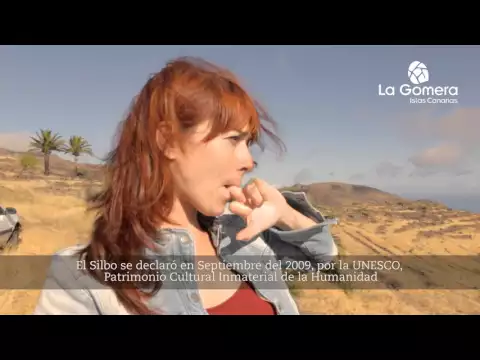
In 2009, UNESCO recognized Silbo Gomero as Intangible Cultural Heritage Of Humanity, reinforcing its historical and scientific value. This type of recognition is not just symbolic: it ensures documentation, preservation, and academic attention.
The Interest Of Linguistics And Neuroscience
Silbo has drawn attention not only for being curious but also for questioning how the human brain processes language. In studies conducted by Spanish and French neuroscientists, proficient speakers underwent brain imaging while listening to Silbo.
The result was surprising: the same areas of the brain activated by normal speech were activated by the whistled language.
In other words, for trained brains, whistles are not musical sounds or artificial noises; they are language. This challenges the idea that speech relies exclusively on signals articulated by vocal cords and opens up discussions about cognition, multimodality, and cultural evolution.
For linguists, Silbo shows that:
- a language does not need a unique acoustic form;
- environment and necessity shape linguistic systems;
- the brain can reinterpret sound stimuli as discourse.
These points make Silbo a rare case study, alongside a few whistled languages found in places like Turkey, Mexico, and the Amazon, but none as well documented as that of La Gomera.
Identity, Future, And The Curiosity It Arouses
Although Silbo is still occasionally used for real communication, its role today is more cultural and educational. Tourists are impressed to see trail guides demonstrating phrases, and linguists continue to study the phenomenon as a living example of cognitive plasticity.
The most fascinating aspect is that, even in a world dominated by smartphones, satellites, and instant messengers, the whistled language continues to exist not for utility, but for identity.
This raises an important question: if human language can take on forms as diverse as speech, writing, signs, and whistles, to what extent do we still underestimate the brain’s creativity in response to the environment?
Silbo Gomero responds with a simple yet powerful lesson: when humans need to communicate, they find a way, even if it is through the wind.


