






 Portuguese
  Spanish


Astronomers discover two giant exoplanets with extremely low density, comparable to cotton candy, and spark interest in exoplanet formation.
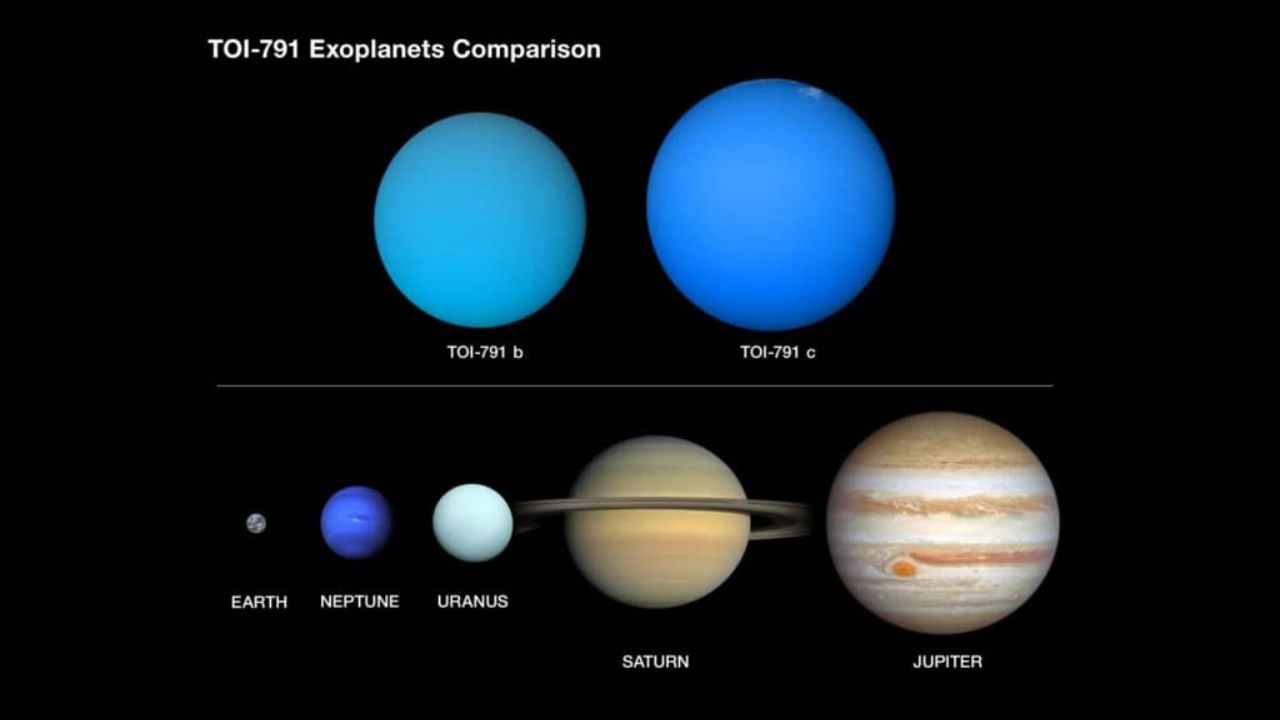
Imagine a planet almost the size of Jupiter, but so light that its density can be compared to cotton candy. It was precisely this unusual characteristic that led astronomers to turn their attention to TOI-791 b and TOI-791 c, two exoplanets located about 1,110 light-years from Earth. The discovery expands knowledge about the so-called super-inflated planets, an extremely rare category that still challenges scientific explanations.
What makes these giant exoplanets so different?
When researchers analyzed the data obtained by NASA’s TESS satellite, they noticed that the two worlds displayed an unusual combination: dimensions similar to those of Jupiter, but a mass much lower than expected for bodies of this size.
This characteristic gives the exoplanets an exceptionally low density, making them the largest objects of this type ever identified by scientists.
-
NASA’s Plan to Dump ISS Debris in Ocean Sparks Environmental Concerns Among Scientists

-
14-Year-Old Invents Eco-Friendly Water Pump Using Recycled Materials to Aid Communities Without Water Access
-
Pigeons Trained to Detect Cancerous Changes in Medical Images Astonish Scientific Community

-
Plastic Waste from Beaches and Poor Communities in Kenya Transformed into School Desks, Replacing Wood in Classrooms and Turning Marine Litter into Durable Study Tables


While Jupiter is known for its enormous mass, TOI-791 b and TOI-791 c have a much more “inflated” structure, placing them among the most unusual cases ever recorded by astronomy.
Category includes less than 40 known exoplanets
Despite the thousands of discoveries made in recent decades, super-inflated planets remain an exception. Currently, astronomers have confirmed approximately 6,300 exoplanets outside the Solar System.
However, less than 40 belong to the same group as TOI-791 b and TOI-791 c, making each new identification an important opportunity to understand how these objects form and evolve. The two celestial bodies orbit a star located in the constellation of the Flying Fish, in the southern celestial hemisphere.
Composition is still a mystery for researchers
Although the team responsible for the study believes that these giants are mainly composed of hydrogen and helium, there is still no confirmation about their internal structure.
Scientists intend to use the James Webb Space Telescope to investigate the atmosphere of these worlds with greater precision. The expectation is to discover which chemical elements predominate in their composition and understand why these planets developed such a reduced density.
Another hypothesis to be analyzed involves the presence of different cloud layers, which may alter the appearance and even the observed coloration of these exoplanets.
Discovery may help explain how such unusual worlds arise
The research, led by George Dransfield from the University of Oxford, reinforces that there are still many unknown aspects about the formation of gas giants outside the Solar System.
According to the team, the lightness of these planets is so unusual that their density can be compared to that of an extremely airy foam. This characteristic makes TOI-791 b and TOI-791 c important natural laboratories for testing theories about the evolution of exoplanets.
The identification of TOI-791 b and TOI-791 c represents more than the recording of two new exoplanets. The study offers an opportunity to understand still little-known processes about the formation and evolution of the so-called super-inflated planets.
As this type of object is extremely rare, each new discovery provides important information for astronomers to refine models that explain the origin of planetary systems outside the Solar System.
Future observations may clarify why these giant planets managed to reach dimensions comparable to Jupiter without acquiring a proportional mass, becoming some of the most unusual celestial bodies ever found by modern astronomy.
With information from Olhar Digital


