Portuguese
  Spanish




The Largest Tropical Forest on the Planet Covers Millions of Square Kilometers of National Territory and Brings Together Documented Evidence of Human Occupation, Social Organization, and Environmental Knowledge Over Millennia
Of this total, approximately 5.5 million square kilometers make up dense forest areas. Many of these regions have extremely limited access, making continuous research and permanent human settlement difficult.
In Brazil, about 60% of the Amazon remains within national borders. This portion represents approximately 4.2 million square kilometers, according to official surveys from the Ministry of the Environment, published throughout the 2010s.
-
Salvador’s Acarajé Vendors Turn Used Frying Oil into Income by Selling it for Biodiesel Production

-
Volunteer Revives Dead Lake in Bengaluru Overnight, Doubling Water Capacity and Attracting Kingfishers and Herons
-
1909 Train Car Once Destined for Abandonment Transformed into Luxury Accommodation in the U.S. After $3,000 Restoration

-
86-Year-Old Brazilian Man Starts Homemade Bread Business After Learning from TV Recipe


Even so, vast stretches remain sparsely populated and poorly studied. This scenario is exacerbated in areas of continuous forest. In these regions, the population density remains extremely low.

The Creation of the Legal Amazon and the Organization of the Territory
In 1953, the Brazilian government created the Legal Amazon. The Law No. 1,806, sanctioned during the administration of Getúlio Vargas, formalized this administrative delimitation.
Since then, this territorial division guides public policies and economic, environmental, and historical studies. The area has come to serve as a reference for national scale analyses.
Currently, the Legal Amazon covers about 5 million square kilometers, which corresponds to approximately 59% of Brazilian territory.
Nine states are part of the region. Pará, Amazonas, Roraima, Amapá, Rondônia, and Acre are fully included. Meanwhile, Maranhão, Mato Grosso, and Tocantins participate only partially.
Why the Amazon Was Treated as an Uninhabitable Region
For centuries, researchers classified large portions of the forest as uninhabitable areas. This view prevailed until the 19th century and influenced public policies and academic studies.
From 1850, European naturalists began systematic scientific expeditions. Later, Brazilian missions expanded these investigations throughout the 20th century.
For decades, this approach reinforced the idea of a sparsely inhabited forest. The narrative ignored consistent evidence of ancient human occupation.
However, from the 1970s, archaeological research began to identify traces of human occupation over more than 10,000 years.
These records mainly emerged in areas of Amazonas and Pará. Over time, Brazilian universities and international centers began to recognize these findings.
Artificial Soils Reveal Planned Human Occupation
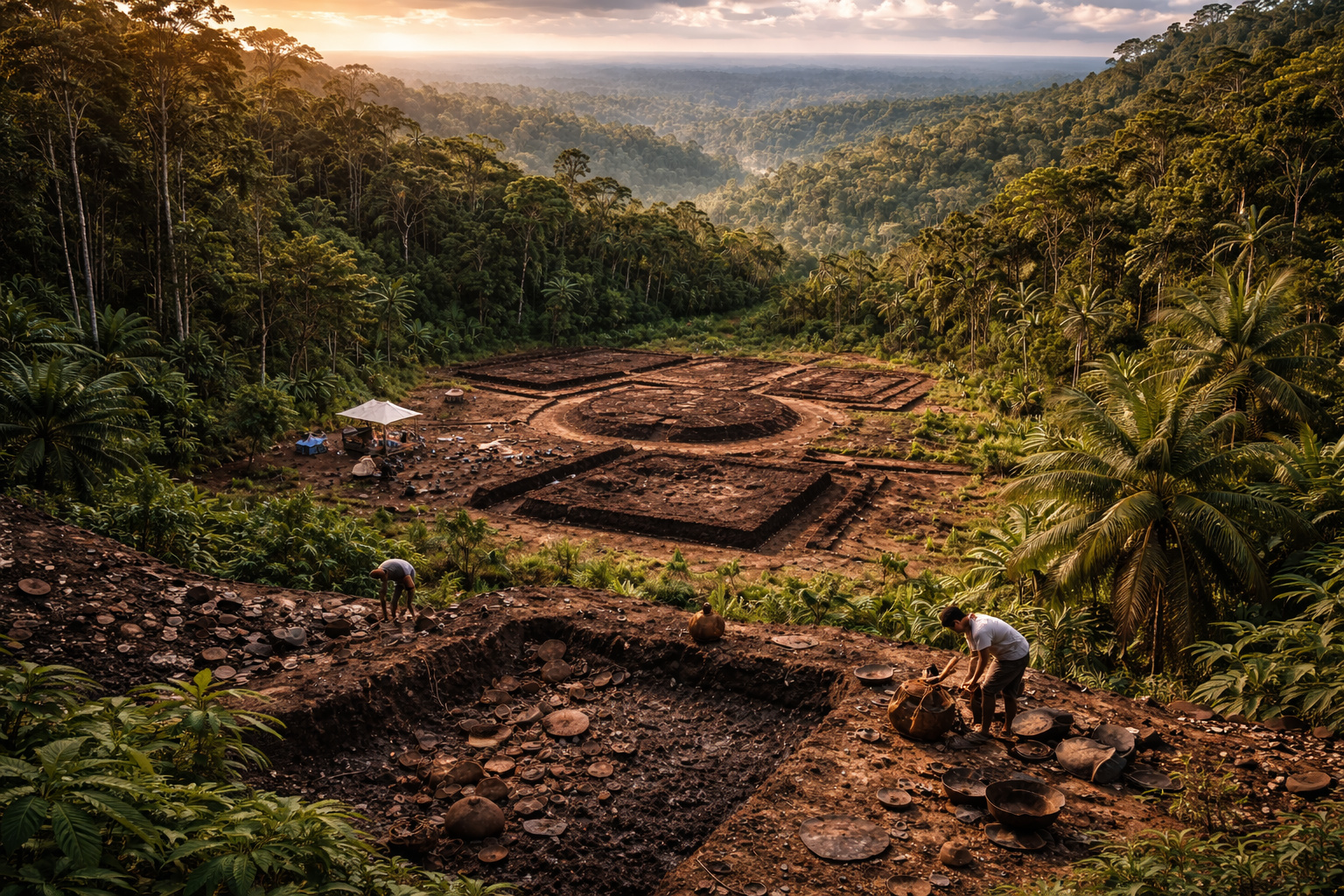
Among the most relevant discoveries, the black earth of the Indians stands out. This anthropogenic soil formed between 500 B.C. and 1500 A.D..
According to Embrapa, continuous and planned human action created this type of soil. It indicates structured agriculture, environmental management, and long-term occupation of the forest.
Moreover, the presence of this soil in different parts of the Amazon reinforces a central fact. Pre-colonial populations not only inhabited the region. They also consciously transformed the environment.
These findings contradict old interpretations of historiography, which for decades treated the forest as a practically untouched space.
New Research Changed the View on the Amazon
From the year 2000, the advancement of research consolidated new interpretations. The studies show that pre-colonial Amazonian societies developed their own technologies.
These technologies adapted to the conditions of the forest environment. They included strategies for land use, territorial organization, and the utilization of natural resources.
As a result, these data have begun to integrate revisions of Brazilian official historiography. The idea of an historically empty Amazon has lost strength.
Today, the 2,124,000 square miles of still underexplored Amazon rainforest represent more than an environmental heritage. They reflect a territory shaped by people, technical knowledge, and environmental adaptation over millennia.
After all, how can we fully understand Brazil’s past without looking at what has remained hidden beneath the largest forest on the planet?