






 Portuguese
  Spanish
  3 min of reading
  0 comments


Few Know, But Gustave Eiffel Built a Secret Apartment at the Top of the Eiffel Tower! At 280 Meters High, the Engineer Hosted Thomas Edison and Conducted Scientific Experiments in the Clouds of Paris
Not many people know, but at the highest point of the Eiffel Tower, there is something that few tourists imagine finding: a small private apartment built by Gustave Eiffel himself, the engineer responsible for creating the most famous monument in France. Hidden over 280 meters above the ground, this space was, for a long time, one of the most curious secrets of Paris, and today can be seen by those who visit the top of the tower.
A Refuge Among the Clouds of Paris
Gustave Eiffel’s apartment was built in 1889, on the third floor of the tower, as a personal refuge and study space. While the rest of the metal structure was intended to accommodate antennas, offices, and public viewing areas, the engineer wanted to reserve an intimate space for himself, away from the hustle and bustle of the city.
With wooden furniture, floral wallpaper, and even a piano, the environment had a simple, almost rural charm, contrasting with the steel and iron of the structure. Gustave Eiffel was not seeking luxury; he simply wanted a place where he could think, host guests, and work in peace.
-
The War of Jenkins’ Ear: How a Severed Ear Sparked One of the 18th Century’s Most Unusual Conflicts

-
The True Story of Beavers Parachuted into Idaho: A Post-WWII Mission Using Planes and Special Crates to Relocate 76 Animals to a Remote U.S. Region
-
Trailblazing Brazilian Mother of Three Becomes First Woman to Drive BYD Electric Truck, Inspiring Her Daughter to Follow Suit

-
6-Year-Old Boy Finds 1,000-Year-Old Viking Sword During School Activity in Norway


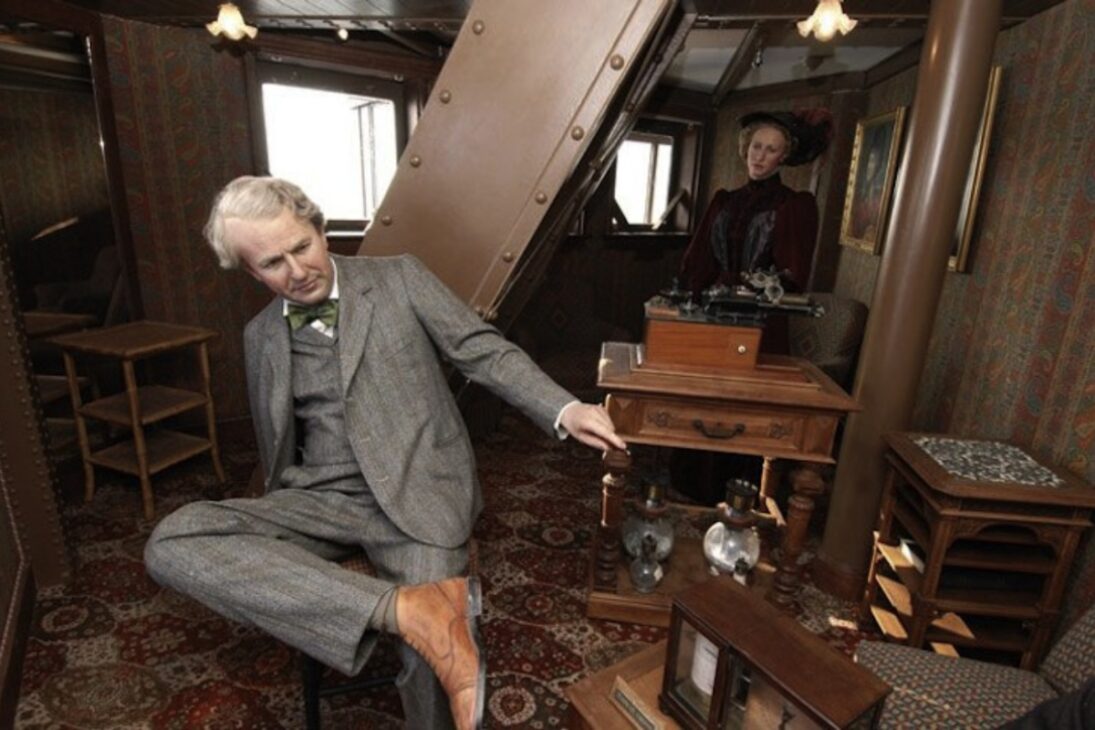
One of the most illustrious visitors was Thomas Edison, the American inventor who, in 1889, gifted Eiffel a phonograph. The meeting between the two geniuses symbolized the union between European engineering and American creativity at a time when Paris was the center of worldwide innovation.
A Laboratory in the Sky
More than just a resting space, the apartment also served as a scientific laboratory. Gustave Eiffel was fascinated by meteorology, physics, and radio communication, and took advantage of the tower’s privileged altitude to conduct experiments on wind, atmospheric pressure, and radio wave propagation.
There were some of the first measurements of wind speed at high altitudes, fundamental for the emerging aviation at the beginning of the 20th century. The engineer also collaborated with French scientists in studies on wireless transmission, decades before the popularization of radio.
In a way, Eiffel’s apartment symbolizes the spirit of the industrial age: a combination of scientific curiosity, technical ingenuity, and the human ambition to reach the sky. Every object in the space — from the small barometer on the table to the windows overlooking the Seine — reflects this quest for knowledge that marked the late 19th century.
The Secret Apartment That Still Exists
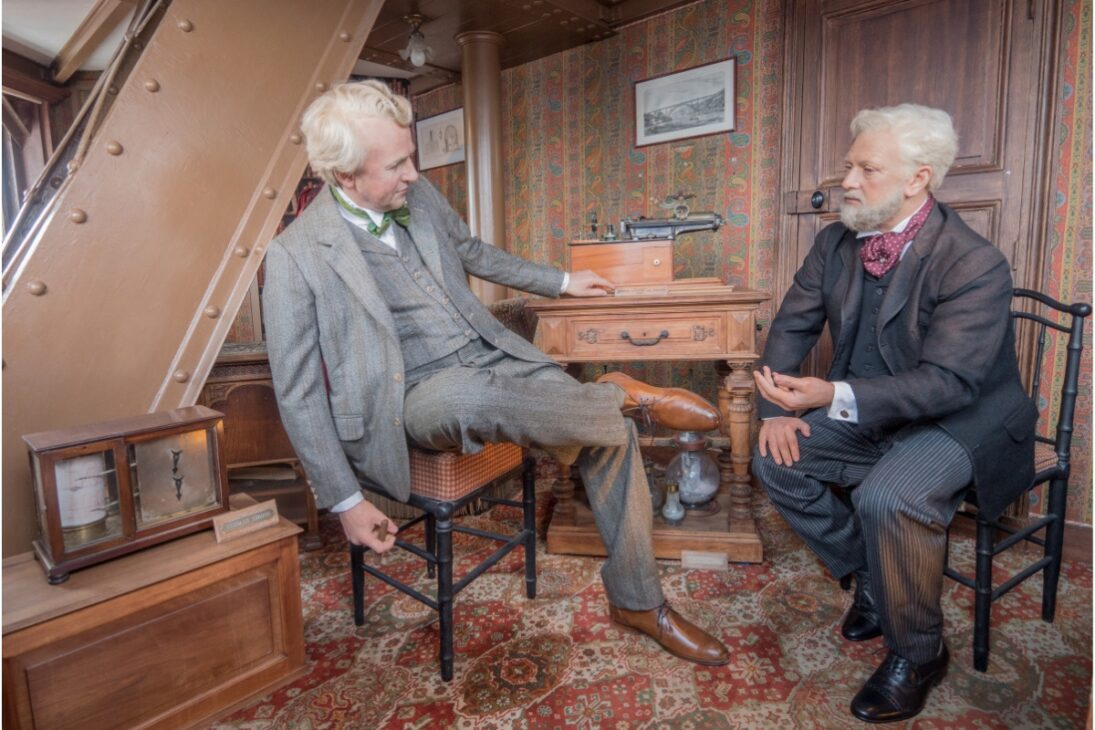
Today, the “secret apartment” is still there. Renovated and preserved by the tower’s administration, the space can be seen by visitors at the top, although access to the interior is restricted. From the outside, it is possible to observe through the window wax figures representing Gustave Eiffel, his daughter Claire, and Thomas Edison, recreating the original atmosphere of the place.
The preservation of the environment is one of the lesser-known aspects of the history of the Eiffel Tower. When the monument was inaugurated in 1889, many Parisians considered it a metal monstrosity. Years later, the same symbol came to represent French elegance and progress, and the small apartment at the top became part of this narrative.
The charm of the place lies in the contrast: while millions of tourists circulate daily through the cafés and platforms of the tower, few know that, high above, there exists an intact piece of Gustave Eiffel’s life, a silent witness to a time when science and art walked hand in hand.
Today, those who visit the top of the Eiffel Tower can, for a brief moment, look through the glass and imagine the French engineer writing notes at sunset over Paris, surrounded by scientific instruments and metallic dreams. A symbol of how human beings have always strived to rise up, not just in height but in knowledge.





-

1 person reacted to this.