






 Portuguese
  Spanish


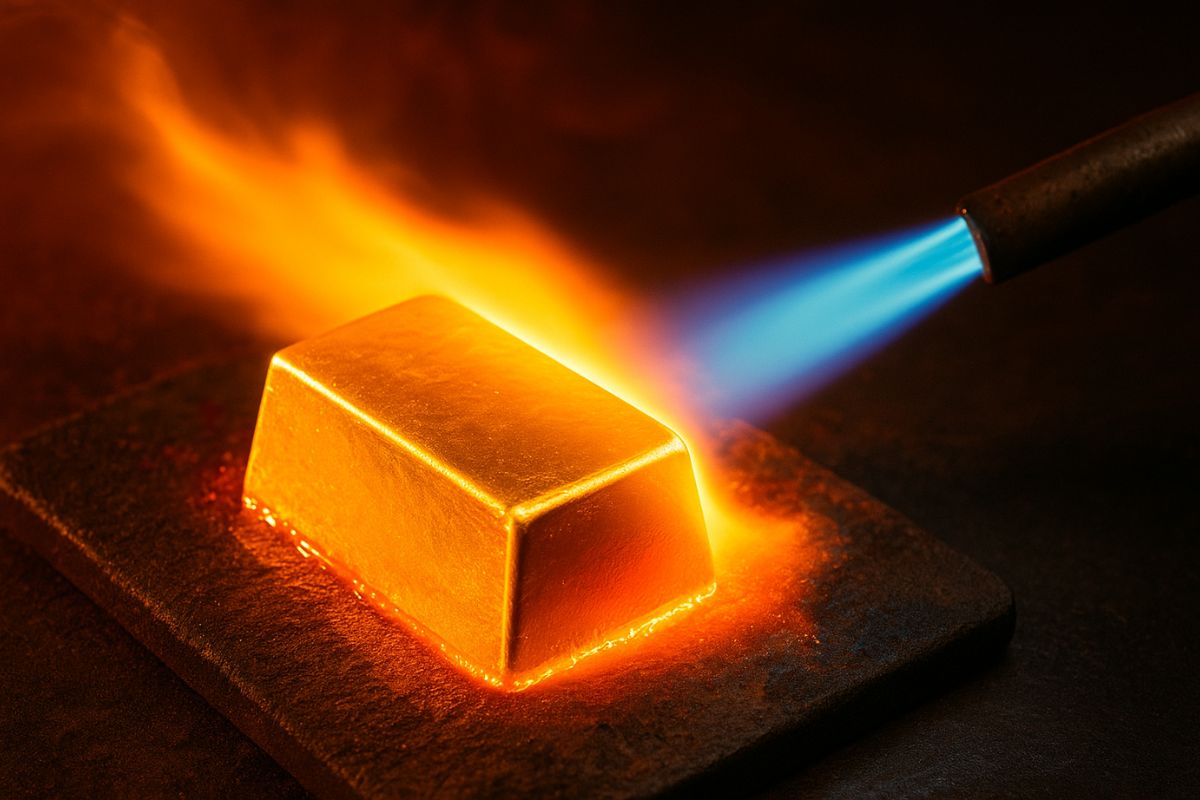

Experiment Shows That Gold Can Remain Solid At Temperatures 14 Times Above The Melting Point, Surprising Scientists
A study published in the journal Nature revealed that gold withstands extreme heat far beyond what traditional physics predicted. The research, conducted by scientists at the SLAC National Accelerator Laboratory in the United States, used ultrafast lasers to heat the metal to about 19 thousand Kelvin (over 18,700°C).
Even under these extreme conditions, gold remained solid for trillionths of a second, challenging current models about the behavior of materials in solid state. The observed phenomenon, known as superheating, reignites debates about the limits of atomic stability in high-energy situations.
Superheating Keeps Gold’s Solid Structure Intact
In the experiment, researchers used ultra-short laser pulses to heat small samples of gold at extremely high speeds. The goal was to force the material to exceed the so-called “entropy catastrophe” — the point at which the structure of the solid theoretically collapses and transforms into liquid.
-
Meta to Launch Arena, a New Prediction App Targeting 3.56 Billion Users, Competing with Polymarket and Kalshi

-
Scientist Challenges Famous Human Evolution Theory, Argues Homo Sapiens Evolved Gradually Over Thousands of Years
-
15-Year-Old American Builds Ocean Generator with PVC Pipe and 3D-Printed Propeller for $12, Wins National Prize, Presents at White House, and Makes Forbes 30 Under 30 List

-
$12 Billion Invested in AI Data Centers in Semi-Desert Mexican State, But 17 of 18 Municipalities Now Face Water Shortages, Residents Receive Water Only 3 Days a Week




However, gold behaved unexpectedly. Melting did not occur immediately, as the heat was applied so quickly that the atoms did not have enough time to reorganize into a liquid state. This behavior is due to extreme superheating, a condition in which the material remains solid even after exceeding its conventional melting point.
Gold Exceeded 14 Times Its Known Melting Point
During the test, gold was heated up to 14 times above its melting point, remaining solid for more than two picoseconds. Although this interval may seem insignificant, it is long enough to challenge established scientific predictions.
Previous models indicated that superheating could reach a maximum of three times the melting point. The new measurement forced physicists to revise this limit, as gold’s behavior showed thermal resistance far greater than imagined. To accurately measure the absorbed energy, scientists used reflected X-rays, allowing them to analyze the process at an atomic scale.
Study Does Not Violate Laws of Physics, But Requires Update of Models
According to Tom White, a professor at the University of Nevada and one of the study’s authors, the results do not violate the laws of thermodynamics. They merely indicate that, on extremely short timescales, materials can behave differently than expected by classical physics.
Now, the team plans to test the same procedure with other solid materials, such as tungsten, titanium, or carbon. If the phenomenon repeats, it will be necessary to revise melting and stability tables used in fields like nuclear engineering, aerospace, and astrophysics.
Practical Applications Range From Heavy Industry To Astrophysics
The discovery could have direct impact on the understanding of extreme events, such as asteroid collisions, solar flares, or failures in nuclear reactors. In all these cases, matter is subjected to high temperatures for fractions of a second, and the behavior of solids is still poorly understood.
For Bob Nagler, a scientist at SLAC, the study opens new possibilities: “If our first attempt already challenges known physics, imagine what else we might find”, he stated in an official statement. Gold’s resistance to superheating may be just the beginning of a new era of discoveries about the limits of matter.
Do you believe that this discovery about gold could transform the way we understand materials? What practical applications do you envision for this advancement?





