






 Portuguese
  Spanish


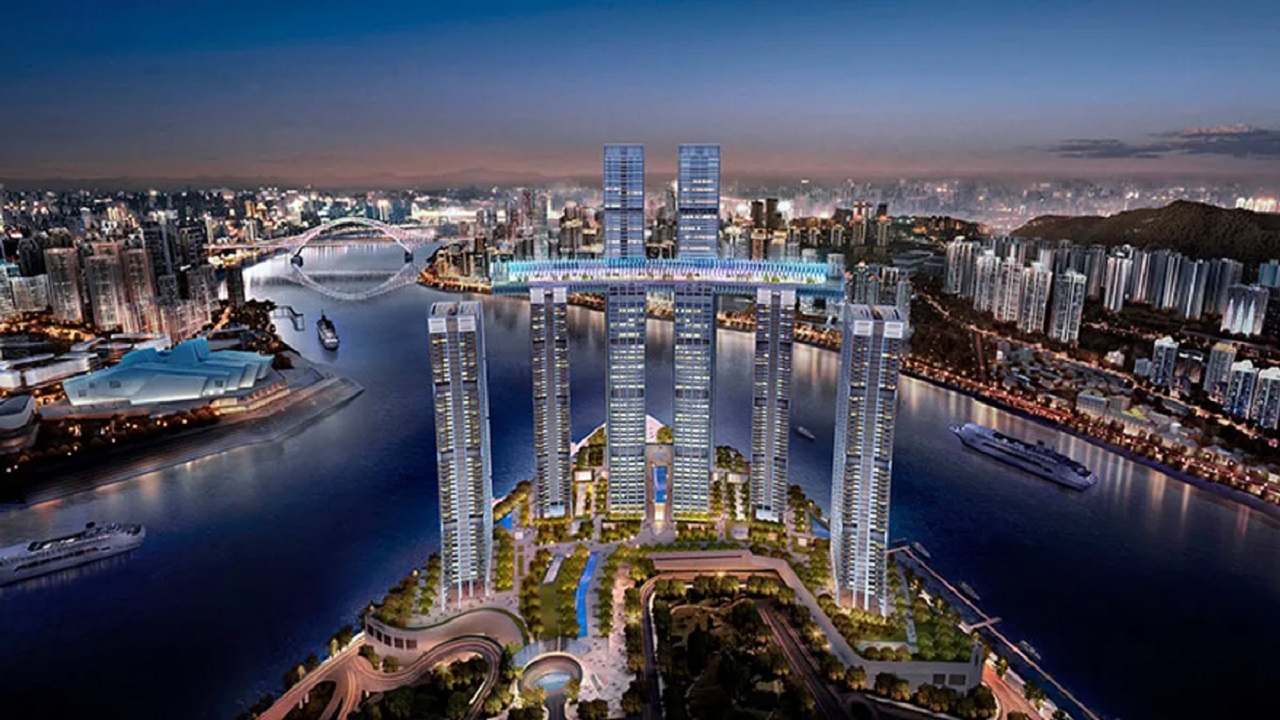
With More Than 1.12 Million M², Raffles City Chongqing Connects Eight Towers with a 300 M Skybridge and Reveals How Engineering Created a Suspended Block in the Air.
According to technical documents released by CapitaLand, structural reports from Arup, and records from the municipal government of Chongqing, the Raffles City Chongqing project began execution in 2013 in one of the most restricted and complex urban areas of China, exactly at the confluence of the Yangtze and Jialing rivers.
The region already had high construction density, saturated infrastructure, and severe space limitations, which led engineers to completely abandon the traditional logic of horizontal expansion and concentrate in a single complex functions that would normally occupy several independent blocks.
The Urban Scale Condensed in More Than 1.12 Million Square Meters
The defining data of Raffles City Chongqing is not its isolated height, but its total built area, which exceeds 1.12 million square meters. This number places the development in a rare category of megastructures that cease to be just buildings and turn into complete urban districts.
-
Canadian City Builds 8 Tiny Homes in 72 Hours for Homeless Youth, Plans 40 Affordable Houses for Female-Led Families Amid Housing Crisis

-
45-year-old Brazilian mother of 9 and grandmother of 12 receives 27 m² house made from recycled plastic, built in 15 hours with interlocking blocks and a recycled roof.
-
Ireland Installs 654 Modular Homes to Shelter 2,640 Ukrainian War Refugees, Offering a 60-Year Guarantee and a Model for Future Housing Crises
-
Sagrada Família Becomes World’s Tallest Church at 172.5 Meters, Surpassing German Church with Gaudí’s Design


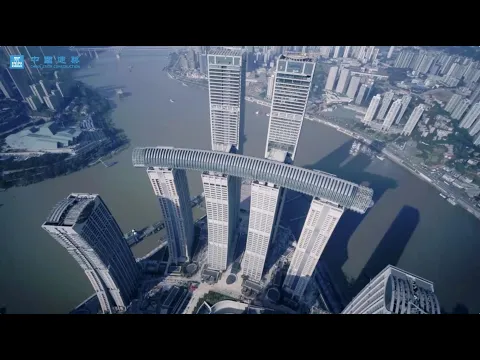

Within this area are distributed residential buildings, corporate offices, large-scale hospitality, shopping centers, elevated public areas, and circulation systems that reproduce, in three dimensions, the functional logic of an entire neighborhood.
This extreme concentration required that the structural project be envisioned as a single integrated system.
The towers do not operate independently; they share infrastructures, deep foundations, load transfer systems, and common platforms, which reduces redundancies but drastically increases the complexity of structural calculations and construction execution.
The Role of the Eight Towers and Large-Scale Load Transfer
The complex consists of eight main towers, two of which reach approximately 354 meters in height. These towers not only support their own vertical loads but also participate in the structural balance of the whole.
Instead of isolated structures, the project adopts stiff cores, transfer slabs, and linking systems capable of redistributing forces among the buildings.
This arrangement was essential to enable the most ambitious piece of the project: a horizontal suspended structure of approximately 300 meters in length, positioned dozens of meters above the ground.
Unlike conventional walkways, this structure was conceived as a complete suspended building, with its own weight, permanent human occupancy, and integrated building systems.
The Construction of the 300-Meter Skybridge Suspended Between Skyscrapers
Known as “The Crystal,” the horizontal structure of Raffles City Chongqing is approximately 300 meters long, over 30 meters wide, and dozens of meters high, forming a volume comparable to that of a medium-sized building arranged horizontally.
For its execution, large structural segments were manufactured on the ground and gradually hoisted to their final position, where they were connected with extremely tight tolerances.
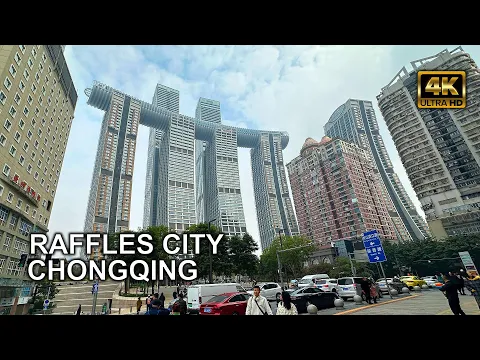
From a construction perspective, the challenge was not only the weight of the structure but also controlling relative movements between the towers. Thermal variations, wind, and natural deformations of the buildings required connections capable of absorbing displacements without compromising the integrity of the whole.
The skybridge needed to be designed to move in a controlled manner, following the dynamic behaviors of the towers that support it.
The Massive Consumption of Materials and Industrial-Scale Cladding
The material scale of Raffles City Chongqing is evident in the finishing and envelope numbers. Just in the suspended structure, about 3,000 glass panels and nearly 5,000 aluminum panels were used, forming a continuous architectural skin that covers an air volume of hundreds of meters. These numbers do not include the cladding of the towers, which further increases the total consumption of high-precision industrial materials.
The extensive use of glass required strict control of wind loads, thermal expansion, and energy efficiency, while the aluminum panels were sized to withstand severe climatic variations and ensure long-term durability.
Together, these materials transform the suspended structure into a visual landmark, but also into a permanent technical challenge of maintenance and performance.
A Complex That Functions as a Single Structural Machine
The final result of Raffles City Chongqing is a unique construction organism in which buildings, platforms, passages, and suspended volumes work as parts of the same structural machine.
This is not just about linking towers, but making them all share efforts, systems, and urban flows on a scale rarely seen in contemporary civil engineering.
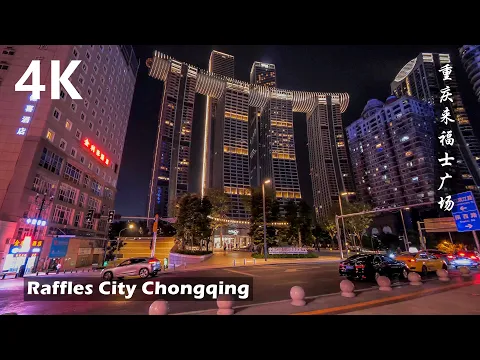
The construction became a reference precisely for demonstrating that, in saturated urban environments, the solution is not only to build higher but to integrate volumes, concentrate functions, and explore three-dimensional space as a direct extension of the city.
In the case of Chongqing, this resulted in a megastructure that materializes, in concrete, steel, glass, and aluminum, the idea of an entire block suspended in the air.


-

1 person reacted to this.