






 Portuguese
  Spanish



Get To Know The Middle Corridor (TITR), The Strategic Alternative That Gained Geopolitical Importance In 2025. We Analyze Its Route, Partners, Challenges, And The Future Of This New Commercial Route.
A multimodal trade route is redefining connectivity between Asia and Europe. The International Trans-Caspian Transport Corridor (TITR), known as The Middle Corridor, emerges as a strategic alternative that circumvents Russian territory. Driven by new geopolitical realities, its development has accelerated.
Understand in detail the Middle Corridor. We will explore its route, the geopolitical actors involved, the operational and economic challenges, and the future of this route that is gaining increasing importance in global trade.
What Is The Middle Corridor And Why Has Its Geopolitical Importance Grown?
The Middle Corridor is a transport network that uses railways, ships, and roads. Its main feature is to connect China to Europe via Central Asia, the Caspian Sea, the Caucasus, and Turkey, avoiding Russia. The genesis of the project dates back to 2013, but its evolution was initially slow.
-
Self-taught Brazilian Mechanic Builds 10-Ton Aluminum Sailboat in Backyard, Now Navigates the Brazilian Coast at 50

-
Santa Catarina Launches $1.4 Billion, 145-Kilometer Highway Project with Six Lanes and Speeds Up to 120 km/h

-
Couple Transforms 1913 School into 370 m² Home with Four Bedrooms After $175,000 Purchase and Three Years of Renovation
-
Bamboo Houses Built in 7 Days for the Price of a Smartphone: 26 Survived Intact in Myanmar’s 7.7 Earthquake




The importance of the Middle Corridor has grown exponentially after 2022. The Russo-Ukrainian war and sanctions against Russia made the Northern Corridor, traditionally dominant, less viable. This transformed the Middle Corridor from a niche initiative into a strategic imperative for many nations and companies.
The Countries And Infrastructure That Form The Middle Corridor
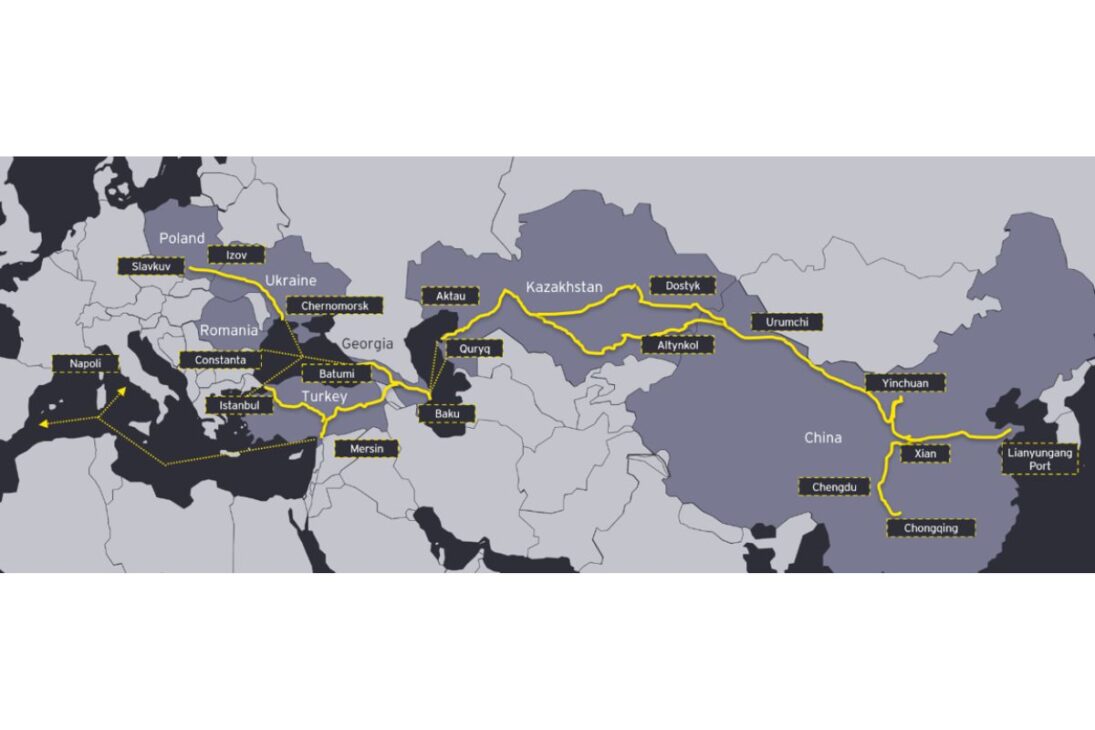
The route of the Middle Corridor mainly involves China, Kazakhstan, Azerbaijan, Georgia, and Turkey. Goods depart from Chinese industrial centers and cross Kazakhstan by rail. They arrive at the ports of Aktau and Kuryk on the Caspian Sea, from where they continue by ship to Baku, Azerbaijan.
From there, the cargo continues along the Baku-Tbilisi-Kars (BTK) railway through Georgia. The route then goes to Black Sea ports or overland through Turkey towards Europe. The multimodal nature, with multiple transshipments, is a key feature but also a logistical challenge.
The Interests Of China, EU, Turkey, And Transit Nations
The Middle Corridor is the stage for various geopolitical interests:
China: Seeks to diversify the routes of its “Belt and Road” Initiative (BRI) and reduce dependence on Russian transit.
European Union: Promotes the route through its “Global Gateway” strategy, seeking a “friendly” way to access resources from Central Asia and bypass Russia.
Turkey: Positions itself as a central logistics and energy hub, strengthening ties with Turkic states.
Central Asian and Caucasian Nations: Increase their sovereignty by reducing dependence on Russia, promote economic growth, and integrate into global supply chains.
Investments, Digitalization, And The Lasting Role Of The Middle Corridor In Global Trade
Diverse infrastructure projects are underway to modernize the Middle Corridor. Kazakhstan is doubling the Dostyk-Moiynty route and expanding its ports. Azerbaijan and Georgia are modernizing the BTK railway. The European Union has pledged 10 billion euros for the corridor’s development.
Digitalization is a priority to improve efficiency, with initiatives like the “Digital Transport Corridor.” Long-term growth projections are optimistic, with the World Bank predicting the potential to triple freight volumes by 2030. Although it may not surpass larger routes, the Middle Corridor is positioned to become a permanent and increasingly important pillar in Euro-Asian connectivity.


