






 Portuguese
  Spanish


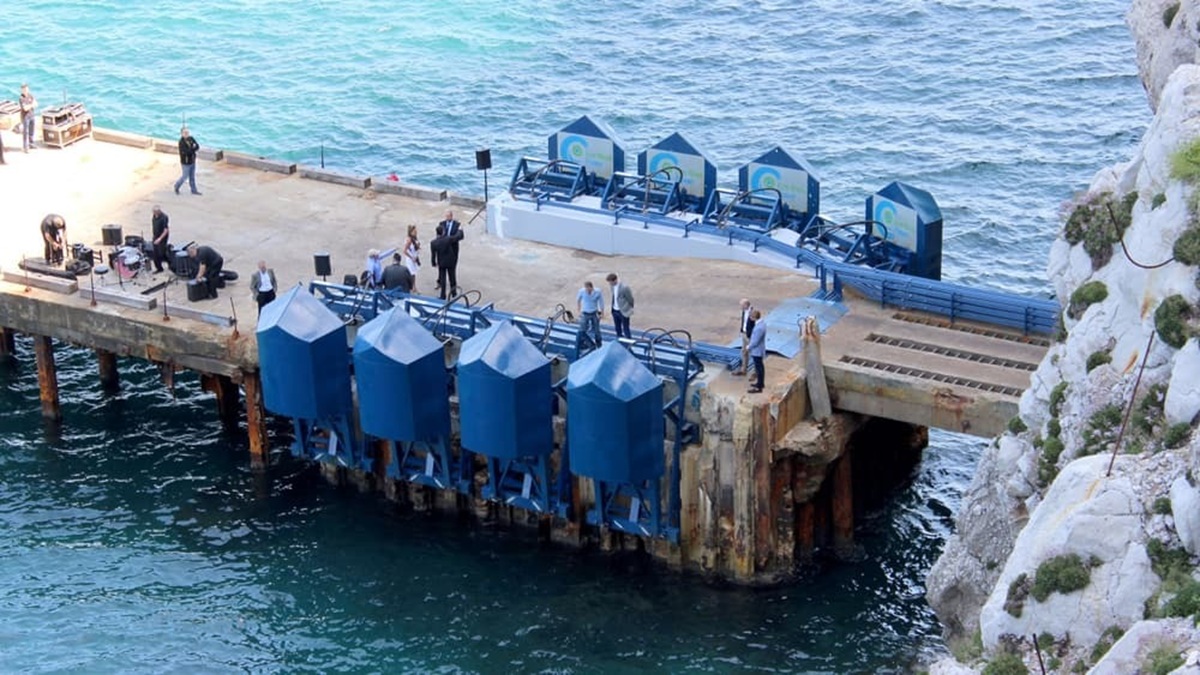

At The Port Of Los Angeles, A Bold Pilot Project Draws Attention. Blue Floating Blades Are Being Tested To Transform Wave Energy Into Clean, Renewable Electricity.
The Port of Los Angeles hosts an innovative experiment in the renewable energy sector. The company Eco Wave Power is testing blue floating blades that convert wave motion into clean electricity.
The system, called Energy Conversion Unit (ECU), completed its initial operational tests on August 27.
According to the company, this milestone represents the transition from the construction phase to pre-operation. CEO Inna Braverman highlighted that this step paves the way for the practical adoption of wave energy in the United States.
-
China Develops Custom 140-Ton Electric Mining Truck with 770 kWh Swappable Battery, Deploys 290 Units in Xinjiang’s Largest Zinc Mine

-
Meta to Launch Arena, a New Prediction App Targeting 3.56 Billion Users, Competing with Polymarket and Kalshi

-
Scientist Challenges Famous Human Evolution Theory, Argues Homo Sapiens Evolved Gradually Over Thousands of Years
-
15-Year-Old American Builds Ocean Generator with PVC Pipe and 3D-Printed Propeller for $12, Wins National Prize, Presents at White House, and Makes Forbes 30 Under 30 List




Founded in Israel in 2011, Eco Wave Power already has experience with similar projects.
How The System Works
The project uses floating devices that resemble piano keys. As the waves rise and fall, hydraulic pistons are activated.
They press a fluid that circulates through pipes, generating enough force to rotate a turbine. The resulting energy is converted into electricity inside 20-foot containers.
In the current pilot, eight floaters are attached to a concrete pier. The design allows the equipment to be retracted during storms, reducing risks of damage and maintenance costs.
This feature makes the technology more practical and economical compared to systems installed offshore.
Potential for Expansion
If the results convince California authorities, Eco Wave Power plans a significant expansion.
The goal is to install hundreds of converters along the 13 kilometers of the breakwater that protects the Port of Los Angeles. This infrastructure could supply up to 60,000 households with clean energy.
According to the AFP Agency, the project is seen as promising because it harnesses the constant movement of the sea. Unlike solar energy, which stops producing at night, and wind energy, which depends on the wind, waves offer greater predictability.
Wave Energy In The United States
The U.S. Department of Energy estimates that just the waves of the West Coast could, in theory, supply 130 million homes. This would equate to one-third of the country’s annual electricity consumption. Even with this potential, the industry has faced challenges in consolidating at a large scale.
Previous projects failed because they were installed far from the coast, increasing costs and complexity. Eco Wave Power aims to differentiate itself with a dock-mounted model, easier to maintain and operate.
International Perspective
The company’s ambition goes beyond U.S. territory. In Israel, at the port of Jaffa, the floaters have already powered local homes.
Additionally, upcoming plans include installations in Portugal, Taiwan, and India. The long-term vision anticipates projects up to 20 megawatts, capable of competing directly with other renewable sources.
Another point emphasized by the company is the environmental impact. The project promises not to affect marine life, a factor that attracts interest in regions like California, where there are carbon neutrality goals by 2045.
Strategic Importance
Authorities and experts consider the initiative a relevant step in combating climate change.
The dependence on fossil fuels is still considerable, but solutions like this could accelerate the energy transition.
The company has already set a date to officially present the project. The ceremony is scheduled for September 9, 2025, at the AltaSea space within the Port of Los Angeles.
Until then, the expectation is that the pre-operation phase will show practical results and reinforce the potential of waves as a source of clean energy.






