






 Portuguese
  Spanish
  5 min of reading
  0 comments


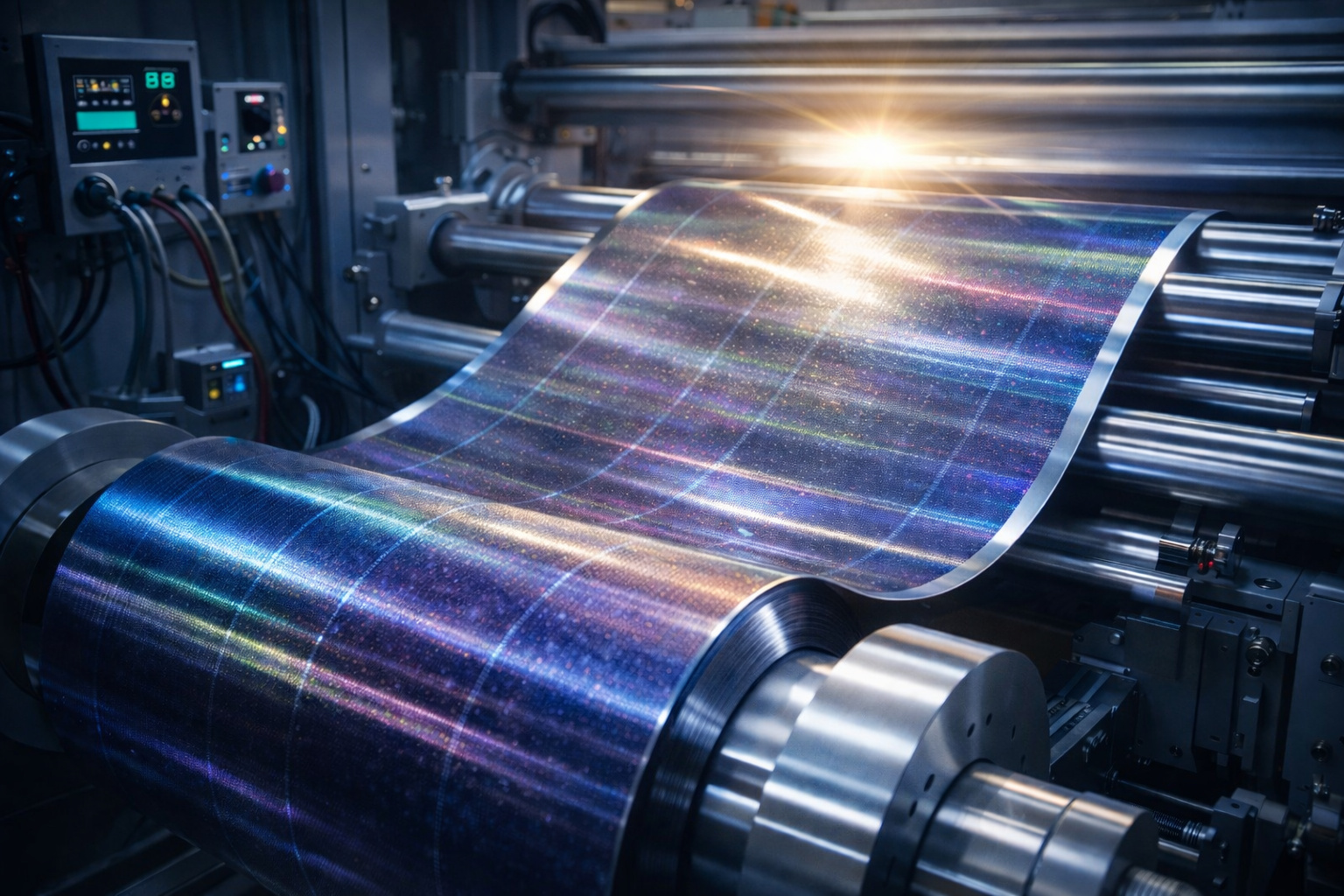
Roll-to-Roll Technology With Perovskites Allows for Printing Cheap Flexible Solar Panels, Increases Efficiency and Triggers Global Race for Photovoltaics.
Over the past four decades, solar energy has gone through a predictable evolution cycle: slow improvement in efficiency, continuous cost reduction, and expansion of industrial scale. However, this cycle almost entirely depends on crystalline silicon, an expensive material to purify, rigid, heavy, and limited to flat formats. This dependence is being disrupted by a technology that until a few years ago was just a laboratory experiment: printed photovoltaic perovskites in roll-to-roll (R2R) industrial processes.
The central point of this technology is not just to generate more energy per square meter, but to change the entire manufacturing logic, allowing solar panels to be printed like newspapers, on flexible plastic films, ultrathin glass, or metal substrates, drastically reducing production costs and expanding the possible uses of solar energy.
Perovskites: The Material That Challenges Silicon
Perovskites are a family of materials with a crystal structure of the type ABX₃, capable of absorbing light with high efficiency even in extremely thin layers. This characteristic allows for the creation of photovoltaic devices with thickness up to a thousand times smaller than that of a silicon cell, while maintaining high performance. The impact of this is significant:
-
Solar energy can increase property value by up to 10% and become a selling point.

-
Solar and wind energy surpass natural gas for the first time in the world and accelerate energy revolution

-
Africa has about 500,000 cell towers and most still burn diesel to operate, while companies rush to cover antennas with solar energy and avoid signal blackouts.
-
Farmers swapped diesel for solar panels in Pakistan, powered irrigation pumps almost cost-free, expanded rice fields, and now groundwater has become a red alert in the countryside.




- Less material
- Lighter weight
- Lower energy consumption in production
- Possibility of mechanical flexibility
- Compatibility with industrial printing


Institutions such as NREL (USA), Fraunhofer ISE (Germany), and Oxford PV (UK/Germany) have already proven that the theoretical ceiling of perovskites exceeds that of silicon, and tandem cells (perovskite+silicon) have surpassed 30% efficiency, while commercial silicon modules have stabilized between 20% and 23%.
The difference may seem small, but in solar energy, every 1% is a revolution — especially when associated with industrial cost reduction.
Roll-to-Roll Manufacturing: When Photovoltaics Become Graphic Industry
The term roll-to-roll (R2R) is common in the printing, packaging, and plastic film industries. It refers to machines where a roll of raw material traverses a continuous production line, receiving successive layers like in a high-speed printing press.
Applied to photovoltaics, R2R enables the production of solar panels using processes such as:
- slot-die coating
- inkjet printing
- gravure printing
- blade coating
- spray deposition
Instead of melting and purifying silicon at temperatures above 1,400°C, the R2R process works close to room temperature, greatly reducing the energy cost of manufacturing.
The MIT Energy Initiative estimates that the potential reduction in CAPEX and OPEX could significantly lower the final cost per square meter, paving the way for panels with prices close to those of industrial coatings.
This difference is not marginal — it changes the paradigm of solar energy.
From Research to Market: Europe Takes the Lead
Europe has become one of the industrial hubs for this technology. In 2021, the company Saule Technologies in Poland installed what many consider the first urban façade with printed flexible perovskite, inaugurating commercial use in buildings (BIPV — Building Integrated Photovoltaics). Meanwhile:
- Oxford PV inaugurated a pilot line for tandem perovskite+silicon cells in Germany, targeting premium efficiency for European homes.
- The Horizon Europe consortium invested in stability and encapsulation routes, the main bottleneck for lifespan.
Innovation has moved from being an academic thesis to entering the industrial sphere.
China, USA, and Japan Enter the Dispute — and the Game Turns Geopolitical
The new photovoltaic route is not just a technological challenge but a geostrategic dispute.
Today, the scenario is as follows:
- China focuses on industrial scale, material chemistry, and possible mass R2R manufacturing.
- USA concentrates on R&D in device physics, advanced characterization, and patents.
- Japan and South Korea target integration in electronics, mobility, and wearables, where flexibility is a differentiator.
This fragmentation creates an environment where intellectual property and chemical supply chains become more important than silicon and melting furnaces.
Applications That Silicon Never Managed to Occupy
More than just replacing conventional panels, printed perovskite opens up unprecedented markets, such as:
- transparent solar facades for skyscrapers;
- BIPV facades in historic buildings;
- urban furniture with integrated generation;
- drones and military devices;
- portable and wearable electronics;
- smart packaging;
- self-sustaining IoT sensors;
- vehicles with built-in solar generation.
These are markets where silicon has never managed to compete, due to its rigidity, weight, and visually intrusive nature. In this sense, perovskite does not only compete on efficiency — it competes for omnipresence.
Efficiency and Stability: The Two Crucial Battles
Every technological revolution carries a “Achilles heel.” In the case of perovskite, it has a name: stability. The main challenges are sensitivity to moisture, UV degradation, thermal instability above 80–100°C, and undesirable chemical reactions during its lifetime.
For this reason, laboratories and manufacturers are heavily investing in multilayer encapsulation, organic/inorganic barriers, and new formulations that replace more unstable halides. Efficiency, on the other hand, has already proven to be viable:
- perovskites have surpassed 25% in cell efficiency;
- perovskite+silicon tandems have exceeded 30% in cell efficiency and >28% in module efficiency;
- commercial silicon has plateaued at 20–23%.
The competition now is over reliability engineering, not efficiency physics.
Whoever Controls Perovskite Controls a New Energy Chain
If the energy transition of the 20th century was based on oil and engines, the 21st century’s transition is based on electricity and advanced materials.
Printed R2R perovskite represents a new industry, not just a new product; a new chemical chain, not just a new cell; a new manufacturing infrastructure, not just a new panel.
This type of change displaces investments, requires reindustrialization, and triggers geopolitical rearrangements — just as happened with semiconductors.
The Question Now Is When, And Not If
Silicon will not disappear — it still sustains over 90% of the global photovoltaic market and is making great strides with technologies like TOPCon and HJT. But printed R2R perovskite points to another type of future, where solar energy is flexible, cheap, invisible, portable, and omnipresent.
If the stability barrier is overcome, the next decade could witness something unprecedented: solar energy being produced like plastic packaging, driving a world where buildings, clothing, vehicles, furniture, and devices will be parts of energy infrastructure.
The question is no longer if this will happen, but who will dominate the intellectual property and industrial production when the market shifts. And when that happens, the oil of the 21st century could be a plastic film that generates energy.






-

-

2 people reacted to this.