Portuguese
  Spanish


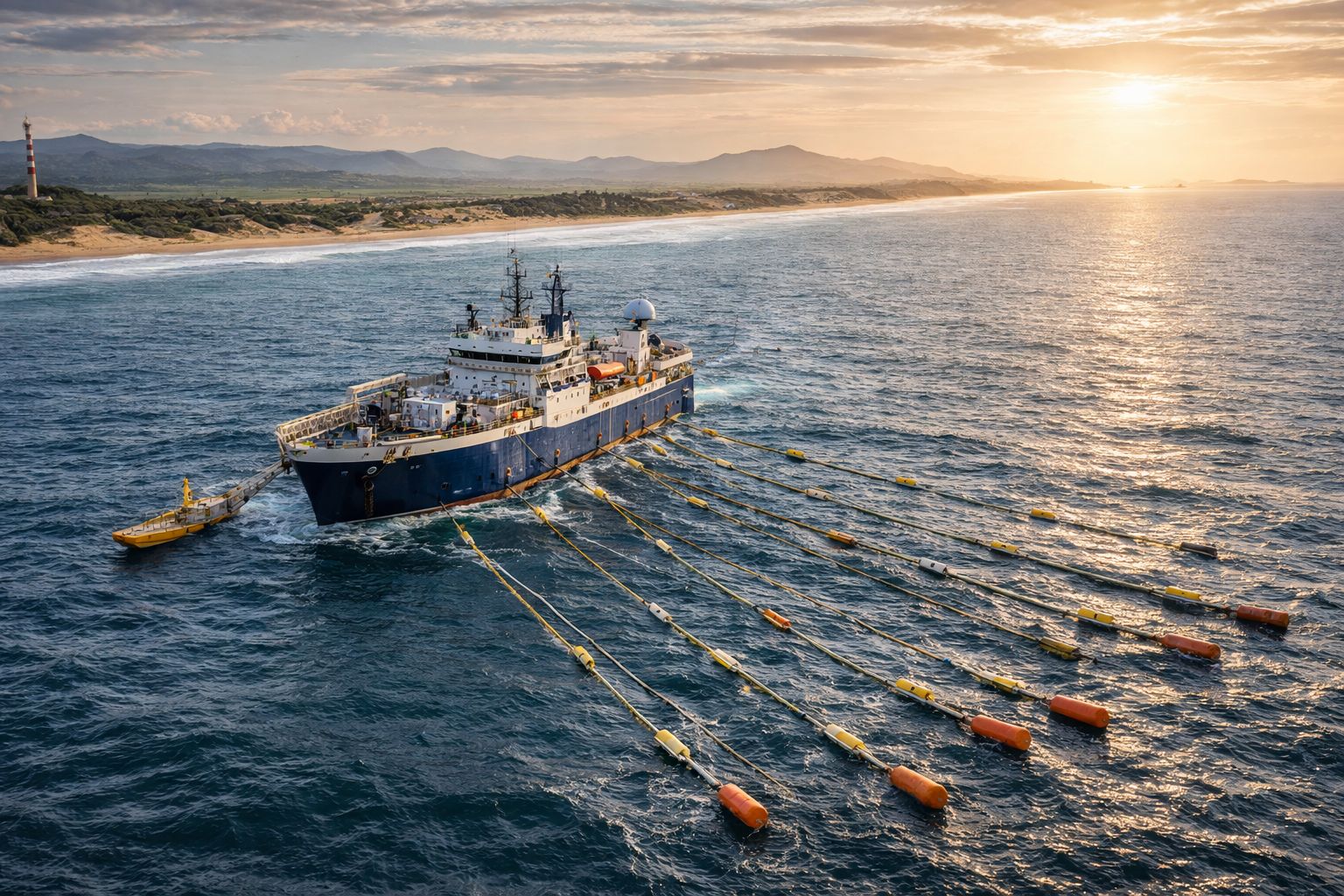


The Seismic Survey Started This Week Near Mostardas Repositions Oil at the Center of the Brazilian Energy Debate, Bringing Together Exploratory History, Technological Advancement, and Environmental Discussions on the Coast of Rio Grande do Sul.
The search for oil in Brazil has always been associated with cycles of expectation, investment, and public debate. This week, this movement gained a new chapter with the beginning of the seismic survey in the region near Mostardas, on the southern coast of the country. This activity marks the start of an extensive geological study program that is expected to last until 2028, according to official sector information.
The survey takes place in a maritime area south of Rio Grande do Sul and aims to map the seabed in search of signs of oil. Although it does not involve drilling, the seismic stage is considered essential to reduce risks and guide future exploration decisions. Without this mapping, there is no safe progress in the oil chain.
This type of study uses acoustic waves to generate images of the geological formations beneath the seabed. The technology has evolved significantly in recent decades. Still, the topic continues to attract attention, especially when it involves environmentally sensitive regions.
-
OPEC+ Boosts Oil Supply by 188,000 Barrels per Day in July 2026, Leading to Price Drop from $112 to $89 per Barrel in Under Two Months

-
TotalEnergies Signs 20-Year Deal to Purchase 2 Million Tons of LNG from Alaska, Boosting Project Viability
-
Turkey Deploys Çağrı Bey Drilling Ship to Explore New Oil Frontier Off Somalia’s Coast
-
Golden Pass LNG Ships First Liquefied Gas Cargo from the U.S., Completing $10 Billion QatarEnergy and ExxonMobil Investment



Oil and the Exploratory History in Southern Brazil
To understand the relevance of the new seismic survey, it is important to look at the history of oil in the southern part of the country. Since the second half of the 20th century, Brazil has concentrated exploratory efforts primarily in the Campos and Santos basins. The success of the pre-salt, starting in the 2000s, reinforced this strategy.
However, other regions never completely left the radar. The Pelotas Basin, which encompasses part of the coastline of Rio Grande do Sul, has appeared in geological studies for decades as an area of still under-explored potential. According to the National Agency of Petroleum, Natural Gas and Biofuels (ANP), the region lacked more detailed seismic data.
Over the years, technological limitations and strategic priorities postponed deeper investigations. Now, with new techniques and greater data processing capabilities, interest has regained strength. Thus, oil reappears as an economic possibility for the extreme south of the country.
The Seismic Survey and the Role of Technology
The seismic survey started this week uses more advanced methods than those employed decades ago. According to technical information released by the ANP and companies in the sector, the new technologies allow for greater precision and less environmental interference.
Moreover, the process takes place under the supervision of environmental agencies. According to the Brazilian Institute of Environment and Renewable Natural Resources (Ibama), the environmental licensing sets strict rules for monitoring marine fauna and immediate interruption of activities in case of risk.
This monitoring became standard after intense debates that took place in recent years. Starting in 2010, especially after international oil-related accidents, Brazil strengthened environmental requirements for offshore activities. Thus, the current seismic survey reflects a more structured regulatory environment.
Oil, Economy, and Regional Expectations
The beginning of the seismic survey also generates economic expectations. Historically, oil discoveries impact local production chains, even before the exploration phase. Services, logistics, and infrastructure often expand as studies progress.
However, authorities and experts emphasize that the survey does not guarantee the existence of commercially viable reserves. It only indicates probabilities. According to the ANP, only a small fraction of the surveyed areas reach the oil production stage.
Still, the debate gains regional relevance. Coastal municipalities monitor the process closely. For many, oil represents a development opportunity. For others, the topic raises environmental and tourism concerns.
Oil and the Environment at the Center of the Debate
Since the 1990s, oil exploration has coexisted with increasingly intense environmental discussions. On the southern coast of Brazil, this debate takes on specific contours. The region is home to sensitive ecosystems, along with economic activities related to fishing and tourism.
According to Ibama, the licensing of the seismic survey requires detailed mitigation plans. Monitoring of cetaceans, time restrictions, and emergency protocols are part of the requirements. These measures seek to balance oil investigation with environmental preservation.
In addition, non-governmental organizations are monitoring the process. According to public statements from environmental entities, the central concern involves long-term cumulative impacts. Nevertheless, technical and regulatory oversight aims to reduce these risks.
Oil and the Energy Transition
While the world discusses energy transition, oil remains relevant. According to the International Energy Agency, global demand for oil continues to be high, especially in emerging countries. At the same time, investments in new reserves have decreased in several markets.
In this context, producing countries are evaluating how to ensure energy security during the transition. Brazil, by investing in seismic research, signals that it still considers oil part of its energy strategy.
This vision appears in official documents. According to the Ministry of Mines and Energy, published between 2023 and 2024, the country seeks to balance the expansion of renewables with the maintenance of oil production, which is responsible for a significant share of revenue and exports.
A Long-Term Process
It is important to highlight that the seismic survey started this week represents only the first step. The timeline foresees studies until 2028. After that, technical analyses will determine whether there is economic potential. Only then would discussions about exploratory drilling arise, which would require new licenses.
According to the ANP, this process usually takes years. Many surveyed areas end up being discarded. Therefore, the current debate focuses more on geological knowledge than on immediate oil production.
Still, the initiation of the survey draws national attention. It reopens discussions on energy vocation, regional development, and environmental limits.
Oil as a Historic Strategic Element
Throughout Brazilian history, oil has always played a strategic role. Since the creation of Petrobras in 1953, the topic has been connected to sovereignty and economic development. Campaigns like “The Oil is Ours” shaped the national imagination.
Decades later, the pre-salt reinforced this centrality. Now, the seismic survey on the southern coast shows that oil remains present in strategic decision-making, even in a scenario of global changes.
Thus, the start of activities near Mostardas represents not just a technical study. It symbolizes the continuation of a historic relationship between Brazil and oil. A relationship marked by expectation, caution, and public debate.
Observing this movement, it is clear that oil remains a structuring topic of Brazilian energy policy. Even in the face of new challenges, it continues to influence decisions, investments, and discussions about the country’s economic and environmental future.