Portuguese
  Spanish


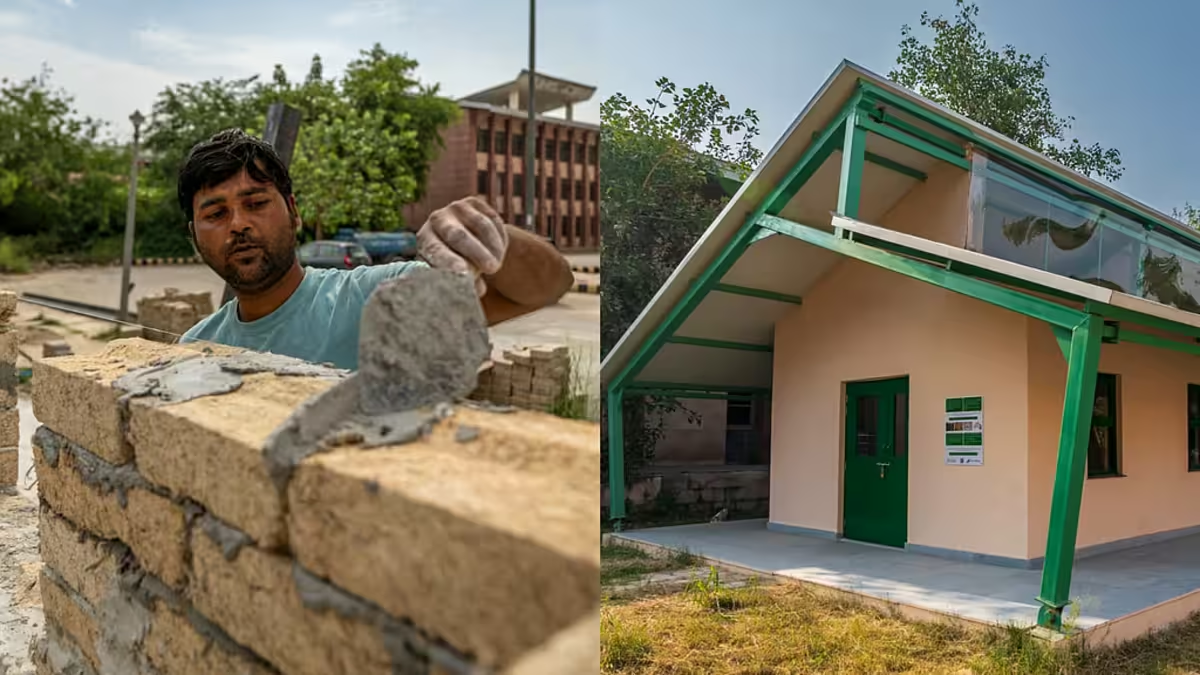


Sugarcrete Transforms Sugarcane Waste Into Eco-Friendly Blocks for a New Generation of Constructions
At Panchsheel Inter College in Uttar Pradesh, a new school wing has just been inaugurated. What stands out is not only the design but the material used. Instead of traditional concrete or bricks, the building was made with Sugarcrete blocks, an innovative material created from sugarcane bagasse.
Sugarcrete was developed by researchers at the University of East London (UEL), who saw the sugarcane waste as an opportunity to transform the construction industry. The material mixes bagasse, sand, and mineral binders, creating lightweight blocks that are fire-resistant and provide good thermal and acoustic insulation.
Sugarcrete: Less Carbon and More Accessibility
The project was born at UEL’s Sustainability Research Institute, led by Alan Chandler and Armour Gutierrez Rivas. According to the team, laboratory tests show that Sugarcrete emits six times less carbon than common bricks and twenty times less than concrete.
-
China Develops Custom 140-Ton Electric Mining Truck with 770 kWh Swappable Battery, Deploys 290 Units in Xinjiang’s Largest Zinc Mine

-
Meta to Launch Arena, a New Prediction App Targeting 3.56 Billion Users, Competing with Polymarket and Kalshi

-
Scientist Challenges Famous Human Evolution Theory, Argues Homo Sapiens Evolved Gradually Over Thousands of Years
-
15-Year-Old American Builds Ocean Generator with PVC Pipe and 3D-Printed Propeller for $12, Wins National Prize, Presents at White House, and Makes Forbes 30 Under 30 List




With only 30% of the global production of bagasse, it would be possible to replace the entire traditional brick industry and save up to 1.08 billion tons of CO₂, researchers claim.
Another feature of Sugarcrete is its open access. Without patents, it can be produced by anyone with the right ingredients and basic tools, benefiting local communities.
First Real Project with Sugarcane-Based Material
The material has already begun to be tested on a large scale. In partnership with the Indian company Chemical Systems Technologies (CST), the UEL team set up the first local Sugarcrete production unit.
Architects from Grimshaw also collaborated, creating interlocking blocks that allow for building structures without mortar.
The new wing of the school in Uttar Pradesh is the first large-scale real project using the material. For Alan Chandler, the experience brings valuable lessons about transitioning to sustainable construction practices.
Challenges and Tests in Real Conditions
Despite the initial success, there are still challenges. The team highlights the need to ensure the availability of materials and develop local skills, such as applying lime plasters. The strength of Sugarcrete is also being tested.
Although laboratory tests have shown good results in fire resistance, compression, and insulation, the true test will be the material’s performance over the years against heavy rain, extreme heat, and natural wear.
A Global Future for Sugarcrete
India, which produces about 400 million tons of sugarcane per year, has abundant raw materials to expand the use of Sugarcrete. And the potential goes beyond that. The entire world generates nearly two billion tons of sugarcane, resulting in 600 million tons of bagasse.
Currently, this waste is often burned or discarded. With Sugarcrete, it can find a new purpose, helping to build solid and sustainable structures.
The new wing of Panchsheel Inter College shows that it is possible to turn waste into innovative material and that the construction industry can enter a new era.
With information from ZME Science.