






 Portuguese
  Spanish
  3 min of reading
  0 comments


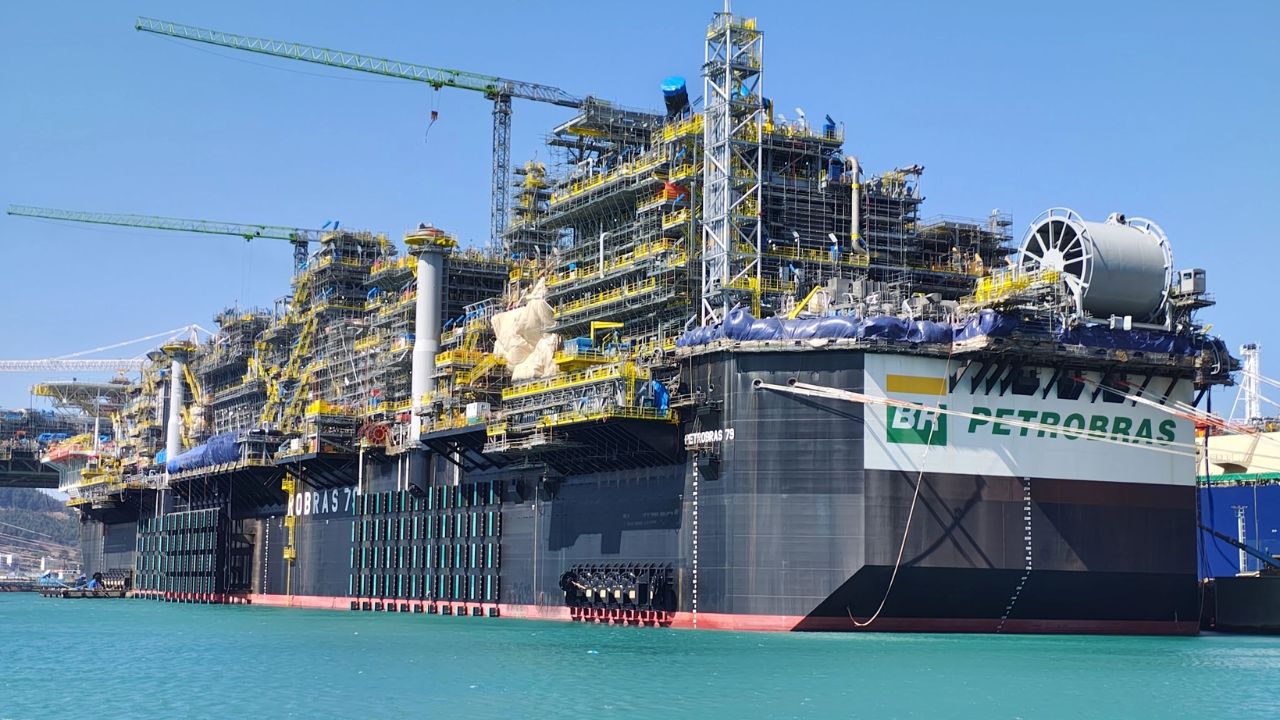
Petrobras Announces Arrival of FPSO P-78, A Floating Production Storage and Offloading Unit That Will Operate in the Búzios Field With A Capacity to Produce 180 Thousand Barrels of Oil Per Day.
The FPSO P-78 vessel, from Petrobras, departed this week towards Brazil to be installed in the Búzios Field, in the pre-salt layer of the Santos Basin. The information was confirmed by the company’s president, Magda Chambriard, on Friday (30), in a social media post.
The unit was in Singapore, where it went through the final stages of commissioning and integration. The vessel was built by the Keppel/Hyundai consortium, with participation from shipyards in Brazil, China, South Korea, and Singapore.
Petrobras chose the Búzios Field for its strategic importance and high production potential.
The new FPSO represents another step for the company in the pursuit of energy efficiency and innovation in its pre-salt operations.
-
Oil production grows in Rio, but reserve replacement raises a warning sign

-
Petrobras is expected to complete the drilling of the Morpho well in the Foz do Amazonas in August 2026, the first well in the Equatorial Margin, an oil frontier that the ANP estimates at more than 30 billion barrels and could redraw the map of Brazil.

-
Oil returns to the center of concerns with tension between the US and Iran

-
IEA reduces forecast for global oil demand in 2026 after impacts of the Middle East crisis



Modern And High-Performance Petrobras Platform
The FPSO P-78 has the capacity to process 180 thousand barrels of oil and 7.2 million cubic meters of natural gas daily.
These numbers reinforce the potential of the Búzios Field as one of the largest assets in the pre-salt.
The unit will be interconnected to 13 subsea wells, consisting of 6 producers and 7 injectors, with robust infrastructure of rigid and flexible pipelines.
Moreover, the floating platform incorporates state-of-the-art technologies. Among them are CO₂ reinjection and separation systems and solutions to reduce routine gas flaring, an essential measure to minimize environmental impacts.
The goal is to increase energy efficiency and sustainability in offshore production.
National Content Was Also Present
Although a large part of the FPSO P-78 was built abroad, Petrobras ensured the participation of the national industry.
In total, 10 of the 21 modules of the platform were manufactured at the Brasfels shipyard in Angra dos Reis (RJ).
“Before anyone says there is no local content, there were topsides made in Brazil,” highlighted Magda Chambriard.
She also mentioned the presence of directors Renata Baruzzi and Sylvia dos Anjos at the FPSO delivery ceremony in Singapore.
The Brazilian participation in the project reinforces the state-owned company’s commitment to developing the national production chain.
The strategy is to balance international competitiveness with the valorization of the local industry.
Búzios Field: A Gem of Brazil’s Pre-Salt
Located in the Santos Basin, the Búzios Field is one of the largest oil discoveries in the world in deep waters.
With high productivity, the field is essential for Petrobras’ growth strategy in the coming years.
The arrival of the FPSO P-78 is expected to further boost production, strengthening the company’s presence in the pre-salt.
Petrobras continues to invest in high-performance assets while adopting sustainable practices.
The FPSO P-78 is an example of this: innovation, efficiency, and environmental responsibility working together.







-

-

2 people reacted to this.