Portuguese
  Spanish



Understand how polymeric mortar is modernizing civil construction with more efficiency in masonry, less waste, and faster projects.
The search for efficiency in civil construction demands solutions that increase productivity on construction sites. The traditional method of mixing cement, sand, and water is giving way to polymeric mortar, an innovative alternative that can replace conventional mixtures with maximum agility.
According to a publication by Super Rádio Tupi on July 5 of 2026, this ready-to-use compound revolutionizes block laying in masonry for sealing, reducing material waste and speeding up the physical schedule of projects. Whether in large buildings or a residential renovation, the technology ensures a clean application and high performance.
Productivity and structural relief in modern masonry
Its advanced chemical formulation eliminates the need for adding water or cement, easing complex preparation steps that usually delay work. This efficiency ensures an extremely fast and clean bonding, meeting the demands of the current market.
-
Biologist Builds 160m² Dream Home in Brazil for $32,000 Using Eco-Friendly Bricks, Achieving 67% Savings Through Smart Planning and Simple Solutions

-
Modular Home in Southern Brazil Offers Quick Assembly, Thermal Insulation, and Ready-to-Install Bathroom for $4,000

-
Tiny House on Wheels Available for Under $30,000: Towable Cabin with Metal Frame and Glass Wall Offers Compact Living Anywhere
-
Innovative Precast Concrete Slabs with EPS Transform Construction Costs in Brazilian Homes


The speed gain is one of the greatest benefits pointed out by experienced builders. The direct application of the compound eliminates idle time with concrete mixers and heavy mass transport, generating greater productivity on the construction site without losing safety.
In addition to agility, there is a significant reduction in structural weight on the walls, which relieves the overall loads of the building. As the joints have millimeter thickness, the system saves resources from the foundation.


Organization and real savings in residential renovation
Material waste drops to almost zero levels with the use of ready resin, generating real financial savings for owners and self-builders who manage their own resources. The cleanliness on the construction site improves the work environment and optimizes the available physical space.
For those conducting a residential renovation, the logistical benefits are evident:
- Simplified logistics: Compact boxes replace dozens of bags of sand and cement.
- Healthy environment: No generation of suspended dust or noise from mixers.
- Zero debris: Eliminates the leftover hardened mortar that usually goes straight to the dumpsters.
Safety criteria in block laying
The technical safety of the product is fully supported by the current national guidelines in the country. Laboratory tests prove that the compound has excellent mechanical resistance when compared to traditional mixtures made of sand and cement.
The official regulation by the standard ABNT NBR 16590 ensures compliance with the essential requirements of masonry. The criteria evaluated for the validation of the material include:
- Tensile strength in the bending of tested prisms.
- Durability against the natural aging of the structure.
- Mechanical stability under different temperature conditions.

Best practices in civil construction with polymeric mortar
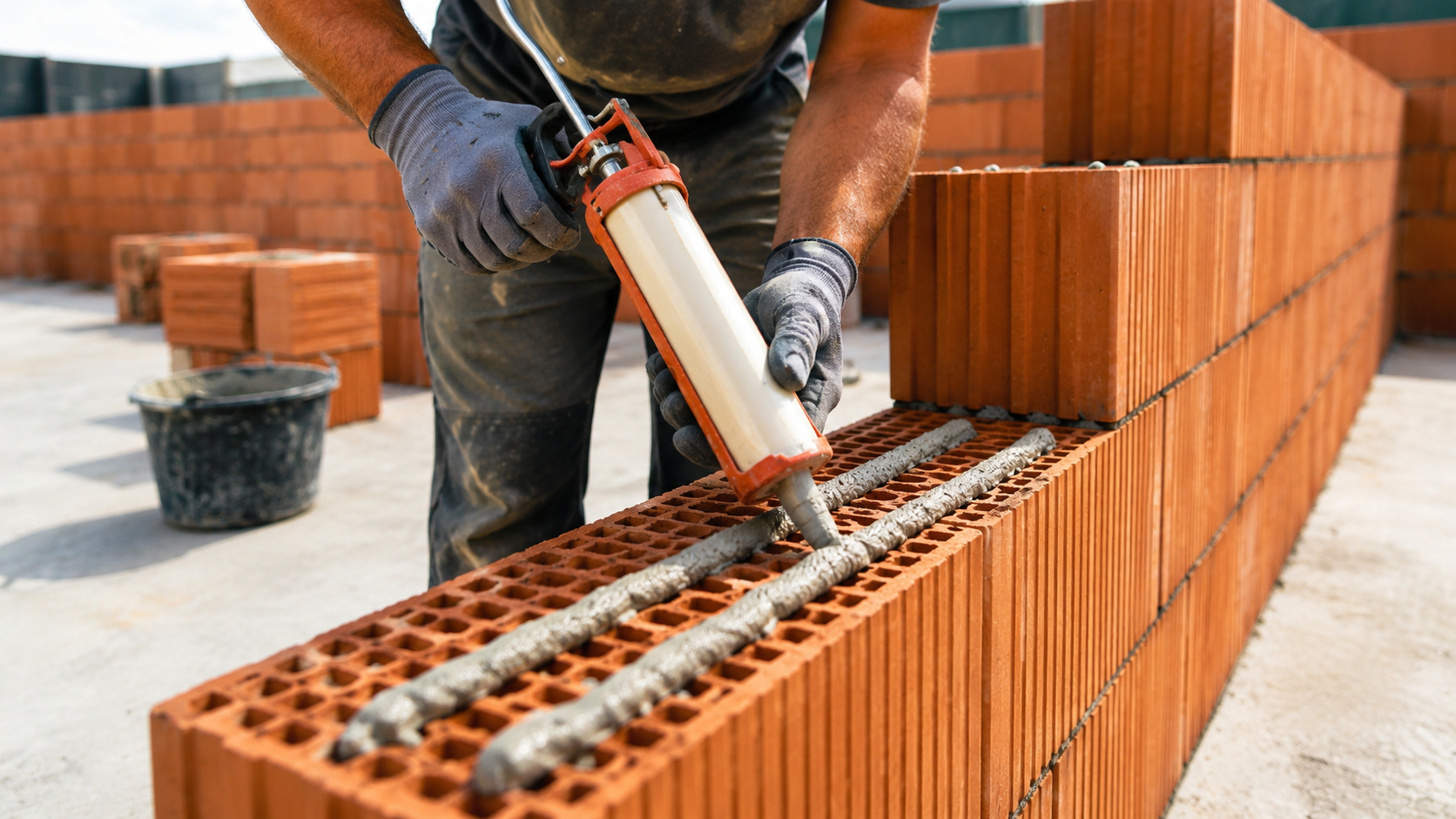
Correct application requires that ceramic or concrete blocks are perfectly aligned and clean to ensure good adhesion. The professional must apply two continuous beads of the product on the surface of the previous course to ensure proper bonding.
Experts from the channel Vida Engenharia, known for disseminating efficient practices in civil construction, emphasize that care with the base dictates the success of the structure. It is essential to follow the manufacturer’s recommendations to avoid future pathologies in the building:
- Ensure the first course is perfectly leveled with traditional mortar before starting the use of polymeric mortar.
- Press the blocks firmly to ensure the correct crushing of the beads and perfect distribution of the product.
- Gently tap with a rubber mallet to adjust the plumb and level without breaking the adhesive film.
- Strictly adhere to the curing time indicated on the packaging to ensure structural stability.
- Keep the base free from dust or excessive moisture and avoid gaps larger than those indicated by the manufacturers.

The cost-benefit that consolidates innovation in the market
Intelligent financial analysis should consider the overall cost of the project and not just the isolated price per kilo of the material. The time gain in completing the structure reduces labor expenses, generating an excellent cost-benefit in block laying.
Logistical optimization and the elimination of losses consolidate this technology as an irreversible trend in the national market. The cultural change transforms the construction site into an industrialized, modern environment focused on high-performance results.
The inevitable future of Brazilian construction sites with polymer mortar
The modernization of construction processes points to the consolidation of polymer mortar as a definitive standard in national engineering. By mitigating errors, accelerating the schedule, and ensuring sustainability, this technology elevates the quality level of buildings.
Whether in managing a large commercial building or executing a residential renovation, replacing artisanal methods with ready-made solutions is the ideal path to combine profitability, cleanliness, and high technical performance.