






 Portuguese
  Spanish
 5 min of reading
  4 comments


The Largest São Paulo Bridge Is Under Construction Over the Tietê River, Between Novo Horizonte and Pongaí, With a Structure of 2.4 Km and Using 208 Beams of 74 Tons Each. The Project Is Part of the Duplication of SP-333 and Will Be Completed by 2026.
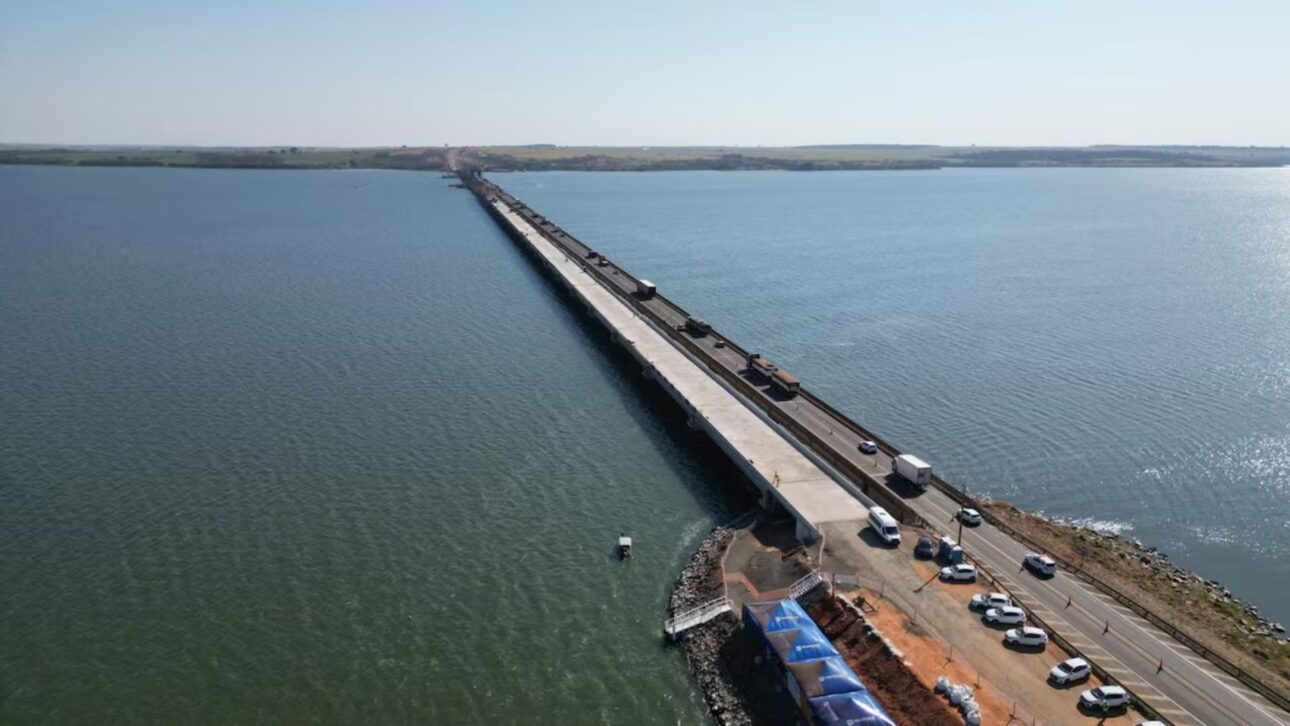
The largest exclusively São Paulo bridge advances over the Tietê River, between Novo Horizonte and Pongaí, on SP-333 (Dr. Mário Gentil).
The new structure, estimated at R$ 373 million, is part of the highway duplication, will have just over 2.4 kilometers in length — 2,416 meters in the executive project — and uses 208 pre-molded beams of 41 meters and 74 tons each.
Construction began in September 2024 and reached 60% completion in September 2025, with delivery scheduled for the second half of 2026.
-
FIRJAN’s mega plan of R$ 526.3 billion for Rio de Janeiro aims to revive Brazil’s largest industry, with two-thirds of the investments going to oil and gas.

-
China signals an increase in beef imports, Brazil has already consumed 70% of the 1.106 million ton quota and seeks to renegotiate the tariff that jumps from 12% to 55%, while demand from the US also skyrockets.
-
Food inflation rose 302% in 20 years in Brazil, but the supermarket changed: purchasing power yielded 87% more mortadella and 31% less fruit, and ultra-processed foods took over the cart.
-
Petrobras sells the first batch of 3,800 m³ of aviation fuel made with certified soy, capable of reducing emissions by up to 70%, in an unprecedented project that anticipates the aviation sector’s requirements expected for 2027.



Location and Importance of the Bridge
Built parallel to the Engenheiro Gilberto Paim Pamplona bridge (from 1975), the new crossing is located between kilometers 229 and 232 of SP-333.
The set will form a binary: the new bridge will concentrate two traffic lanes in one direction, while the existing structure will be renovated to accommodate the flow in the opposite direction and a illuminated walkway for pedestrians.
Although there are larger bridges in interstate connections in the country, this is the largest bridge located entirely in São Paulo, according to the state government and the responsible concessionaire.
Engineering and Construction Method
The project adopts a central span of 125 meters and a vertical clearance of 15 meters, allowing trains from the Tietê–Paraná Waterway to pass without interruptions.
To achieve this, the construction uses the successive cantilever method, which lifts the deck from the piers in symmetrical segments, reducing interference in navigation and on the riverbed.
The pre-molded beams are manufactured at a plant installed on-site, shortening logistics, standardizing parts, and maintaining a rhythm in launching.
In addition to the pre-molded elements, the project requires more than 3,900 tons of steel and the equivalent of 5,000 truckloads of concrete.
The foundations comprise kilometers of piles to cross the bed of the Tietê and ensure stability to the support structures.
In the end, the new bridge will be combined with the restoration of the current one to enhance the capacity of the corridor and raise the safety standards.
Duplication of SP-333 and Benefits for Traffic
The duplication of the bridge is part of a larger package: the concessionaire Entrevias is carrying out the duplication of 52.4 kilometers of SP-333 in the area affected by the new crossing, with the implementation of new accesses and return points.
The expectation is to reduce bottlenecks, shorten travel times, and offer a more predictable route for the flow of cargo from the central-west of São Paulo.
During the construction period, traffic will continue on the old bridge, with planned interventions to mitigate delays.
Environmental Measures and Wildlife Protection
By requirement of CETESB, the work fronts operate with measures to reduce impacts on wildlife and water quality.
Among the actions are the isolation of quadrants in the river with geotextile mats, followed by the disturbance of the fish population with nets under the supervision of biologists and veterinarians, preventing fish from remaining in the concreting and anchoring area.
On land, the licensing includes wildlife underpasses, directing fences, and markers for birds in the bridge sections, aimed at guiding the flight of birds and reducing the risk of collision with the structures.
The water used in the activities and the sediments removed from the riverbed are subject to control and disposal according to environmental regulations.
Timeline and Current Stage of the Works
The initial milestone of the duplication occurred in September 2024.
A year later, in mid-September 2025, the state government and the concessionaire reported about 60% of physical progress, with all piles driven and efforts concentrated on the superstructure — launching beams, executing slabs, and progress of the successive cantilever in the central span.
The contractual forecast is to complete the work in the second half of 2026, in line with the adjacent highway duplication schedule.
Meanwhile, the current bridge is undergoing inspections and receiving preparatory services for future structural reconfiguration and installation of the walkway.
Accident and Safety Protocols
On October 6, 2025, a 44-year-old worker, identified as Daniel Cordeiro Barbosa, fell into the Tietê River during activities related to the duplication.
The Fire Department located the body following search efforts, and the Civil Police is investigating the circumstances.
In a statement, the concessionaire expressed condolences, stated it is monitoring the investigation, and mentioned providing support to the family of the employee from the involved subcontracting company.
The teams have also reviewed operational safety protocols at water fronts, focusing on access procedures, rescue, and use of equipment.
Impact on Drivers and Regional Logistics
With the delivery, SP-333 will gain additional capacity and complete separation of flows in both directions over the Tietê.
For drivers, this tends to reduce risky turns and speed divergences typical of single-lane crossings.
Pedestrians and cyclists will have a dedicated and illuminated path on the old bridge, eliminating coexistence with heavy vehicles in a sensitive stretch.
In cargo transport, the expansion and fluidity over the river should alleviate peak traffic hours and better synchronize the road corridor with the waterway, especially during periods of high agricultural movement.
Technical Data and Dimensions of the Bridge
The bridge totals 2,416 meters in length, with a central span of 125 meters and a vertical clearance of 15 meters.
The deck incorporates 208 pre-molded beams of 41 meters and 74 tons, produced on-site.
The structural package consumes more than 3,900 tons of steel and 5,000 truckloads of concrete, while the associated duplication of SP-333 covers 52.4 kilometers.
The environmental measures include fish isolation, wildlife passages, and markers for birds.
In operational planning, the successive cantilever method ensures the continuous navigability of the Tietê–Paraná Waterway throughout the works.
Final Stages and Outlook
In the coming months, progress will be concentrated on closing the central span, completing slabs and joints, and the electromechanical and signaling stage.
In parallel, the existing bridge will continue following the recovery schedule, including localized reinforcements, a new driving layer, and the installation of the walkway.
In the end, the binary operation is expected to reconfigure the section between Novo Horizonte and Pongaí, directly impacting road safety, user comfort, and the reliability of the logistics corridor crossing the central-west of São Paulo.
Following these changes, which other critical points of SP-333 should be prioritized for duplication and safety after the new bridge is delivered?




Existe um elevado, que é uma ponte, no Rodoanel, em Poá, com quase 10 km e pouca gente percebeu isso.
É totalmente no Estado de São Paulo e é a maior, sobre rio, alagado, cidade e área rural. Acredito que deve ser considerada a maior do Estado.
A tranferroviaria da SP 320 que liga rubineia SP a Aparecida do Taboão MS tem 3.700 km de extensão,vcs deveriam se informar antes de divulgar informações improcedentes.
Pelo amor em,se essa aí tem 2,4 km de extensão como eka seria a maior de SP 🤦♂️🤦♂️🤦♂️🤷🏽♂️
Na reportagem menciona que trata-se da maior em território exclusivo de SP. A que você cita está em dois estados.
Toma seu desavisado. Presta atenção rapaz.