






 Portuguese
  Spanish


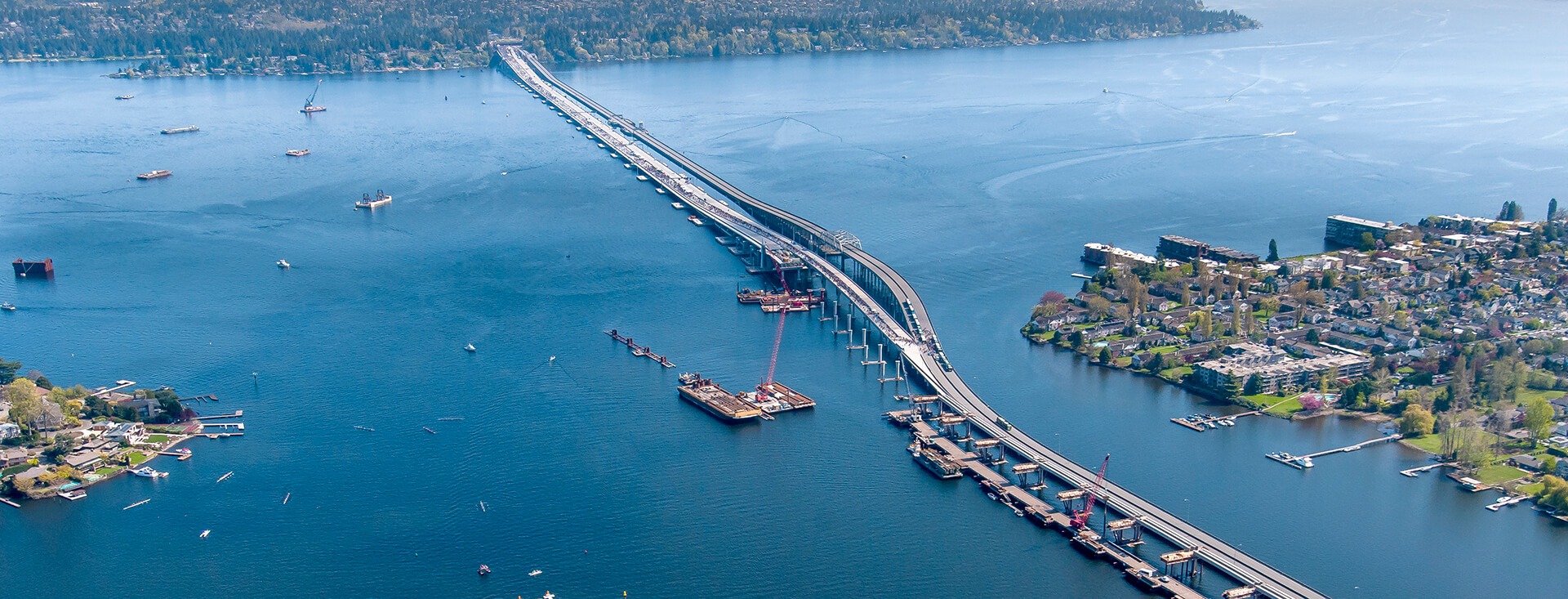


Evergreen Point Floating Bridge of 2.4 km in the USA Does Not Touch the Lake Bottom, Uses Concrete Floaters, and Requires Constant Monitoring to Operate.
The Evergreen Point Floating Bridge does not look like an ordinary bridge because, in fact, it is not. Unlike traditional structures supported by pillars driven into the ground, this crossing was designed to permanently float on the water, following the natural movements of the lake, level variations, winds, and waves. Located in the state of Washington, it spans Lake Washington, connecting Seattle to Medina and represents one of the most extreme examples of adaptive engineering ever put into continuous operation.
Why Does the Bridge Not Touch the Lake Bottom?
Lake Washington reaches depths of over 60 meters in some sections, with unstable soil and sediment layers not suitable for conventional deep foundations.
Driving thousands of piles to a solid substrate would make the work technically complex and economically unfeasible. The radical solution found was to make the bridge float, eliminating the need for contact with the bottom across almost its entire length.
-
China to Drill 90 Kilometers Under the Sea to Connect Two Cities Currently Linked Only by Ferry

-
18 m² Home Built in Two Days by Teto Volunteers Provides Shelter from Insects and Cold for Resident in Brazilian Community; 43 Delivered in 2026

-
$134.7 Million Project in São Paulo Installs Over 5 Kilometers of Pipes, Creates New Underwater Crossing to Boost Water Supply for Over 450,000 People

-
At 61, Former Homeless Wheelchair User Receives Key to Container Home in Brazil, Declares Independence



This decision completely transformed the structural concept of the crossing.
Nearly 2.4 km Supported by Concrete Floaters
The Evergreen Point Floating Bridge is approximately 2.35 kilometers long, supported by a sequence of hollow reinforced concrete pontoons, designed to provide enough buoyancy to support the weight of the bridge itself, traffic, and environmental loads.


These floaters function like large static hulls, anchored to the lakebed by cables and flexible anchoring systems.
The concrete used is not common: it is a specially formulated material designed to resist water, structural fatigue, and thermal variations over decades.
A Structure That Moves All the Time
Unlike rigid bridges, the Evergreen Point was designed to constantly move. Strong winds, temperature variations, and even seasonal changes in lake level cause controlled horizontal and vertical shifts.
Expansion joints, articulated connections, and anchoring systems allow the bridge to absorb these movements without compromising structural integrity.
In practice, the bridge is never completely static, and this is an essential part of its safe operation.
Being a large-scale floating structure, the bridge requires permanent monitoring. Sensors track displacements, tensions in the anchoring cables, behavior of the floaters, and the structural response to extreme weather events. This monitoring allows for preventive interventions before small issues become operational risks.
Maintenance is not optional: it is an integral part of the project from the conception stage.
Winds, Waves, and Extreme Events
Although Lake Washington may seem calm at first glance, intense storms generate significant waves and lateral forces capable of stressing the structure.
The bridge was designed to withstand strong winds and combined water movements, maintaining stability even in adverse conditions. Still, historical episodes have shown that the bridge’s dynamic behavior requires constant adjustments over the years.
This reinforces the idea that the work was not “completed” in the traditional sense; it is always in assisted operation.
Why Are Floating Bridges Rare?
Despite being efficient in specific situations, floating bridges are rare precisely due to the complexity of maintenance and monitoring. They are only justified in locations where deep foundations are technically or economically unfeasible.
In the case of Evergreen Point, the cost of not touching the bottom of the lake was offset by structural viability and the need to maintain a strategic link between dense urban areas.
It is engineering tailored to an extreme problem.
A Solution That Challenges the Traditional Concept of Bridge
The Evergreen Point Floating Bridge redefines what a bridge is understood to be. Instead of overcoming water with rigidity, it coexists with movement, floating, absorbing forces, and adapting to the environment. Every meter of the structure was calculated to accept that the ground would not be there to help.
More than just a crossing, it serves as a reminder that, in engineering, sometimes the only possible solution is to abandon the idea of absolute stability and design something that survives precisely by knowing how to move.





Can the Engineering concept of its design (Evergreen Point F. B) be applied to repair the sinking Kansai Airport in Japan?
We have a floating bridge in kelowna B.C canada driving over it with a big wind storm is something else lol
Artigo bem fraquinho