Portuguese
  Spanish


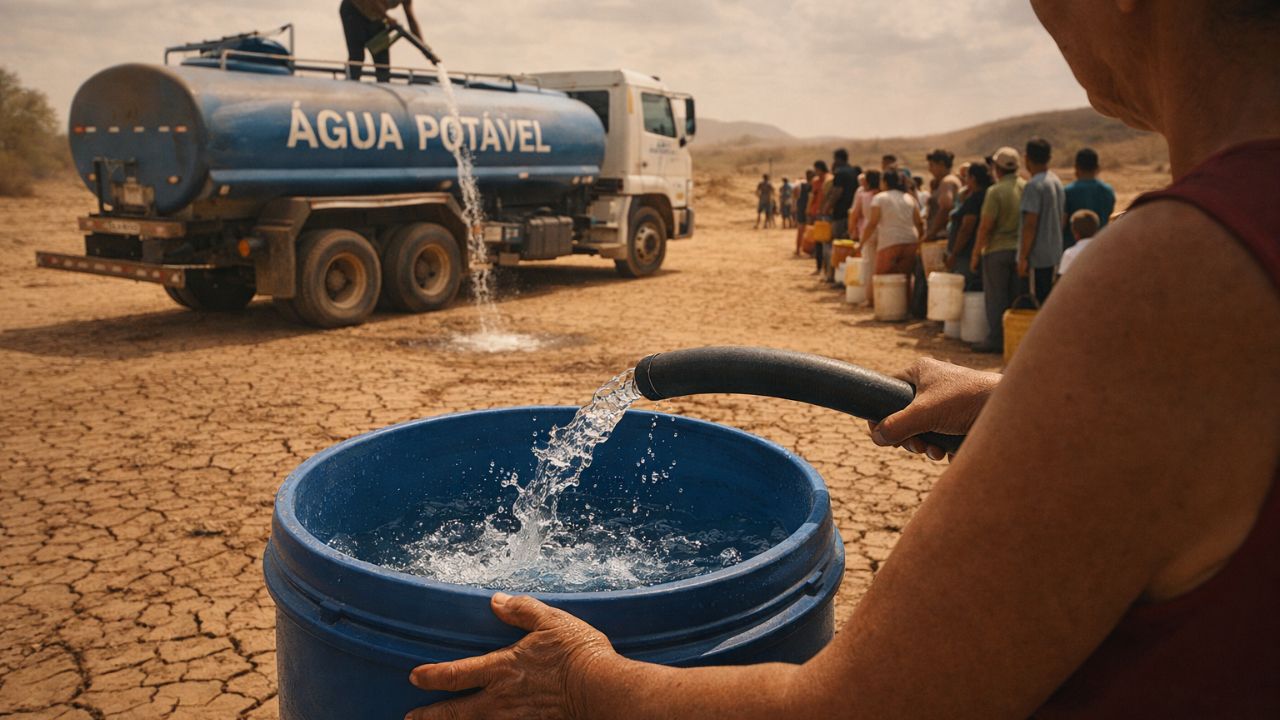

Drought in the Northeast Is Not Just a Climatic Issue, but a Lasting Political Business that Affects Millions of Brazilians
The drought in the Brazilian Northeast is a reality that has been dragging on for over a century, being treated as an inevitable climatic phenomenon. However, as time goes by, the perception grows that this drought has also been used as a tool for political and economic control. It is not just the lack of water that leaves the populations of the semiarid region at the mercy of political promises, but rather the manipulation of the situation for the benefit of a few. The drought in the Northeast has become a tool of power.
Despite the numerous promises of solutions to the water problem, such as the construction of reservoirs and the distribution of water through water trucks, communities continue to depend on these emergency services.
However, even with proven and low-cost technologies, such as masonry cisterns, the problem of drought continues to be manipulated by public policies that, instead of solving it, perpetuate dependence and suffering.
-
Former Marketing Agency Owner Thrives on Foraging for 250 Days, Sampling Over 170 Plants, and Says He No Longer Remembers Supermarkets

-
IKEA’s AI Handles Nearly Half of Customer Calls, Company Reassigns 8,500 Staff as Design Consultants, Boosting Revenue by €1.3 Billion
-
Owner of Havan Visits Paraguay to Discuss Lower Taxes, Local Suppliers, and International Expansion with President

-
Brazilian Construction Retail Chain Closes After 60 Years, Begins Liquidation Sale Across Five Cities




The Past of Drought in the Northeast and the Birth of the “Drought Industry”
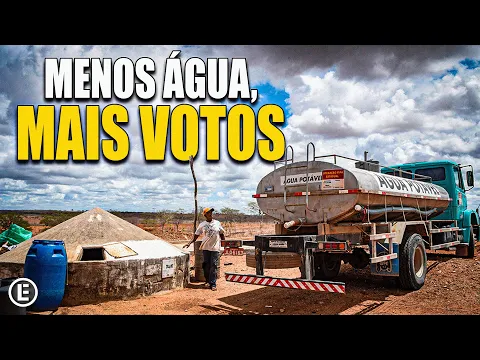

Drought in the Northeast is not a new problem. Since the 19th century, the Brazilian state has constructed the narrative that drought was a natural tragedy that required emergency responses and works to combat it.
The great drought of 1877, considered one of the worst in Brazil, resulted in the death of hundreds of thousands of people, and the response of the government at the time was the construction of reservoirs and the distribution of food.
However, these works, far from benefiting the population, ended up favoring large landowners, merchants, and local politicians, who controlled the water and the distribution of resources.
Over the decades, the situation hasn’t changed much. The federal government created entities such as SUDENE (Superintendency for the Development of the Northeast) and DNOCS (National Department of Works Against Drought), but these institutions quickly became part of a corrupt and centralizing system, with overpriced works and without technical criteria, made solely to maintain political control over water and the votes of the most needy populations.
Drought as a Profitable “Business”
Drought in the Northeast has ceased to be merely a natural phenomenon, becoming a highly profitable “business”, with billions of reais in billion-dollar contracts for public works that never reach the population.
An example of this is the diversion of the São Francisco River, a project that diverts the course of one of Brazil’s largest rivers to supply regions in the Northeast.
Although it was announced as the definitive solution to the drought, the diversion was marked by overpricing, embezzlement of resources, and a lack of technical criteria.
While water is diverted to agribusiness, the populations that need it most continue to depend on water trucks, in a system that privileges politically strategic cities, while the most needy regions remain marginalized.
The water that should serve the poorest families is politically controlled and used as a bargaining chip, perpetuating misery and inequality in the region.
Simple and Effective Solutions Are Ignored
Despite the misuse of water and the expensive and ineffective solutions, there are simple, low-cost alternatives that could sustainably resolve the problem of water scarcity in the semiarid region.
Masonry cisterns, for example, capture rainwater and can store up to 16,000 liters, enough to get through an annual drought.
The cost is much lower than large works, and they allow families to become self-sufficient, without depending on local political power to ensure water supply.
The implementation of these low-cost technologies has already shown positive results in communities in the semiarid region, with a direct impact on the health, education, and income of families.
However, cisterns and other simple solutions are ignored by authorities, who prefer to invest in works that move large amounts of money and guarantee votes in elections.
The “Drought Industry” and the Perpetuation of Misery
What is observed in the Northeast is the perpetuation of the “drought industry”, a system that uses the misery of the population as a strategy for power and profit.
Even with billions invested in waterworks and water distribution programs, solutions do not effectively reach those who need them most.
Instead of solving the problem, large works merely serve to ensure political control over water and maintain the dependency of the population, who continue to lack access to sustainable solutions.
The Future: Learning to Coexist with Drought
Drought in the Northeast is inevitable, but the suffering of the population does not have to be. The future of the region involves a new model of water management that considers existing and efficient solutions, such as cisterns, and breaks the vicious cycle of the drought policy.
The problem is not the lack of water, but rather the way it is distributed and manipulated by those who profit from poverty and dependency.
Instead of large works and temporary solutions, it is time to invest in technologies that restore autonomy to families and allow them to become self-sufficient, breaking the cycle of dependency and misery that has lasted for over a century.
Drought in the Northeast, although a natural phenomenon, has long been used as a tool to control votes and keep the population dependent.
What do you think about this? Is the problem really the lack of water or what is lacking is the will to solve the problem effectively? Leave your opinion in the comments!