Portuguese
  Spanish


The chatbot Billie took over simple customer service and, instead of cutting staff, IKEA invested in retraining: 8,500 agents became remote design consultants, a service that now generates 1.3 billion euros per year and shows another path for artificial intelligence at work.
At a time when half the world fears losing their jobs to technology, IKEA did the opposite of what was expected. When their chatbot Billie began to independently handle nearly half of customer service interactions, the Swedish furniture giant didn’t lay anyone off: they took the 8,500 agents who could have been cut and turned them into remote design consultants. This turnaround was detailed by PYMNTS, a site specializing in digital economy and payments.
The result became one of the most talked-about cases regarding artificial intelligence and work. Instead of using technology just to save money, IKEA discovered a revenue source hidden within their own customer calls. The consulting service that emerged from this retraining now earns about 1.3 billion euros per year, according to figures gathered by the business press and Grey Journal.
What is IKEA’s chatbot Billie
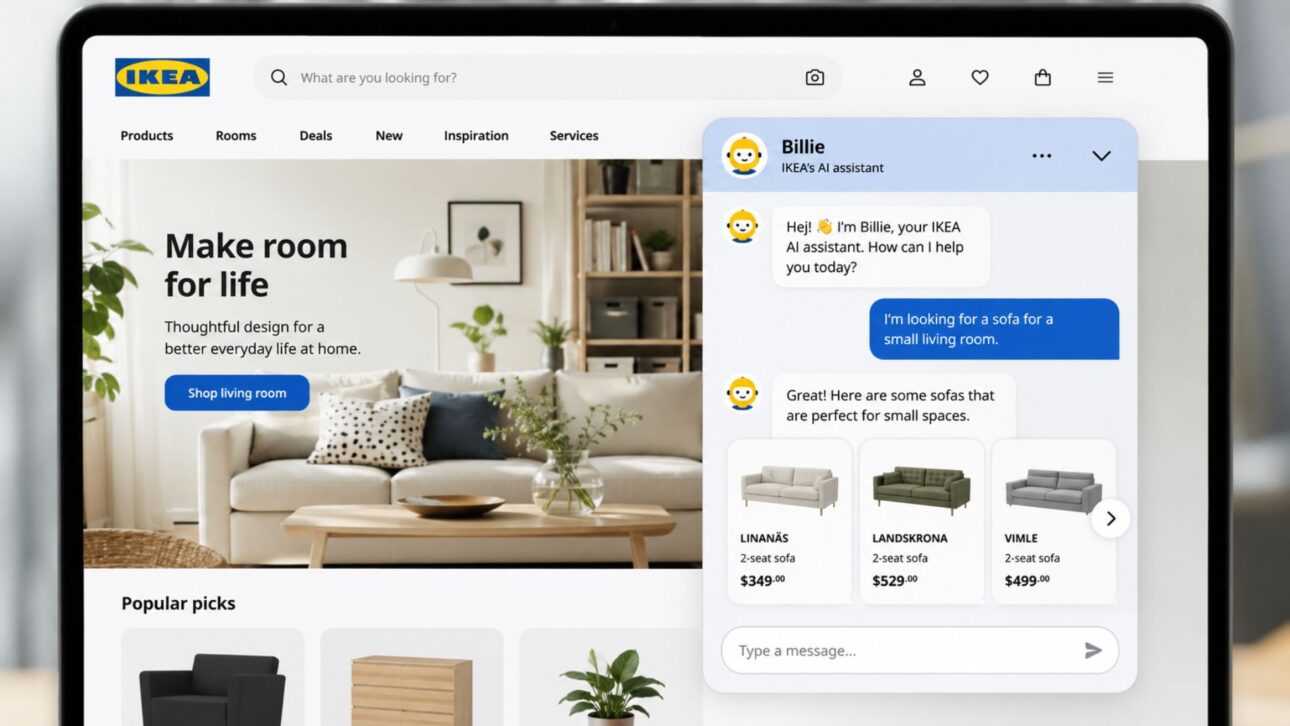
Order status, delivery time, exchange policy, store hours, these types of simple and high-volume inquiries began to be answered by the machine. As a result, the chatbot Billie managed to resolve about 47% of customer interactions, a number that more recent reports suggest is even higher.
-
Owner of Havan Visits Paraguay to Discuss Lower Taxes, Local Suppliers, and International Expansion with President

-
Brazilian Construction Retail Chain Closes After 60 Years, Begins Liquidation Sale Across Five Cities

-
Brazil Approves Landmark Bill Requiring Workplace Adaptations for Autism Inclusion

-
Brazil’s Micro-Entrepreneur Program May See Major Changes: Income Cap Could Increase to R$ 130,000, Annual Inflation Adjustments, and Allow Hiring of an Additional Employee



Here lies the point that usually scares. When an artificial intelligence absorbs almost half of the customer service, the obvious calculation many companies make is to cut half of the team. It was exactly this expectation of mass layoffs that IKEA decided not to fulfill, and the choice changed history.
Why IKEA did not lay off the 8,500 attendants
Instead of looking at what Billie could do, IKEA looked at what it couldn’t. The chatbot solved the simple tasks but got stuck on those requiring listening, taste, and conversation: how to organize a small room, match furniture, plan a kitchen, solve a difficult space. These requests required a human with the eye of a design consultant, not a robot.
The company realized there was a huge and underserved demand for decoration advice. That’s where requalification came in: the 8,500 call center attendants, who already knew the products and how to talk to customers, were trained to become remote design consultants. Instead of informing delivery times, they started designing spaces together with the customer, by phone and video.
The logic is simple and powerful. The artificial intelligence took over the boring and repetitive work, and people were relocated to the creative work, which generates more value and that the machine does not deliver. The requalification cost less than firing and hiring from scratch, and it also preserved people who knew the brand from the inside.
How requalification turned into 1.3 billion euros in revenue
The new consulting service is not a courtesy, it’s a business. The remote design sessions, conducted by these design consultants, guide the customer in choosing products and setting up the environment, and naturally lead to larger and more well-thought-out purchases. The assisted sales channel that emerged from this requalification started generating about 1.3 billion euros per year for IKEA, in addition to an estimated saving of around 13 million euros.
Those who hire a design consultant tend to buy the whole set, not just a single piece. It’s the difference between selling a shelf and selling the entire room designed around it. By transforming customer service into consulting, IKEA increased the average ticket and built customer loyalty, proving that artificial intelligence yielded more as a team partner than it would have as their substitute.
Did IKEA really lay off because of artificial intelligence?

The case of Billie and the retraining of 8,500 attendants is a strategic decision that has been consolidating since the beginning of the decade, when IKEA expanded remote sales and customer service through artificial intelligence. This is the core of the story and remains intact.
Meanwhile, in March 2026, the Ingka Group, the main operator of the brand, announced the cut of about 800 administrative positions, concentrated in offices in Sweden and the headquarters in the Netherlands. President Jesper Brodin said that the company “became too complex” and that the goal was to simplify to lower costs and prices. This cut targets office bureaucracy, representing less than 0.5% of the 166,000 employees and is not related to the customer service sector that underwent retraining. Mixing the two would generate the false idea of contradiction.
What this case teaches about AI and employment
The central lesson bothers those who only see artificial intelligence as a firing machine. IKEA showed that it is possible to use technology to remove the mechanical part from people and push them towards the human part, where they are more valuable. The chatbot Billie did not empty the team, it freed the team.
This does not mean that the path is easy or automatic. It requires investing in retraining, seeing the hidden demand, and having the patience to train attendants until they become design consultants instead of cutting costs abruptly. But the return of 1.3 billion euros suggests that treating the 8,500 attendants as an asset, not an expense, was the most profitable decision IKEA could have made in the face of artificial intelligence.
A model that other companies will look at closely
In the end, what IKEA did was refuse the lazy way out. Instead of letting artificial intelligence decide who is left out, it used the chatbot Billie to discover where people would make more of a difference, and bet on retraining instead of cutting. The result was design consultants instead of phone operators, more satisfied customers, and over 1.3 billion euros in new revenue.
And you, do you think more companies will follow the path of IKEA and invest in reskilling, or will most use artificial intelligence as an excuse to lay off employees? Share in the comments what you would do if you were in the bosses’ shoes.