






 Portuguese
  Spanish
  5 min of reading
  0 comments


Billion-Dollar Project Delayed in the Northeast, with Stalled Works, Political Disputes, and Uncertainty About Completion, Directly Affecting Grain Transport and Agricultural Competitiveness in the Region.
The construction of the Transnordestina Railway, budgeted at R$ 15 billion, illustrates how political, administrative, and economic challenges can hinder the progress of large logistics projects in Brazil.
Twenty years after the start of the works, the railway remains unfinished and directly threatens the competitiveness of agribusiness in the Northeast, especially in the flow of grain production from Matopiba — a region that encompasses Maranhão, Tocantins, Piauí, and Bahia.
Designed to boost integration and reduce logistics costs, the Transnordestina Railway includes two major sections, both still not fully completed.
-
Railway returns to prominence in Brazil after STF approval: a R$ 25.2 billion project promises to save R$ 9 billion in freight, transport 50 million tons per year, and transform Sinop into a logistics powerhouse for agribusiness.

-
Retired trains leave European tracks and become tons of steel, aluminum, and copper in dismantling yards where recycling exceeds 90%, but batteries, composites, and electronics create a new frontier of railway waste.

-
The strategic railway of Santa Catarina will receive R$ 608 million, will undergo historic modernization, and could transform logistics between Mafra and the Port of São Francisco do Sul.
-
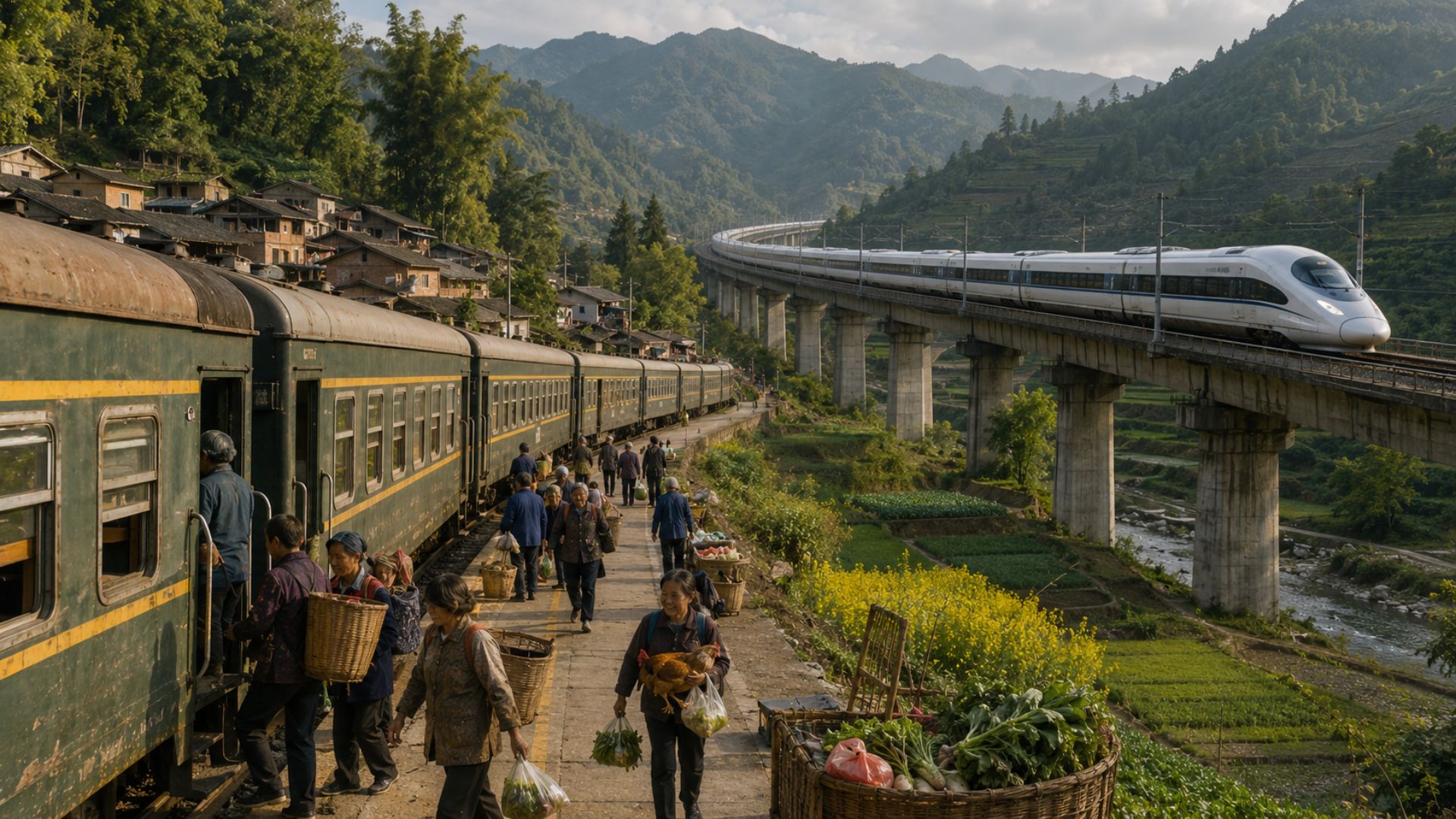
While showcasing bullet trains traveling at over 300 km/h, China maintains about 81 slow train lines that travel at 40 km/h, charge less than R$ 2 for a ticket, and cross remote villages carrying residents, students, and even chickens and vegetables to the market.


According to official data, of the R$ 15 billion projected, approximately R$ 8 billion has already been spent, leaving R$ 7 billion for completion.
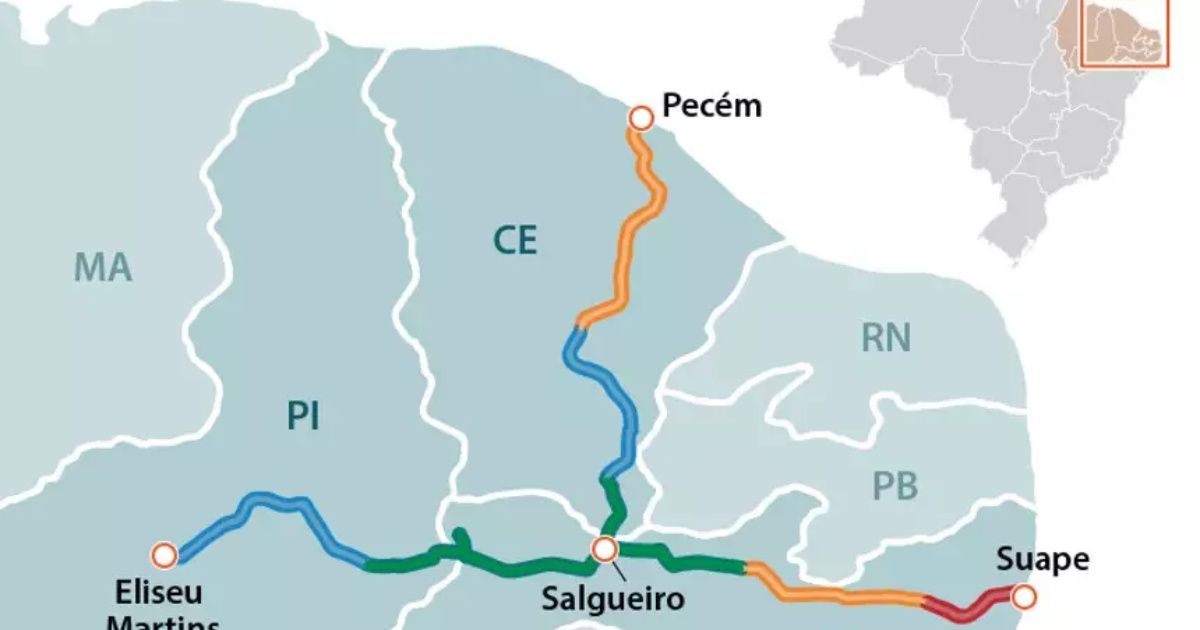
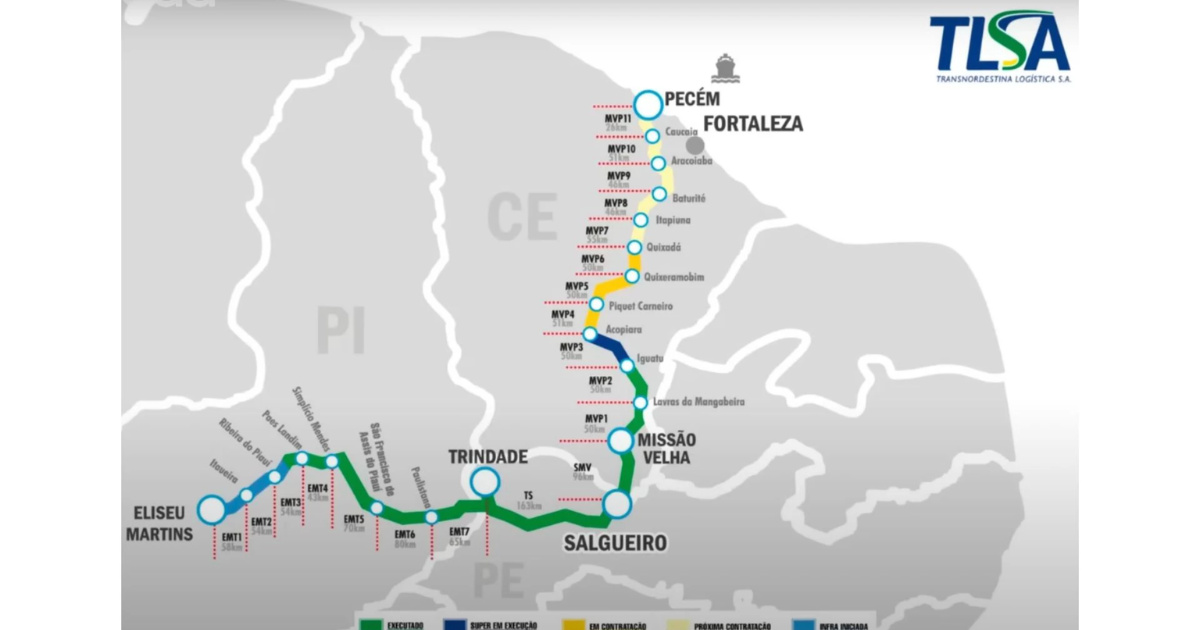
The division between the two main axes highlights the difficulties: the section connecting Eliseu Martins (PI) to the Pecém Port in Fortaleza (CE) is progressing rapidly due to financial support from the federal government and the concessionaire Transnordestina Logística (TLSA), a subsidiary of the Companhia Siderúrgica Nacional (CSN).
However, the Pernambuco branch, which was supposed to connect Salgueiro to the Suape Port, has been stagnant since 2016, and was officially returned by TLSA in 2022 due to economic feasibility issues.
The responsibility for resuming the project has passed to the federal government, which has not yet established a concrete timeline for completion, despite announcing a new bidding process for the second half of this year.
Delays and Budget Disputes in the Transnordestina Railway
The execution of the project has been marked by frequent interruptions, political clashes, and budget disputes.
One of the most recent events was the dismissal of then-superintendent of the Superintendência do Desenvolvimento do Nordeste (Sudene), Danilo Cabral, in July 2025.
The dismissal occurred amid disagreements with the government of Ceará over the allocation of funds for the Pernambuco section of the Transnordestina.
Although Cabral was able to include part of the works in the New PAC 2025, initially securing R$ 450 million, the amount was considered insufficient by local representatives.
The Fundo de Desenvolvimento do Nordeste (FDNE), responsible for financing structural projects in the region, redirected its entire annual budget of R$ 1 billion until 2026 for the completion of the Ceará section.
The financial boost, which has already guaranteed R$ 3.6 billion to the project, has generated dissatisfaction among Pernambuco politicians and leaders from other states, who claim there is an imbalance in the allocation of resources for regional development.
Progress of the Ceará Section and Revised Timeline
The restructuring of the project in Ceará, initiated in 2022, has allowed for significant physical progress: of the 1,200 km planned, 676 km have already been delivered.
In July 2025, the federal government announced a new investment of R$ 1.4 billion, sourced from the FDNE and public banks, ensuring the inauguration of the section between Bela Vista do Piauí (near Simplício Mendes), in Piauí, to Iguatu (CE) as early as October.
This segment of about 500 km will enable the transport of grains in compositions of up to 126 wagons, equivalent to 380 trucks, with an expectation of reducing logistics costs by up to 30% and shortening the route to the ports by 40%.
In contrast, the Pernambuco section has 160 km completed, but needs an additional 370 km to reach the Suape Port, which will demand additional investments of approximately R$ 5 billion.
The uncertainty regarding the continuity of the works generates concern among rural producers and infrastructure experts, as the total completion of the railway is seen as essential to ensure the efficiency of agricultural flow in the Northeast.
Integration Challenges and Structural Limitations
Logistics experts point out that the design of the Transnordestina presents limitations, primarily due to the lack of integration with other railways in the Midwest and Southeast of the country, hindering the full utilization of the logistical potential of the line.
This lack of interconnection increases the dependence on road transportation for long distances, raising costs and diminishing the competitiveness of production from the Northeast in national and international markets.
Additionally, another vital railway for the region, the Ferrovia Transnordestina Logística (FTL) — which is not to be confused with the sections under construction — is also facing challenges.
With 1,237 km connecting Fortaleza (CE) to São Luís (MA), the FTL has been under concession since 1998 and its renewal contract, requested until 2062, may be questioned by the Tribunal de Contas da União (TCU).
The concessionaire proposed to return 3,000 km of sections deemed “non-operational,” concentrating investments in active branches and offering as a countermeasure the construction of Light Rail Vehicles (VLTs) in Campina Grande (PB) and Arapiraca (AL).
However, the TCU raised complex issues regarding indemnities and required guarantees for the concession renewal.
According to the Agência Nacional de Transportes Terrestres (ANTT), part of the contractual obligations was not fulfilled during the contract’s term, increasing uncertainty for the railway future in the Northeast.
Impacts on Agribusiness and Regional Infrastructure
The impasse in completing the Transnordestina and the delay in renewing the FTL have direct consequences for the agribusiness of Matopiba.
The region, considered one of the main agricultural frontiers in the country, relies on rail transport to ensure competitive prices, increase productivity, and expand its market share globally.
Official reports indicate that the full operation of the railway could transform the logistical profile of the Northeast, bringing structural gains to the entire regional economy.
While the Ceará section progresses with a projected delivery date of the main axis by the second half of 2027, the future of the Pernambuco branch and national integration remains uncertain.
The current scenario raises a pertinent question: why, even with so many public and private investments, does the Northeast still face challenges in ensuring a railway infrastructure commensurate with its agricultural and logistical potential?
What do you believe is the main obstacle preventing strategic projects like the Transnordestina from advancing efficiently in Brazil?






Be the first to react!