Portuguese
  Spanish


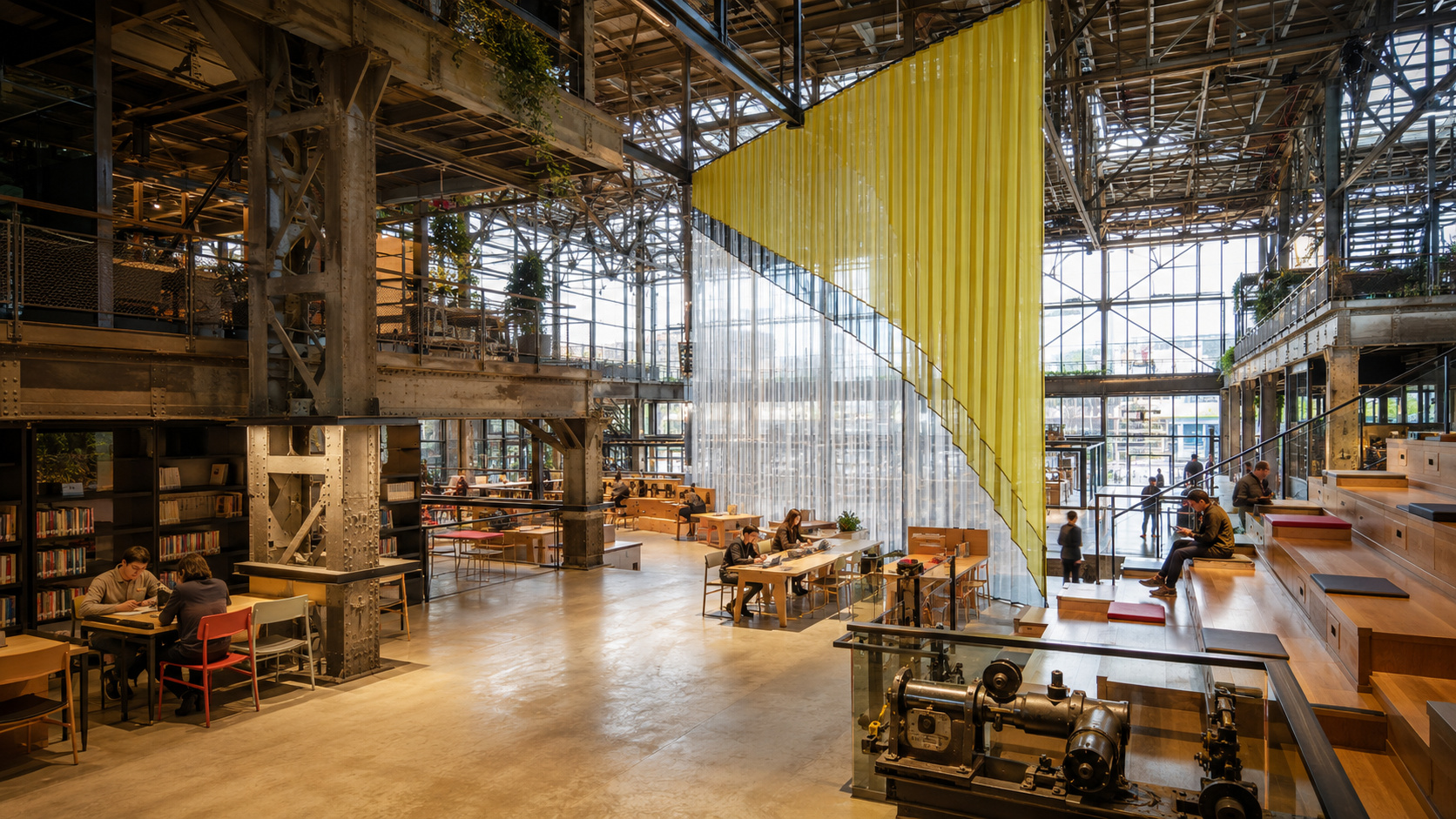

The LocHal library shows how an old railway workshop became a public reading square, preserved tracks and industrial columns, and gained giant curtains to adapt the hall for studies, meetings, and cultural events
While old buildings are often abandoned, a city in the Netherlands transformed a 1932 locomotive shed into a library with giant curtains and preserved railway memory. LocHal, in Tilburg, shows how architecture can breathe new life into an industrial space without erasing its history.
The old train workshop now houses the LocHal library, a public space used for reading, studying, meetings, events, and cultural activities. What once served the heavy work of locomotives now functions as an open place for residents, visitors, students, and workers.
The information was published by De Gruyter, an academic publisher of books and journals. The study presents LocHal as a former railway shed converted into a public library, with full-height textile curtains, visible tracks on the floor, and adaptable internal areas.
-
While many ports want to grow, Barcelona has decided to do the opposite and will cut cruise terminals from 7 to 5 after pressure from residents, protests, and crowds.

-
The United States wants to tighten control over submarine cables that carry 99% of international internet, silently cross oceans, total more than 400 routes worldwide, and have become a strategic piece in the competition for data, technology, and suppliers.
-
European Union looks again at Brazilian seafood after a nearly 8-year ban and may unlock a coveted market for lobster, tuna, tilapia, and shrimp.
-
Voltalia secures 322 MW of electrical connection in Pecém and targets data centers with renewable energy, robust network, and dedicated wind projects in Ceará.


How a locomotive workshop became a public library in the Netherlands
LocHal is located in Tilburg, in the south of the Netherlands, within a railway area that was once linked to train production and maintenance. The shed was built in 1932 and was part of the city’s industrial routine.


The transformation is noteworthy because the building was not treated as a shell without a past. The new library maintained the scale of the old hall, the marks of railway use, and the feeling of being inside a structure built to accommodate huge machines.
Today, the public library in the Netherlands functions as a reading room, workspace, meeting point, and cultural center. This mix helps explain why LocHal is more than just a place to borrow books.
The Tilburg Culture Councilwoman, Marcelle Hendrickx, called the space “a true living room for everyone.” The phrase sums up the new role of the old warehouse, which is no longer closed to the public and has become part of the city’s daily life.
Giant fabric curtains change the size of spaces without raising walls
One of the most curious aspects of LocHal is the giant fabric curtains. They reach up to the ceiling and were used to divide the hall without creating fixed walls inside the warehouse.
In practice, these curtains function as movable partitions. When the space needs to be open, they can be moved out of the way. When an activity requires more silence or separation, they help form smaller areas within the same hall.
This feature prevents the old workshop from losing its grandeur. Visitors continue to perceive the industrial size of the building, but the library can host meetings, readings, events, and smaller activities more comfortably.
The curtains also soften the light that enters through the large glass facades. Additionally, they help with acoustic comfort, reducing echo and noise spread in very large spaces.
Tracks on the floor and old columns keep the railway memory alive
The preserved railway memory appears in details that any visitor can understand. The tracks remain visible on the concrete floor, reminding that locomotives passed through that hall before the arrival of books and reading tables.
The project also reused the logic of the old tracks to move large tables within the space. These tables can serve as an extension of the café, stage, runway, or support for events in the square.
The industrial columns were maintained and gained new uses. With tables and lighting, they have become reading and study points, without hiding the marks of the old workshop.
This care makes a difference. LocHal does not seem like a library forcibly installed in an old building. It uses the past as part of the experience and shows that the history of the place is still present.
The LocHal library became a covered square for reading, meeting, and culture
De Gruyter, an academic publisher of books and journals, detailed LocHal as a space that redefines the function of a library in the current time. The building not only serves to store collections but also to create meetings and new ways of learning.
The central area functions as a kind of covered square. There, people can circulate, study, converse, watch events, participate in activities, and use different areas of the library throughout the day.
Peter Kok, director of the library in Tilburg, summarized the proposal by talking about “connecting people, facilitating interaction and the sharing of knowledge and stories.” This idea is reflected in the way the building was organized.
The library also received spaces dedicated to experiences, creation, and learning. In simple terms, the LocHal ceased to be just a place of silence and became a lively environment where reading and socializing go hand in hand.
The old warehouse became public comfort without losing its industrial appearance
Transforming a locomotive warehouse into a library requires more than placing bookshelves in the hall. The building needed to remain open and beautiful, but also needed to be comfortable for those who would read, study, or spend a few hours there.
Therefore, the project worked with the existing structure’s own strength. The industrial building, designed for heavy activities, was adapted to accommodate people, books, tables, events, and public circulation.
The result is a library with a striking visual, yet easy to use. The old structure did not become an obstacle. It became part of the charm and function of the new space.
This choice also helps the visitor understand the city. Upon entering the LocHal, one sees both the past of the trains and the present of an open, illuminated library used by different audiences.
Why this transformation resonates with Brazilian cities
The story of the LocHal draws attention in Brazil because many cities have industrial warehouses, depots, and railway structures that are unused or underutilized. These spaces often remain forgotten, even when they carry an important part of urban memory.
The case of Tilburg shows a simple possibility to understand: instead of erasing the old building, the city gave it a new function. The old workshop became a library, cultural center, and public space.
This transformation helps to imagine other uses for abandoned buildings. A warehouse can become a school, library, cultural market, training center, or meeting point, as long as the project respects the history of the place.
The LocHal impresses because it combines three very strong elements for the public: an old train building, a modern library, and giant curtains that change the space without destroying the original architecture.
The Dutch library shows that repurposing old buildings can be a way to preserve memory and return important areas to the population. The 1932 warehouse ceased to be a closed mark of the past and became a place of social interaction.
In the end, the LocHal proves that architecture does not need to choose between history and modern use. It can combine both, creating a beautiful, functional space full of meaning for the city.
If an old railway workshop can become a library and covered square in the Netherlands, which forgotten buildings in Brazil could also gain a new public life? Comment and share this idea.