






 Portuguese
  Spanish


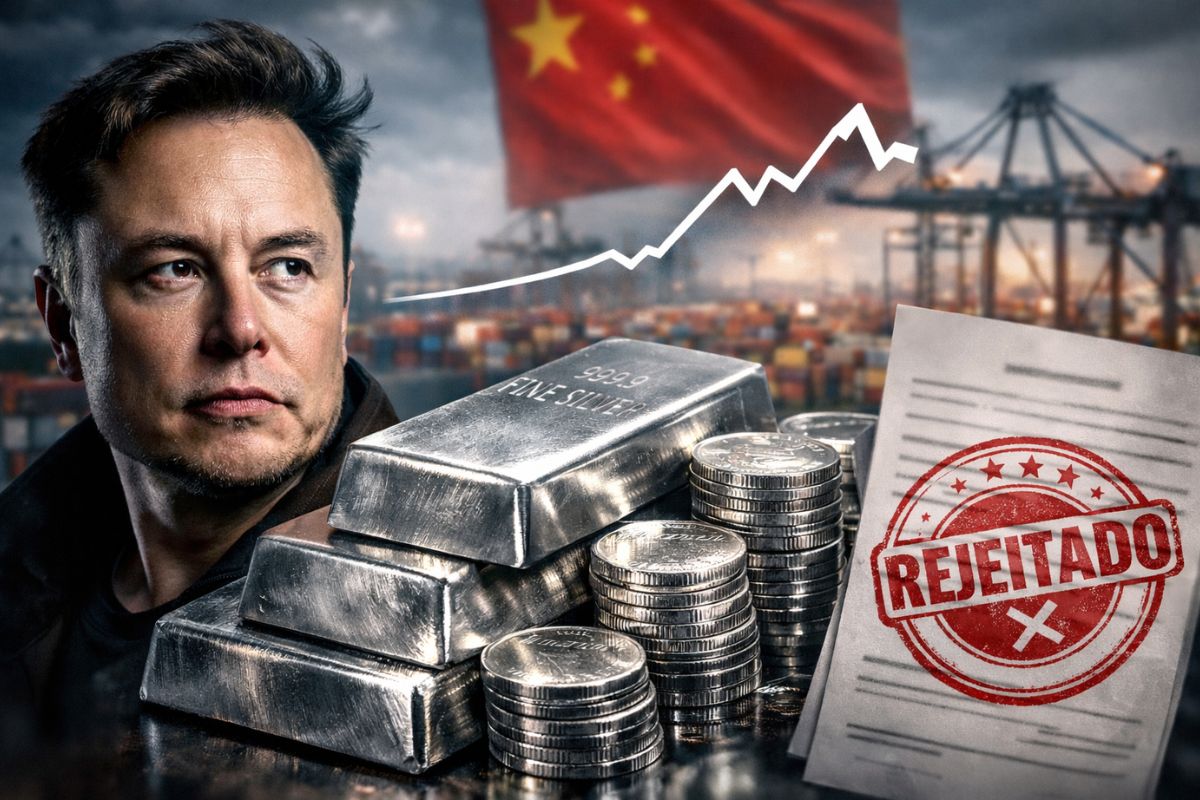


With Tight Supply, Chinese Restriction on Silver Exports Starting January 1st and Elon Musk’s Alert, Metal Soars 142% in 2025, Approaches US$ 83.62 per Ounce and Threatens Factories, Clean Energy, Electronics, and Global ETFs Across Entire Industrial Chains in Asia, Europe, and the Americas
In 2025, silver jumped from just below US$ 30 per ounce to a rise that already totals more than 142% increase this year, briefly touching US$ 83.62 before retreating to around US$ 75.32. In this rally and scarcity context, an alert from Elon Musk on social media put the market on alert: in response to a post about new Chinese rules, the billionaire stated, “this is not good” and reminded that silver “is needed in many industrial processes.”
Starting January 1st, China will require government licenses for silver exports, at a time when the metal has already been classified by the United States as a critical mineral, amid the combination of limited supply and growing demand from industrial users and investors. Elon Musk’s alert adds to the Chinese regulatory tightening and a historic rally in 2025, creating a critical zone for clean energy chains, electronics, medicine, and equipment manufacturers across multiple continents.
How Elon Musk’s Alert Emerged
The starting point of the alert from Elon Musk was a post on platform X highlighting that, starting January 1st, Chinese companies will need official authorization to export silver.
-
Brazil’s 2026 Tax Refund: Record 9.58 Million Filers in Largest Payout Ever, But a Key Detail on Priority Recipients Draws Nationwide Attention

-
Itaú Alters Hybrid Work Model, Increasing Office Days from 2028, Prompting Employees to Adjust to New Routine
-
Facing Labor Shortage, Japan Plans to Invest $34 Million to Attract Foreign Workers in Construction, Healthcare, Industry, and Commerce

-
Brazilian City Makes Remarkable Leap, Becomes 4th Wealthiest in the Country with GDP of R$ 134.1 Billion




Musk publicly responded, drawing attention to the fact that the metal is an essential input in numerous industrial processes.
In practice, the billionaire vocalized what some manufacturers had already been noticing throughout 2025: a market where prices surge, supply is tight, and a dominant supplier begins to control export licenses, raising the risk of sudden bottlenecks.
Silver is used in electronics, medicine, and renewable energy, which broadens the scope of the alert far beyond the financial sector.
China Restricts Exports and Turns Silver into a Strategic Weapon
By requiring licenses to export silver, China adds a political layer to a market already pressured by scarcity of supply and price rally.
The move does not equate to a total ban, but it increases uncertainty regarding volumes, timelines, and shipping priorities.
This comes just after the United States added silver to its list of critical minerals, acknowledging its importance to industry and clean energy projects.
When the world’s largest industrial hub starts filtering the external flow of a critical metal, the perceived risk to automakers, solar panel manufacturers, electronics companies, and hospitals increases immediately.
Historic Rally in 2025: 142% Increase and Record Above US$ 80
Up to the Monday session, silver prices had accumulated more than 142% appreciation in 2025, with the spot contract briefly touching US$ 83.62 per ounce at an intraday high before retreating to around US$ 75.32.
The iShares Silver Trust, the largest ETF linked to the metal, closely followed this explosive movement.
Analysts describe the recent adjustment as a technical pause.
Part of the day’s drop is attributed to profit-taking at “spectacularly high levels”, while cautious optimism regarding peace negotiations in Ukraine also reduces the pressure on protective metals.
Still, analysis firms highlight that the fundamentals of restricted supply remain valid and support positive projections for 2026.
Factories, Clean Energy, and Electronics Under Cost Pressure
The designation of silver as a critical mineral by the United States is not symbolic.
The metal is at the center of value chains ranging from solar panels and renewable energy components to medical devices and consumer electronics.
In a record price scenario, each additional cent per ounce pressures margins, investments, and production timelines.
For clean energy manufacturers, the combination of the silver rally, Chinese regulatory tightening, and Elon Musk’s alert reinforces the perception that supply is not trivial.
Expansion projects may need to recalibrate costs, long-term contracts, and technological alternatives if volatility persists.
In the electronics segment, the rise in critical input costs tends to be passed on to the end consumer sooner or later.
ETFs, Miners, and the Role of Silver in the S&P 500
The silver rally in 2025 also spilled over into equity markets.
Shares of precious metal miners played an important role in the recent surge of the S&P 500 to new highs, following the records of gold and silver.
Managers point out that if both metals end 2025 at historic levels, the broad American index gains extra support to close another year of double-digit gains.
At the same time, recent volatility shows that ETFs and sector stocks are not just a hedge, but also amplifiers of short-term movements.
As the market starts pricing in risks of Chinese restrictions, Elon Musk’s alert, and expectations regarding global monetary policy, the price curve may fluctuate even more sharply.
2026 on the Radar: Scarcity, Volatility, and Industrial Repositioning Risk
Market professionals remind that part of the recent correction is tactical, but insist that the silver supply restrictions continue to be a structural factor, including for 2026.
If industrial demand remains robust and China maintains tight control over exports, the environment of high prices and sharp fluctuations may persist.
In this scenario, companies may be forced to seek longer supply contracts, reassess strategic inventories, or even consider partial substitutions in some products, always with technical limitations.
The bottom line is that Elon Musk’s alert exposed, in simple terms, an uncomfortable reality: a single metal, concentrated in a few suppliers, can reshape costs in clean energy, electronics, and cutting-edge sectors when it enters a critical zone.
In light of the surge in silver, Chinese restrictions, and Elon Musk’s alert, do you think the industry should rush to secure stock and long-term contracts now or is the risk being exaggerated by the financial market?








